
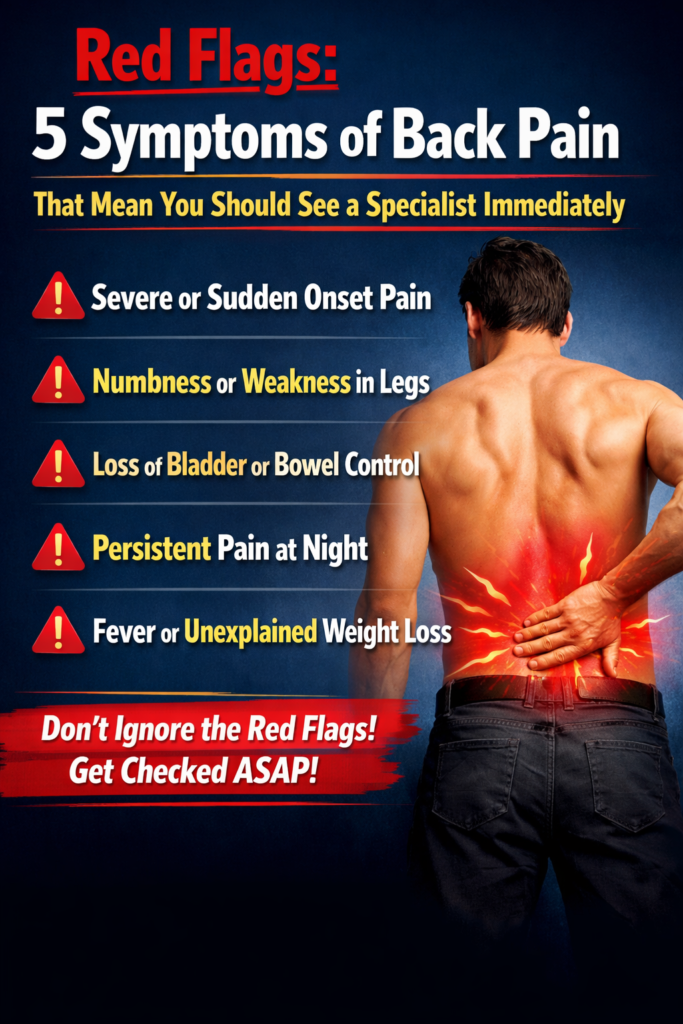
We’ve all been there—reaching for a dropped pen or twisting slightly too fast, only to be met with that familiar, dull ache in the lower back. Back pain is one of the most common human experiences, affecting nearly 80% of adults at some point in their lives. Most of the time, it’s a simple muscle strain that resolves with rest, ice, and maybe a few days of taking it easy.
However, because back pain is so common, it is easy to become complacent. We tend to dismiss it as “just part of getting older” or “the result of a long day.” But your spine is the structural highway of your central nervous system. When something goes seriously wrong, your body doesn’t just whisper; it sends out urgent “red flag” signals.
Ignoring these symptoms isn’t just a matter of enduring discomfort—it can lead to permanent nerve damage or the progression of underlying systemic issues. Here are the five critical symptoms of back pain that mean you should skip the heating pad and see a specialist immediately.
1. Sudden Loss of Bowel or Bladder Control
This is arguably the most urgent red flag in the world of spinal health. If you experience back pain accompanied by an inability to “hold it” or, conversely, an inability to go at all despite feeling the urge, you are facing a potential medical emergency.
What’s happening? This symptom is a hallmark of Cauda Equina Syndrome (CES). At the base of your spinal cord is a bundle of nerve roots called the cauda equina (Latin for “horse’s tail”). If a massive herniated disc, tumor, or infection compresses these nerves, it cuts off the communication between your brain and your pelvic organs.
Why you can’t wait: CES is a surgical emergency. The longer those nerves are compressed, the higher the risk of permanent incontinence or sexual dysfunction. Specialists typically aim to operate within 24 to 48 hours of symptom onset to prevent lifelong disability.
2. "Saddle Anesthesia" (Numbness in the Groin Area)
If you were to sit on a horse’s saddle, the areas of your body that would touch the leather—your inner thighs, groin, and buttocks—are referred to as the “saddle region.” If you notice a loss of sensation or a “pins and needles” feeling in these specific spots, it is a major warning sign.
What’s happening? Like bowel/bladder issues, saddle anesthesia is often linked to the compression of the lower sacral nerves. You might notice that wiping after using the bathroom feels “different” or that you can’t feel the texture of your clothing against your skin in that area.
Why you can’t wait: Sensory loss in the midline of the body suggests that the pressure on your spinal nerves is centralized and severe. A specialist needs to perform an MRI immediately to locate the source of the pressure before the sensory loss becomes permanent.

3. Progressive Neurological Deficit (Weakness in the Legs)
There is a significant difference between your back feeling “tight” and your leg feeling “weak.” If you find that you are tripping over your own feet, struggling to stand up from a chair, or experiencing “foot drop” (where you can’t lift the front part of your foot), you are experiencing a neurological deficit.
What’s happening? This usually indicates that a nerve root in the lumbar spine is being severely pinched (radiculopathy). While “sciatica” often causes pain, true weakness means the motor signals from your brain are failing to reach your muscles.
Why you can’t wait: Pain is a warning, but weakness is a sign of failing function. If the weakness is progressive—meaning it’s getting worse hour by hour—it indicates that the nerve is dying. A specialist can intervene with injections or decompression surgery to “feed” the nerve again before the muscle atrophies.
4. Back Pain Accompanied by Unexplained Fever
If your back hurts and you also feel like you’re coming down with the flu—chills, sweats, or a temperature over 101°F—do not assume they are unrelated.
What’s happening? Back pain paired with fever is a primary indicator of spinal osteomyelitis (an infection of the bone) or a discititis (infection of the disc). It could also signal a spinal abscess—a pocket of pus putting pressure on the spinal cord.
Why you can’t wait: Spinal infections are aggressive. They can erode the vertebrae, leading to spinal instability or the spread of infection into the bloodstream (sepsis). These cases require high-dose intravenous antibiotics and, in some cases, surgical drainage.
5. Night Pain and Unexplained Weight Loss
Most mechanical back pain gets better when you lie down and rest. However, if your pain actually worsens at night to the point where it wakes you up, and you’ve noticed the scale dropping without trying to diet, you need an urgent evaluation.
What’s happening? In the medical world, “nocturnal pain” and “unintentional weight loss” are classic systemic red flags. While rare, these can be signs of a spinal tumor or malignancy. Tumors in the spine often expand at night due to changes in blood flow and inflammatory patterns, causing intense, deep-seated aching that doesn’t respond to changing positions.
Why you can’t wait: Early detection is everything when dealing with spinal oncology. A specialist will use advanced imaging and blood work to rule out serious underlying pathologies and ensure that any growth is caught while it is still manageable.