
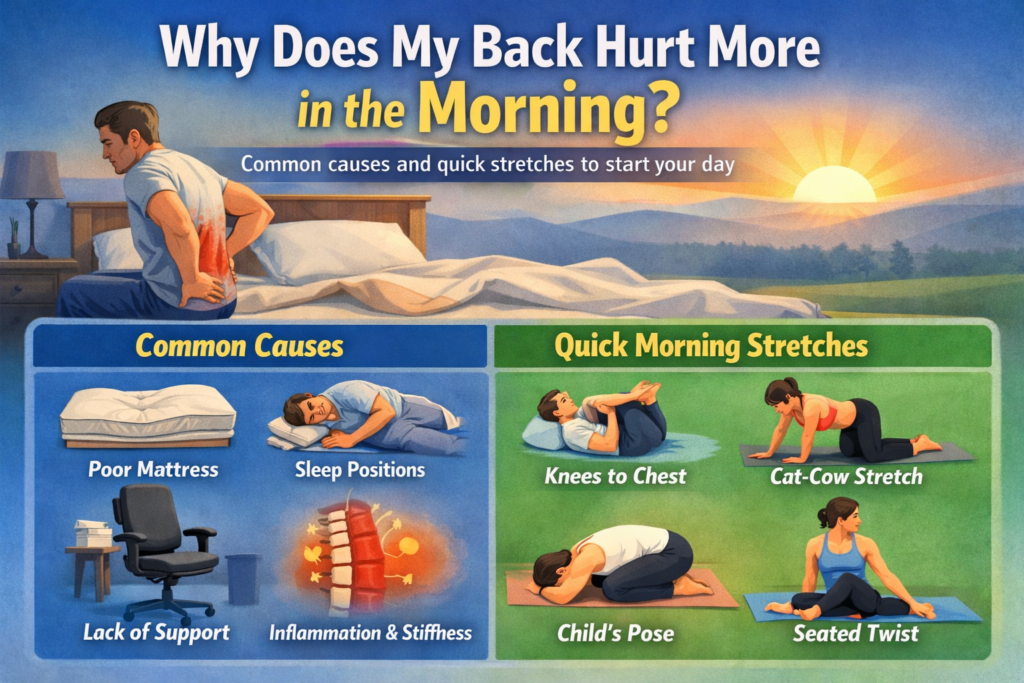
We’ve all been there. The alarm goes off, you reach out to hit snooze, and—ouch. Your lower back feels like it’s been replaced by a rusted hinge. You shuffle to the bathroom like a protagonist in a zombie movie, wondering how “resting” for eight hours managed to make you feel worse than when you went to bed.
Morning back pain is one of the most common complaints in physical therapy offices and clinics worldwide. It’s a frustrating way to start the day, casting a shadow over your morning coffee and making the simplest tasks feel like a chore.
But here’s the good news: in most cases, morning back stiffness isn’t a sign of permanent damage. It’s usually a combination of biology, environment, and habit. Let’s dive deep into why your back is acting up at 7:00 AM and, more importantly, how to fix it.
The Culprits: Why Your Back Rebels in the Morning
1. Disc Swelling (The "Hydration" Factor)
Believe it or not, you are actually taller in the morning than you are at night. Your spinal discs—the rubbery cushions between your vertebrae—are made mostly of water. During the day, gravity compresses these discs, squeezing fluid out.
When you lie down to sleep, the pressure is removed, and the discs rehydrate and swell. This is a healthy process, but it means that first thing in the morning, your discs are at their most “plump,” which can create temporary tension in the surrounding nerves and ligaments.
2. The "Sleep Posture" Trap
We spend a third of our lives asleep, yet we rarely think about our ergonomics during those hours.
Stomach Sleepers: This is often the biggest offender. Sleeping on your stomach forces your neck to turn at a sharp angle and causes your lower back to arch excessively, putting “static load” on your spine for hours.
The Soft Mattress: If your mattress is too soft, your hips sink deeper than your shoulders, creating a “hammock” effect that strains the muscles and ligaments of the lower back.
3. Inflammatory "Gunk" (The Gelling Phenomenon)
If you have underlying issues like osteoarthritis or general muscle tightness, a night of stillness can cause joint fluid to thicken. Think of it like a car engine in winter—the oil gets viscous when it’s cold and hasn’t moved. This “gelling” makes your joints feel locked until you’ve moved around enough to “warm up” the fluid.
4. Chronic Stress and Cortisol
Stress doesn’t stay in your head; it lives in your muscles. If you’ve been stressed, you might be clenching your back muscles or jaw while you sleep. Furthermore, cortisol (our stress hormone) is naturally higher in the morning, which can occasionally heighten our perception of pain.

5 Quick Stretches to Reclaim Your Morning
Don’t jump out of bed and try to touch your toes! Your discs are still hydrated and sensitive. Instead, try these “bridge” movements to transition from sleep to activity.
1. The Knee-to-Chest Hug
While still in bed:
Lie on your back with your knees bent.
Slowly pull one knee toward your chest, holding it with both hands.
Hold for 20 seconds, feeling the lower back lengthen.
Switch legs, then try both together. Why it works: It gently opens the facet joints in your spine without forceful movement.
2. Pelvic Tilts
While still in bed:
Lie on your back with knees bent and feet flat.
Imagine you have a clock on your belly. Tilt your pelvis so your lower back flattens against the mattress.
Slowly tilt the other way to create a small arch.
Repeat 10 times. Why it works: It’s like “greasing the gears” of your lower spine.
3. Cat-Cow (The Gold Standard)
Move to the floor:
Get on all fours (hands and knees).
As you inhale, drop your belly and look slightly up (Cow).
As you exhale, round your back like an angry cat, tucking your chin (Cat).
Flow between these for 1 minute. Why it works: It moves the entire spine through its natural range of motion.
4. Bird-Dog
Stay on all fours:
Reach your right arm forward and your left leg back simultaneously.
Keep your back flat—don’t let your hips tilt.
Hold for 5 seconds, then switch. Why it works: It “wakes up” the core muscles that support your spine throughout the day.
5. The "Doorway" Chest Stretch
Standing up:
Stand in a doorway and place your forearms on the doorframe.
Lean forward slightly until you feel a stretch in your chest. Why it works: Back pain is often caused by tight chest muscles pulling your shoulders forward. Opening the chest helps your spine sit in a neutral position.
When Should You Be Concerned?
While morning stiffness is common, it shouldn’t be ignored if it’s accompanied by “Red Flag” symptoms. Consult a professional if you experience:
Pain that lasts more than 30–60 minutes after waking.
Numbness or tingling down your legs (sciatica).
Pain that wakes you up in the middle of the night.
Unexplained weight loss or fever.