
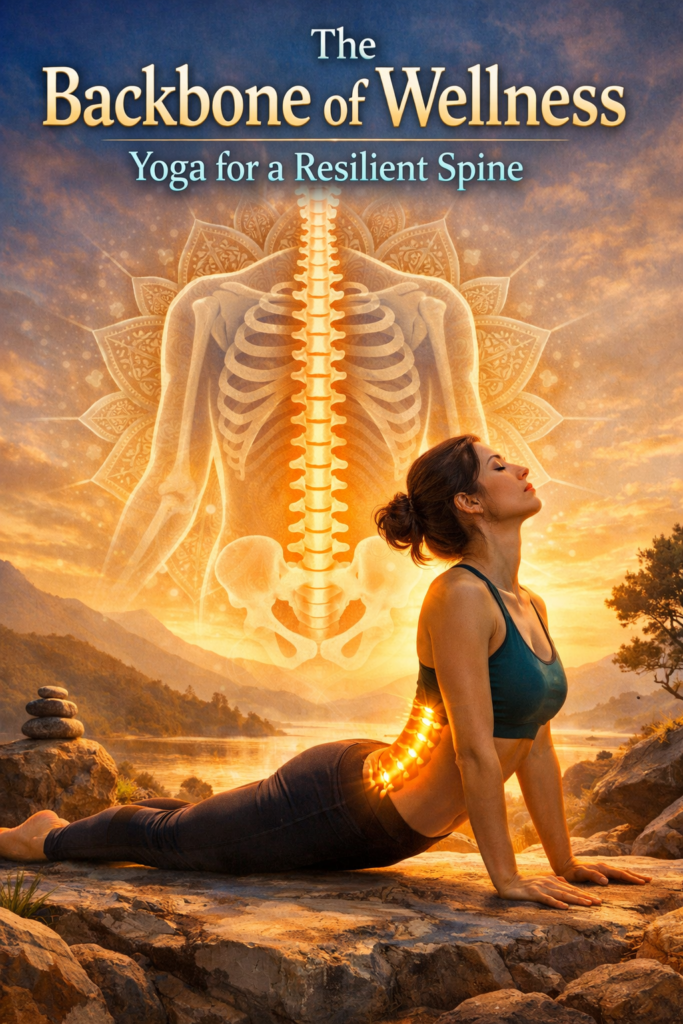
In our modern world, the human spine is under siege. We spend hours hunched over glowing screens, compressed into office chairs, or slumped on sofas. It’s no wonder that back pain is one of the leading causes of disability worldwide. While many turn to painkillers or invasive procedures, an ancient solution has stood the test of time: Yoga.
Yoga isn’t just about touching your toes; it’s about maintaining the integrity of the “main mast” of your body. When practiced with awareness, yoga can be a literal lifesaver for your back. However, when practiced mindlessly, it can do more harm than good.
Let’s dive into the mechanics of spine health, the poses that act as medicine, and the ones that—depending on your back’s history—you might want to skip entirely.
Understanding the Architecture: Why Your Spine Needs Movement
The spine is a mechanical marvel of 33 vertebrae, cushioned by intervertebral discs and supported by a complex web of muscles and ligaments. It serves three primary roles:
Protection: Enclosing the spinal cord (the highway of your nervous system).
Support: Carrying the weight of your head and torso.
Flexibility: Allowing you to bend, twist, and reach.
The “secret sauce” of yoga for spine health lies in decompression and blood flow. Unlike muscles, spinal discs don’t have a direct blood supply. They stay healthy through “imbibition”—a sponge-like action where movement draws nutrients in and flushes waste out.
The Green List: Safe and Healing Poses
For most people—from the “tech-neck” sufferer to the weekend warrior—these poses offer the best ratio of benefit to risk. They focus on gentle extension, core stability, and natural alignment.
1. Cat-Cow (Marjaryasana-Bitilasana)
This is the ultimate warm-up. By syncing breath with movement, you gently mobilize each vertebra.
The Benefit: It increases the circulation of spinal fluid and stretches both the anterior (front) and posterior (back) muscles of the torso.
Pro Tip: Focus on moving from your tailbone first, letting the head be the last thing to move.
2. Bird-Dog (Parsva Balasana)
While it looks simple, this is a powerhouse for spinal stability.
The Benefit: It strengthens the multifidus muscles—the tiny muscles that hug the spine—and the transverse abdominis (your internal corset).
Safety Check: Keep your hips level. Imagine a glass of water resting on your lower back; don’t let it spill!
3. Sphinx Pose (Salamba Bhujangasana)
Unlike the deeper Cobra pose, Sphinx allows for a passive, controlled extension of the lumbar spine.
The Benefit: It counteracts the “C-curve” we collapse into while sitting at desks. It encourages the natural inward curve (lordosis) of the lower back.
Modification: If you feel a “pinch” in your low back, move your elbows further away from your body.
4. Legs-Up-The-Wall (Viparita Karani)
The ultimate restorative pose.
The Benefit: It allows the psoas muscle (a major hip flexor that attaches to the lumbar spine) to fully relax. When the psoas is tight, it pulls on the lower back; this pose releases that tension without effort.
The "Daily Five" Routine
If you only have five minutes a day, perform this sequence to keep your spine “lubricated” and resilient:
Cat-Cow (1 minute): Move with the breath.
Bird-Dog (1 minute): 30 seconds per side.
Sphinx Pose (1 minute): Focus on breathing into the chest.
Downward Facing Dog (1 minute): Keep the knees bent to prioritize a long, straight back over straight legs.
Child’s Pose (1 minute): With knees wide to allow the spine to drape.