
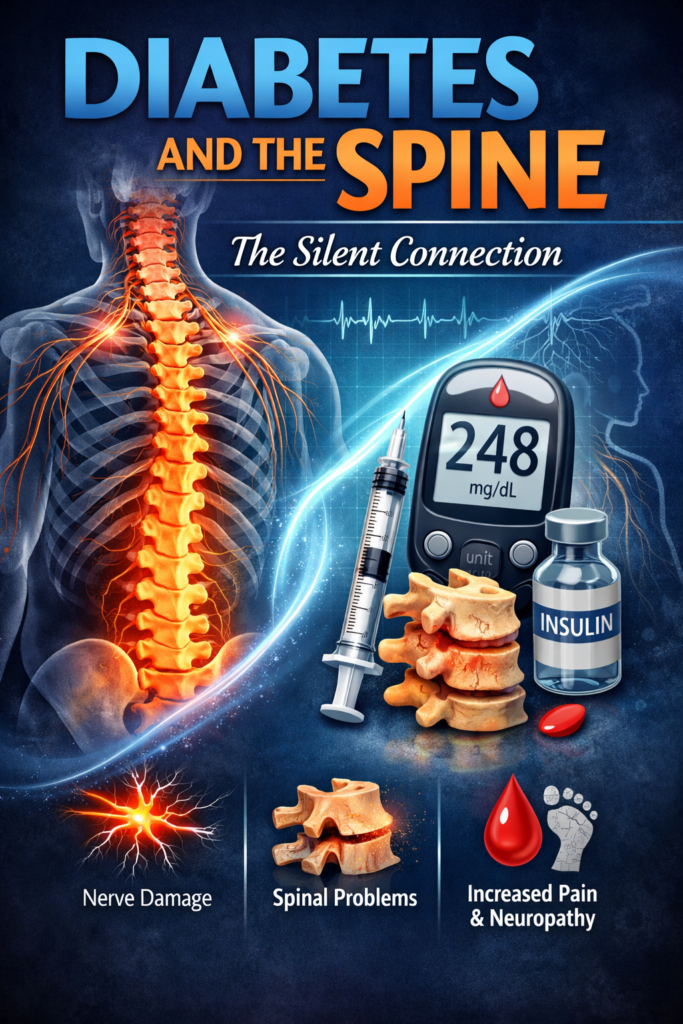
When we think of diabetes complications, the mind usually goes to the “big three”: the heart, the eyes, and the feet. We talk about neuropathy, retinopathy, and cardiovascular health. But there is another structural pillar of your health that is quietly under siege by high blood glucose—your spine.
Research increasingly shows that people with Type 1 and Type 2 diabetes are at a significantly higher risk for chronic back pain, herniated discs, and spinal stenosis. This isn’t just a coincidence of age or weight; it’s a biochemical breakdown.
In this deep dive, we’ll explore how sugar literally “caramelizes” your spinal proteins and what you can do to protect your back.
1. The Anatomy of a Disc: A Vulnerable Ecosystem
To understand how diabetes wreaks havoc, we first have to look at the Intervertebral Disc (IVD). Think of your discs as the shock absorbers of your spine. They consist of:
-
The Nucleus Pulposus: A jelly-like center that handles compression.
-
The Annulus Fibrosus: Tough, concentric rings of collagen that keep the jelly contained.
Unlike your muscles or skin, discs are avascular, meaning they have no direct blood supply. They rely on “diffusion” from the vertebral endplates to get nutrients and oxygen. This unique anatomy makes them particularly susceptible to the metabolic shifts caused by diabetes.
2. The "Sticky" Problem: Advanced Glycation End-products (AGEs)
The primary villain in the link between diabetes and spine health is a process called glycation.
When blood sugar is chronically high, glucose molecules bond to proteins and fats without the help of an enzyme. This creates harmful compounds known as Advanced Glycation End-products (AGEs).
In the spine, AGEs target the collagen in your discs. Here is what happens:
Cross-linking: AGEs create “cross-links” between collagen fibers, making the disc stiff, brittle, and less elastic.
Loss of Cushion: A healthy disc is mostly water. As AGEs accumulate, the disc loses its ability to hold water (proteoglycan loss), leading to Disc Desiccation—the “drying out” of the spine.
Inflammation: AGEs trigger a low-grade inflammatory response, accelerating the breakdown of the disc matrix.
3. Microvascular Damage: Starving the Spine
Diabetes is famously a disease of the small blood vessels (microvasculature). While the disc itself doesn’t have blood vessels, the vertebral endplates that feed it do.
In a diabetic body, these tiny vessels can become narrowed or blocked (atherosclerosis). When the blood flow to the endplates is compromised:
Nutrient Deprivation: The disc stops receiving the glucose and oxygen it needs to repair itself.
Waste Accumulation: Lactic acid and other metabolic waste products build up inside the disc, creating an acidic environment that kills disc cells (chondrocytes).
The result? The disc begins to collapse faster than it can regenerate.
4. Specific Spinal Conditions Linked to Diabetes
Degenerative Disc Disease (DDD)
While DDD is a natural part of aging, diabetes acts as a catalyst. Studies suggest that diabetic patients experience disc degeneration earlier in life and with greater severity than non-diabetics.
Spinal Stenosis
This is the narrowing of the spaces within your spine, which can put pressure on the nerves. Diabetes contributes to this by causing the ligamentum flavum (a ligament in the spinal canal) to thicken and lose elasticity, encroaching on the nerve space.
DISH (Diffuse Idiopathic Skeletal Hyperostosis)
DISH is a condition where the tendons and ligaments along the spine turn into bone (calcify). It is remarkably common in people with Type 2 diabetes, likely due to the growth-promoting effects of high insulin levels (hyperinsulinemia).
5. The Inflammation Loop: Cytokines and Pain
Diabetes is a pro-inflammatory state. High blood sugar increases the production of pro-inflammatory cytokines like IL-1β and TNF-α.
These chemicals do two things:
Sensitize Nerves: They lower the pain threshold, meaning a small bulge that might not bother a non-diabetic person causes intense pain for a diabetic patient.
Enzymatic Breakdown: They activate enzymes called Matrix Metalloproteinases (MMPs) that literally eat away at the disc’s structural framework.
6. How to Protect Your Spine: A Multi-Pronged Approach
If you have diabetes, back pain isn’t an inevitability—but you do have to be more proactive than the average person.
Glycemic Control: The Foundation
The most effective way to stop the accumulation of AGEs is to keep your blood sugar within your target range. Stable $HbA1c$ levels reduce the rate of collagen cross-linking.
Movement as Medicine
Since discs rely on diffusion for nutrients, movement is vital. Walking, swimming, and gentle yoga act like a “pump,” forcing nutrients into the discs and flushing out waste.
Weight Management
Type 2 diabetes and back pain often share a common factor: excess weight. Every extra pound adds significant “load” to the lumbar spine. Reducing weight takes the mechanical pressure off the already chemically-stressed discs.
Hydration and Nutrition
Hydration: Since discs are mostly water, staying hydrated is crucial for maintaining disc height.
Anti-inflammatory Diet: Focus on Omega-3 fatty acids (found in fish and walnuts) which can help counteract the systemic inflammation caused by high glucose.