
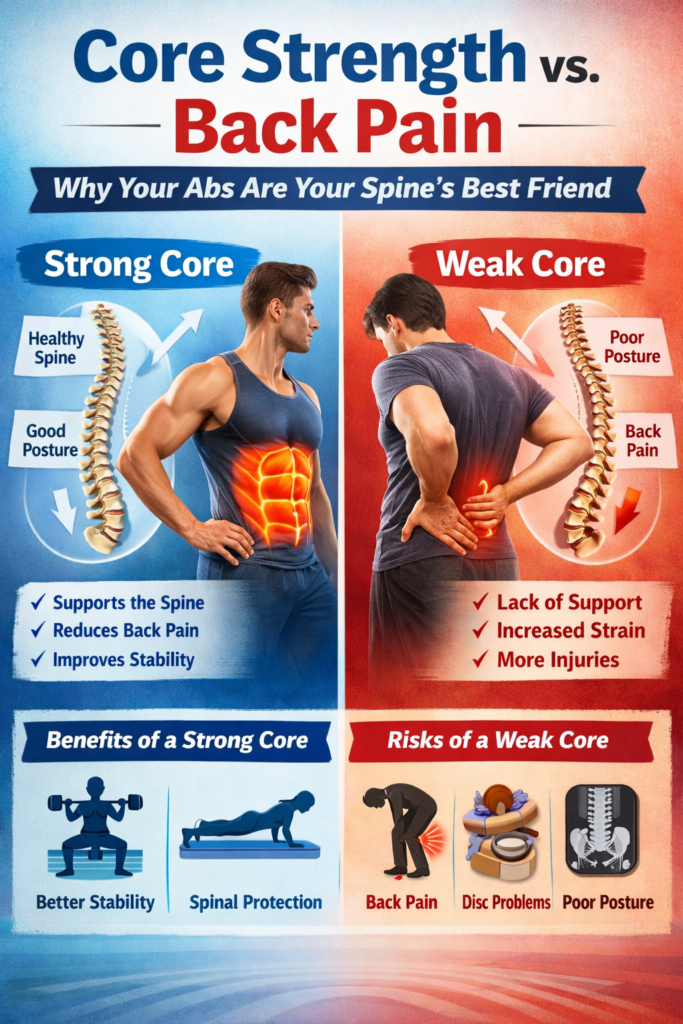
If you’ve ever experienced that sudden, sharp “tweak” in your lower back while picking up a grocery bag—or the dull, nagging ache after sitting at a desk for eight hours—you aren’t alone. Back pain is one of the most common reasons people visit the doctor or miss work.
But here’s the secret: your back isn’t usually the “bad guy.” Often, it’s just an overworked employee doing the job of an entire department because the “Core Department” decided to take a permanent lunch break.
Let’s dive into why your abs are actually your spine’s best friend and how building a solid foundation can change your life.
1. The Great Misconception: "Core" Doesn't Mean "Six-Pack"
When we hear “core,” we often think of the rippling “washboard” abs seen on fitness magazine covers. However, your core is much more than the Rectus Abdominis (the six-pack muscle).
Think of your core as a 360-degree biological corset. It includes:
Transverse Abdominis: The deepest layer that acts like a weight belt.
Obliques: The side muscles that handle twisting and lateral stability.
Multifidus and Erector Spinae: The muscles running along your spine.
Diaphragm: The “roof” of your core.
Pelvic Floor: The “floor” of your core.
When these muscles work together, they create intra-abdominal pressure, which stabilizes your spine from the inside out.
2. The Relationship: How Your Core Protects Your Spine
The “Tent Pole” Analogy
Imagine your spine is a tent pole. If you have no guy-wires (muscles) pulling from all sides with equal tension, the pole will buckle under the slightest wind.
A Weak Core: Forces your spinal discs and ligaments to absorb all the shock. Over time, this leads to herniations, “wear and tear,” and chronic inflammation.
A Strong Core: Acts as the guy-wires. It keeps the “pole” upright, shares the load, and ensures that when you move, the force is distributed across muscles rather than jammed into joints.
3. The Modern Culprit: Why Our Cores Are Quiet
We live in an “active-sitting” world. We sit in the car, sit at the desk, and sit on the couch. Constant sitting puts the hip flexors in a shortened, tight state and causes the glutes and abs to “turn off”—a phenomenon sometimes called Lower Crossed Syndrome.
When your abs are “off,” your pelvis tilts forward (Anterior Pelvic Tilt). This puts an aggressive arch in your lower back, pinching the facet joints and straining the lumbar muscles. By re-engaging the core, you pull the pelvis back into a neutral position, instantly relieving that pressure.
4. Stability Over "Crunching"
If you have back pain, the worst thing you can do is start performing hundreds of sit-ups. Traditional crunches actually place significant compressive force on your spinal discs.
To be your spine’s best friend, you should focus on stability—the ability to resist unwanted movement.
The Big Three Movements for Spine Health
| Exercise | What it Does | Why it Saves Your Back |
| The Plank | Trains anti-extension | Prevents your back from sagging/arching painfully. |
| Bird-Dog | Trains cross-body stability | Strengthens the tiny muscles that support the vertebrae. |
| Side Plank | Focuses on Obliques/Q_L | Supports the spine laterally to prevent “side-tweak” injuries. |
5. The "Bracing" Technique: A Daily Life-Saver
You don’t just need a strong core at the gym; you need it when you’re sneezing, reaching for the milk, or unloading the dishwasher.
Try this: Imagine someone is about to poke you in the stomach. You naturally “stiffen” your midsection. That is bracing. Learning to lightly engage this brace during everyday movements creates a protective shield for your spine, preventing those “micro-traumas” that add up to major pain.