
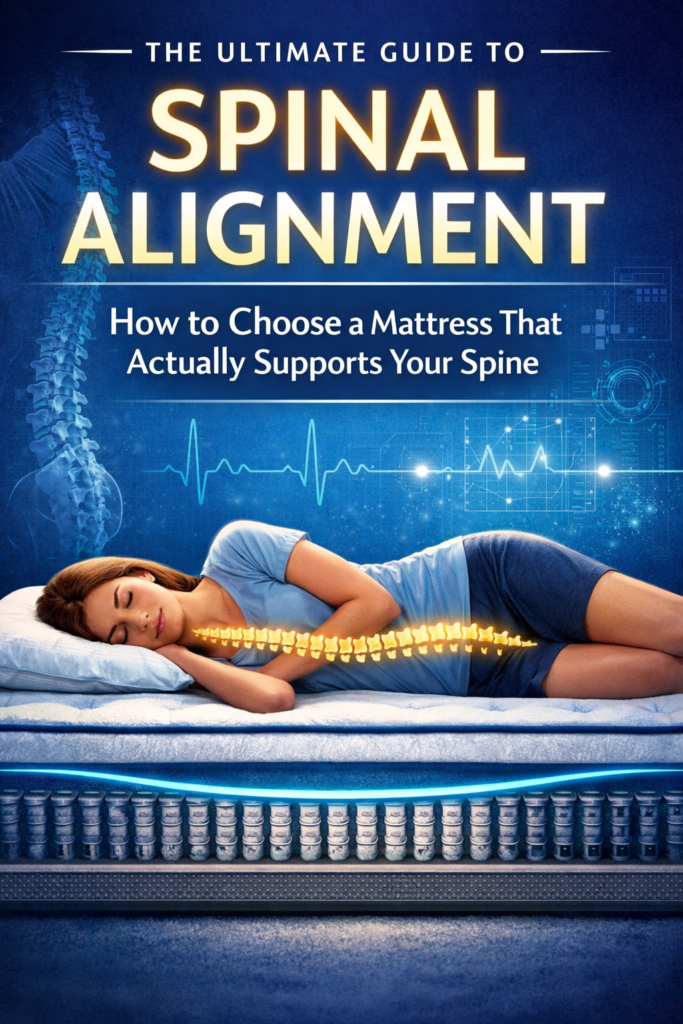
We spend roughly one-third of our lives asleep—or at least, we try to. But if you’re waking up with a stiff lower back, a “cricked” neck, or the sensation that you’ve aged twenty years overnight, your mattress isn’t just uncomfortable; it’s likely failing your spine.
In the world of bedding marketing, “orthopedic support” is often thrown around as a buzzword. However, spinal support isn’t a one-size-fits-all metric. It is a mechanical relationship between your body weight, your sleeping position, and the counter-pressure of the bed.
Here is everything you need to know to choose a mattress that keeps your spine in its happy place.
1. Understanding Spinal Neutrality
Before looking at materials, you need to understand the goal. Your spine isn’t a straight line; it’s a soft “S” curve.
-
The Cervical Spine (Neck): Needs to stay level with the rest of the back.
The Thoracic Spine (Mid-back): Naturally curves outward.
-
The Lumbar Spine (Lower back): Curves inward and is the most common site of mattress-related pain.
Spinal Neutrality occurs when your ears, shoulders, and hips are aligned, regardless of whether you are on your back or your side. If your mattress is too soft, your hips sink, creating a “hammock” effect that strains the lower back. If it’s too firm, it pushes against your shoulders and hips, forcing your spine to arch upward.
2. Decode the "Firmness" Myth
There is a persistent myth that a “firm mattress is best for a bad back.” Science disagrees.
A landmark study published in The Lancet found that participants with chronic lower back pain reported better outcomes using medium-firm mattresses rather than firm ones.
The Firmness Scale (1–10)
1–3 (Soft): Great for cloud-like comfort, but risky for spinal alignment unless you are very lightweight.
4–6 (Medium to Medium-Firm): The “Goldilocks” zone for the vast majority of sleepers. It provides enough “give” for the shoulders but enough “push-back” for the hips.
7–10 (Firm to Extra-Firm): Best for stomach sleepers or individuals with higher body weights who need to prevent deep sinking.
3. The Role of Sleeping Positions
Your preferred position dictates where the mattress needs to yield and where it needs to hold firm.
Side Sleepers (The Most Common)
Side sleepers have the most dramatic “peaks and valleys”—the shoulders and hips stick out, while the waist and neck need support.
The Goal: Pressure relief.
The Choice: A mattress with a thicker comfort layer (memory foam or latex) that allows the shoulders and hips to sink in just enough to keep the spine straight.
Back Sleepers
This is the most “spine-friendly” position, as weight is distributed evenly.
The Goal: Consistent support across the lumbar region.
The Choice: A medium-firm hybrid or foam mattress. You want to feel the mattress filling the gap in your lower back.
Stomach Sleepers
This is the most taxing position for the spine. It often causes the lower back to arch excessively.
The Goal: Flatness.
The Choice: A firmer mattress. If the bed is too soft, your pelvis will sink deeper than your chest, putting immense pressure on the vertebrae.
4. Material Matters: Innerspring, Foam, or Hybrid?
How a mattress is built determines how it reacts to your weight.
| Material | Best For… | Spinal Support Logic |
| Memory Foam | Pressure relief & Side sleepers | Contours to your specific shape to eliminate pressure points. |
| Latex | Eco-conscious & Back sleepers | Naturally “bouncy” and durable; pushes back against the spine immediately. |
| Innerspring | Traditional feel & Stomach sleepers | Provides strong “heave” or lift, keeping the body on top of the bed. |
| Hybrid | The “Best of Both Worlds” | Uses pocketed coils for support and foam layers for alignment. |
5. How to Test a Mattress (The 15-Minute Rule)
You cannot judge a mattress in 30 seconds. When testing a mattress in a showroom:
Lie down for at least 15 minutes in your primary sleeping position.
The “Hand Test”: If you sleep on your back, try to slide your hand under the small of your back. If it slides through too easily, the bed is too firm. If you can’t get it under at all, the bed is too soft.
Check the “Gap”: If you’re on your side, have a partner look at your spine. Does it look like a straight line, or is your midsection dipping?
6. Don’t Forget the Foundation
A world-class mattress on a sagging box spring is a recipe for back pain. Ensure your bed frame provides a flat, rigid surface. For memory foam and hybrid mattresses, a slatted base is usually best, provided the slats are no more than 3 inches apart.