
When we think about spinal health, we often visualize posture, ergonomic chairs, or perhaps a grueling session at the gym. We focus on the “macro” structures—the bones we can feel and the muscles we can stretch. However, the true foundation of a resilient back is built at the microscopic level through a delicate chemical dance between two powerhouse minerals: Calcium and Magnesium.
While they are often grouped together in the “bone health” category, these two minerals play vastly different, yet complementary, roles. If calcium is the brick that builds your spinal column, magnesium is the foreman that ensures those bricks are laid correctly and that the surrounding mortar remains flexible.
In this deep dive, we will explore why your spine is essentially a “mineral bank,” how these two elements interact, and how you can balance them to live a life free of chronic back pain.
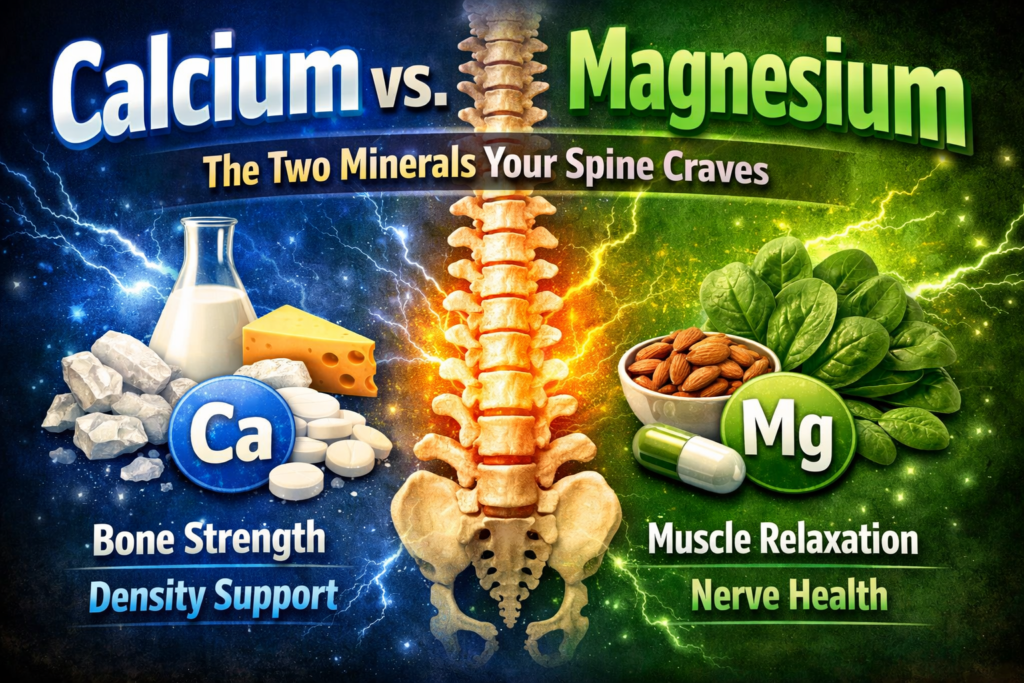
1. The Anatomy of a Mineral-Hungry Spine
To understand why you need these minerals, you first have to understand what they are protecting. Your spine is a marvel of engineering, consisting of 33 vertebrae, intervertebral discs, and a complex network of ligaments and muscles.
The Vertebrae: These are the weight-bearing bones. They require high density to prevent compression fractures.
The Discs: These act as shock absorbers. While mostly water and collagen, their health depends on the metabolic environment created by minerals.
The Muscles: The spinal stabilizers (like the erector spinae) rely on mineral ions to contract and, more importantly, to relax.
Without the right balance of calcium and magnesium, this system begins to degrade. Bones become porous (osteoporosis), and muscles become hyper-irritable, leading to the dreaded “back spasm.”
2. Calcium: The Structural Steel of the Spine
Calcium is the most abundant mineral in the body, and about 99% of it is stored in your bones and teeth. For your spine, calcium is non-negotiable.
-
The Role of Calcium in Bone Density
Your bones are not static rocks; they are living tissues in a constant state of “remodeling.” Cells called osteoclasts break down old bone, while osteoblasts build new bone using calcium.
If your blood calcium levels drop too low, your body doesn’t hesitate—it “withdraws” calcium from your spinal vertebrae to support heart and nerve function. Over time, these withdrawals lead to a weakened spinal structure, increasing the risk of:
-
Kyphosis: The “hunchback” curve often caused by small fractures in the vertebrae.
-
Spondylosis: General wear and tear of the spinal components.
-
The Catch: Calcium Can’t Work Alone
A common mistake is “calcium loading.” Taking massive amounts of calcium without its partners (Magnesium, Vitamin D3, and Vitamin K2) is like delivering a thousand bricks to a construction site with no masons. The bricks just sit there—or worse, they end up in the wrong place, like your arteries or kidneys (causing stones).
3. Magnesium: The Unsung Hero of Flexibility
If calcium is about strength, magnesium is about regulation and relaxation. Magnesium is a cofactor in more than 300 enzymatic reactions in the body, and when it comes to the spine, its jobs are vital.
The "Gatekeeper" of Calcium
Magnesium stimulates the hormone calcitonin, which helps draw calcium out of the blood and soft tissues and back into the bones. It also converts Vitamin D into its active form, which is necessary for calcium absorption. Without magnesium, calcium can actually become toxic to your soft tissues.
Muscle Relaxation and Nerve Health
Have you ever had a back cramp that wouldn’t quit? That’s often a magnesium deficiency.
Calcium causes muscles to contract.
Magnesium allows them to relax.
In the spine, magnesium helps maintain the integrity of the intervertebral discs and prevents the surrounding muscles from tightening into painful knots (trigger points).
4. The Tug-of-War: Finding the Perfect Ratio
The relationship between calcium and magnesium is a “physiological tug-of-war.” They compete for the same absorption pathways in the intestines and the same binding sites in the muscles.
Historically, humans evolved on a diet with a 1:1 ratio of calcium to magnesium. However, the modern “Western Diet” has skewed this heavily toward calcium (often 4:1 or higher) due to high dairy intake and processed food fortification.
Why the Imbalance Hurts Your Back
Too much Calcium / Too little Magnesium: Leads to “calcification” of spinal ligaments and excessively tight muscles. It can also lead to the formation of bone spurs (osteophytes) that pinch spinal nerves.
Too much Magnesium / Too little Calcium: While rarer, this can lead to low bone density and a “lethargic” muscular system that doesn’t provide enough tension to support the spine.
The Goal: Aim for a ratio closer to 2:1 (e.g., 1000mg of Calcium to 500mg of Magnesium), though many functional medicine practitioners now suggest moving back toward that ancestral 1:1 ratio.
5. Dietary Sources: Eating for a Stronger Back
Supplements are great, but the spine prefers minerals packaged in whole foods, where they are accompanied by trace minerals and phytonutrients.
Best Calcium Sources (Beyond Dairy)
| Food Source | Why it’s Great |
| Sardines (with bones) | High in Calcium + Vitamin D. |
| Collard Greens / Kale | Highly bioavailable calcium without the inflammatory potential of some dairy. |
| Chia Seeds | Packs a massive punch of minerals in a tiny serving. |
| Fortified Tofu | An excellent plant-based structural builder. |
6. Lifestyle Factors That "Steal" Your Minerals
You can eat all the kale in the world, but if your lifestyle is “leaking” minerals, your spine will still suffer.
Stress: Chronic stress triggers cortisol, which causes the kidneys to excrete magnesium at an accelerated rate.
Sugar Consumption: Processing a single molecule of sugar requires 54 molecules of magnesium. Sugar is a mineral thief.
Soft Drinks: Many sodas contain phosphoric acid, which binds to calcium in the digestive tract and prevents it from reaching your bones.
Phytates and Oxalates: Found in raw spinach and unsoaked grains, these can bind to minerals. Pro tip: Lightly steam your greens to unlock the calcium!
7. Supplementation: Dos and Don’ts
If you decide to supplement, quality and form matter.
For Calcium: Avoid Calcium Carbonate (essentially chalk) if you have low stomach acid. Calcium Citrate is generally better absorbed.
For Magnesium: Avoid Magnesium Oxide (it’s a laxative with poor absorption). Opt for Magnesium Glycinate for muscle relaxation or Magnesium Malate for energy and nerve support.
Important Note: Always consult with a healthcare professional before starting high-dose mineral supplements, especially if you have kidney issues or are on heart medication.