
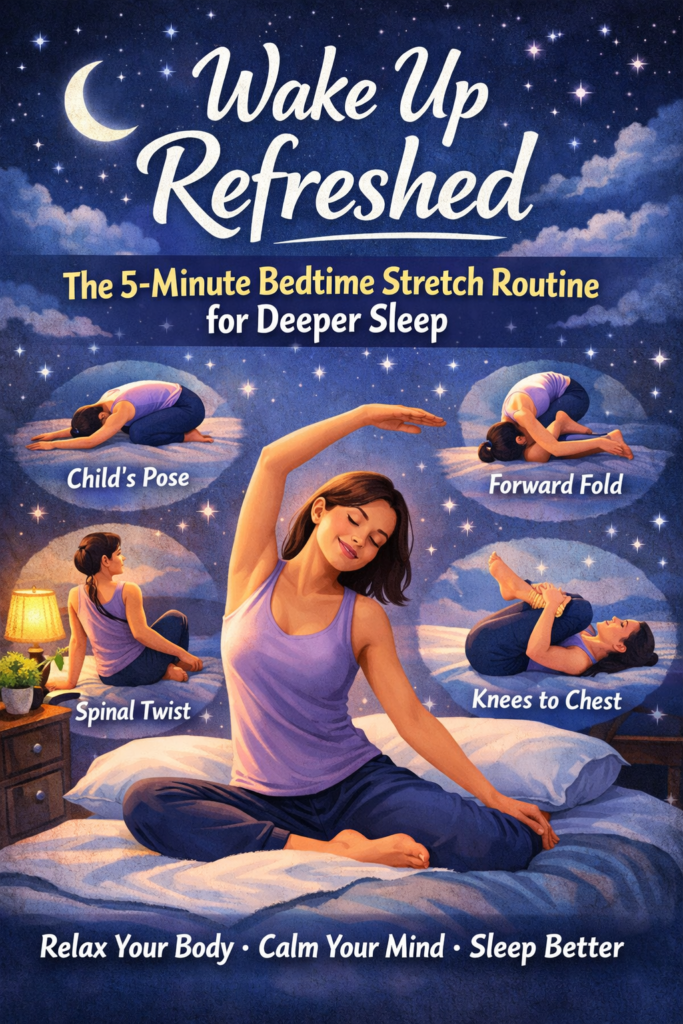
We’ve all been there: staring at the ceiling at 2:00 AM, our minds racing while our lower back throbs or our neck feels like it’s been set in concrete. We blame the caffeine, the blue light, or the stress of the day. And while those play a part, we often overlook the most physical barrier to rest—tension.
Your body carries the day’s stress in its fibers. Whether you spent eight hours hunched over a laptop or an afternoon chasing kids, your muscles are likely “shortened” and tight by sunset. Attempting to fall asleep in a tight body is like trying to park a car with the parking brake still engaged.
The solution isn’t necessarily a longer sleep window; it’s a better transition. Enter the 5-minute bedtime stretch routine. This isn’t a workout; it’s a physical “off switch.”
Why Stretching Changes Everything
Before we dive into the “how,” let’s talk about the “why.” Stretching before bed does more than just make you flexible; it triggers a physiological shift from your Sympathetic Nervous System (fight or flight) to your Parasympathetic Nervous System (rest and digest).
Lowers Cortisol: Gentle movement helps flush out the “stress hormone” accumulated during the day.
Regulates Body Temperature: A slight increase in blood flow followed by the cooling down process mimics the natural drop in body temperature required for deep sleep.
Muscle Recovery: During REM sleep, your body repairs tissue. By stretching first, you ensure blood flows freely to the areas that need it most.
Mindfulness: It forces you to inhabit your body rather than your to-do list.
The "Big Five" Routine
This routine is designed to be done on your rug or even directly on your mattress. Hold each pose for one minute. Focus on slow, diaphragmatic breathing—inhaling through the nose for four counts, and exhaling through the mouth for six.
1. The Child’s Pose (Balasana)
Target: Lower back, hips, and shoulders. This is the ultimate “reset” button. It gently elongates the spine and creates a sense of safety and withdrawal from the external world.
-
How to do it: Kneel on the floor (or bed) with your big toes touching. Sit back on your heels and fold forward, resting your forehead on the surface. Extend your arms in front of you or let them rest by your sides.
-
The Benefit: It opens up the lumbar spine, where most people carry their “desk-sitting” pain.
2. Cat-Cow Stretch (Chakravakasana)
Target: Spine mobility and core tension. If your back feels like a stiff board, this rhythmic movement will break up the stagnation.
How to do it: Get on all fours. As you inhale, drop your belly and look toward the ceiling (Cow). As you exhale, round your spine like an angry cat and tuck your chin (Cat).
The Benefit: It massages the internal organs and helps sync your breath with your body—a key step in calming the nervous system.
3. Kneeling Hip Flexor Stretch
Target: Psoas and hips. If you sit all day, your hip flexors are chronically tight. Since these muscles are connected to your lower back, tight hips often equal a backache in bed.
How to do it: Kneel on one knee with the other foot flat in front of you (like a proposal). Shift your weight forward slightly until you feel a pull in the front of your trailing hip. Switch after 30 seconds.
The Benefit: Releasing the psoas tells your brain that you are no longer in a “ready to run” state.
4. Supine Spinal Twist
Target: Obliques, chest, and lower back. Twisting is like wringing out a wet towel; it helps “rinse” the spine of the day’s rigidity.
How to do it: Lay on your back. Hug your knees to your chest, then drop both knees to the right while looking to the left. Keep your shoulders glued to the mattress. Switch sides after 30 seconds.
The Benefit: This encourages spinal rotation and opens the chest, making it easier to take the deep, full breaths required for deep sleep.
5. Legs-Up-The-Wall (Viparita Karani)
Target: Nervous system and circulation. If you only have time for one move, make it this one. It is the king of restorative poses.
How to do it: Scoot your hips as close to a wall as possible and swing your legs up so your body forms an “L” shape. Rest your arms at your sides, palms up.
The Benefit: It facilitates venous drainage and lowers your heart rate almost instantly. It’s a physical signal to your brain that the day is officially over.
Optimizing Your Environment
A 5-minute stretch is powerful, but it works best when the environment supports the goal. To make this routine a “habit loop,” try these tips:
Dim the Lights: Use a warm bedside lamp rather than overhead LEDs. This triggers melatonin production.
Scent the Air: Lavender or cedarwood essential oils can anchor the routine in your sensory memory.
The “No-Phone” Rule: The second you start your first stretch, your phone should be out of reach. This 5 minutes is a digital-free sanctuary.
The Science of the "Cool Down"
When we stretch, we aren’t just pulling on muscle fibers. We are communicating with the Golgi Tendon Organs (GTOs). These are sensory receptors located where the muscle meets the tendon. When you hold a static stretch for more than 30 seconds, the GTOs send a signal to the brain saying, “It’s okay to let go.” This results in autogenic inhibition—the muscle relaxes to prevent injury.
By utilizing this science, you aren’t just “feeling better”; you are literally rewiring your muscle tone for the night.