
We’ve all heard it. From childhood dinner tables to modern ergonomic seminars, the command is universal: “Sit up straight!”
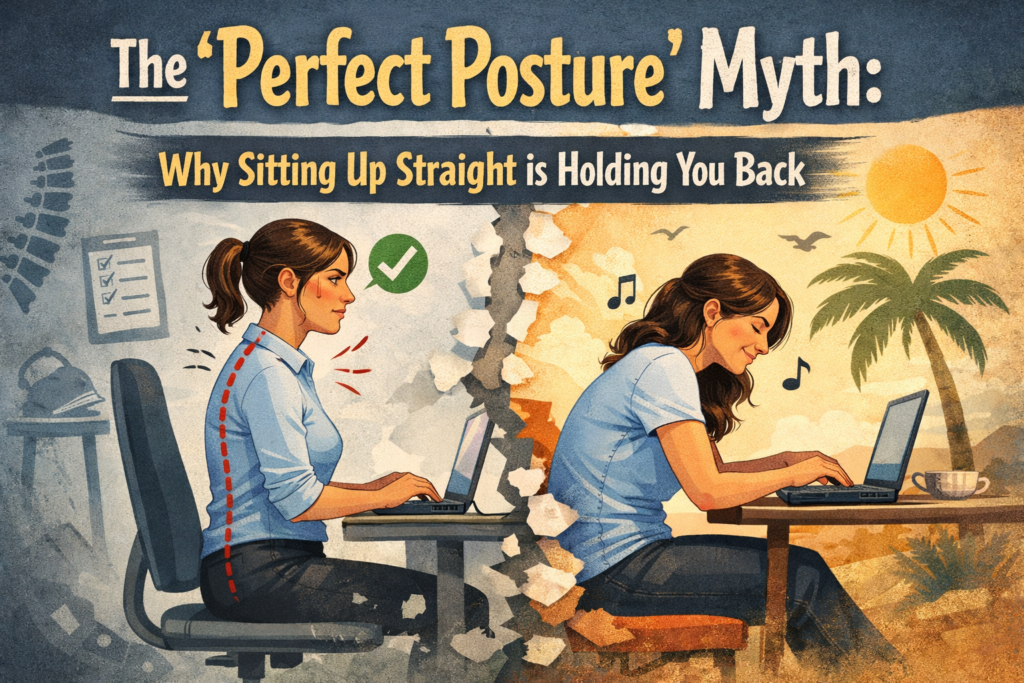
The image of “perfect posture” is etched into our collective consciousness—shoulders pinned back, spine as rigid as a ruler, chin tucked, and feet flat on the floor at a precise 90-degree angle. We are told that this architectural alignment is the holy grail of spinal health, the secret to avoiding back pain, and the hallmark of a disciplined professional.
But here is the uncomfortable truth: The “perfect posture” is a myth.
In fact, the hyper-fixation on maintaining a rigid, upright position might be doing more harm than good. As we move further into a sedentary digital age, it’s time to dismantle the Victorian-era obsession with “standing tall” and embrace a more fluid, science-backed approach to how we inhabit our bodies.
1. The Origin of the Straight-Back Obsession
The idea that a straight spine equals a healthy body isn’t purely medical; it’s historical. In the 18th and 19th centuries, “good posture” was a social signifier. It represented moral character, military discipline, and upper-class breeding. Slumping was seen as a sign of laziness or a “weak” constitution.
Medical science eventually adopted these social norms, theorizing that the body functioned like a machine with “correct” and “incorrect” alignments. If a machine is out of alignment, it breaks. Therefore, the logic went, if a spine is “crooked,” it must cause pain.
However, modern biomechanics and pain science tell a different story. The human body isn’t a bridge or a skyscraper; it’s a living, breathing, adaptive biological system.
2. Why "Perfect" is Often Painful
If you try to sit perfectly straight for eight hours, you’ll likely notice something: it’s exhausting.
When you force your spine into a rigid vertical line, you are engaging in a constant isometric contraction of your back muscles. You are essentially asking your muscles to hold a “clinch” all day long. This leads to:
Muscle Fatigue: Constant tension reduces blood flow to the tissues, leading to that dull, aching heaviness in the mid-back.
Increased Intra-abdominal Pressure: Rigid upright sitting can actually make breathing more shallow, as it limits the natural expansion of the ribcage and diaphragm.
Mental Burnout: The cognitive load required to constantly check your posture “borrows” energy from the work you’re actually trying to do.
3. The Myth of the "Slipped Disc" from Slumping
One of the biggest fears used to enforce the posture myth is that slumping will cause your discs to “pop out” or wear down. While extreme, repetitive loading in poor positions can contribute to issues, the spine is remarkably resilient.
Research has shown that there is a very poor correlation between spinal curvature (like a slight slouch or a “tech neck”) and the actual presence of pain. Many people with “perfect” X-rays live in chronic pain, while many others with “terrible” posture feel completely fine. Pain is a complex bio-psycho-social experience; it isn’t just a matter of “bad” angles.
4. The Real Secret: "The Next Posture is the Best Posture"
If sitting straight isn’t the answer, what is? Physical therapists and ergonomic experts are moving toward a new mantra: Movement is Medicine.
The human body was designed to move. Our joints produce synovial fluid (lubricant) when they move, and our discs stay hydrated through “osmotic pumps” triggered by changes in pressure. When we stay in any single position for too long—even the “perfect” one—we starve our tissues of this movement.
The 135-Degree Rule
Studies using upright MRIs have suggested that sitting at a 135-degree angle (a slight recline) is actually better for spinal disc pressure than sitting at the traditional 90-degree “L” shape. Reclining allows the chair back to take over some of the work of supporting your upper body weight, reducing the load on your lumbar spine.
5. Breaking the Cycle of Sedentary Rigidity
If you want to feel better at your desk, stop trying to be a statue. Instead, try these three strategies:
A. Micro-Movements
Every 20 minutes, change something. Cross your legs, then uncross them. Lean back for a phone call. Lean forward to read a document. These small shifts redistribute the load across different muscles and joints.
B. The "External Environment" Fix
Instead of relying on willpower to sit straight, change your environment:
Monitor Height: Keep your eyes level with the top third of the screen to prevent “turtle necking.”
Lumbar Support: Use a small pillow or a rolled-up towel in the curve of your lower back to provide passive support.
Feet Support: If your feet don’t reach the floor comfortably, use a footrest. This prevents your pelvis from tilting uncomfortably.
C. Active Recovery
Since we spend so much time in “flexion” (bending forward), we need to feed our bodies “extension.” Simple movements like standing up and reaching for the ceiling or doing a gentle chest-opening stretch can undo the stiffness of a long work session.
6. The Psychological Component: Stop Feeling Guilty
Perhaps the most damaging part of the “perfect posture” myth is the guilt. People often blame themselves for their back pain, thinking, “If only I had sat straighter, I wouldn’t feel this way.”
This self-blame creates tension, and tension increases pain sensitivity. By letting go of the need to sit “correctly,” you reduce the stress response in your body. Your body isn’t fragile; it’s adaptable. It doesn’t need to be policed; it needs to be moved.