
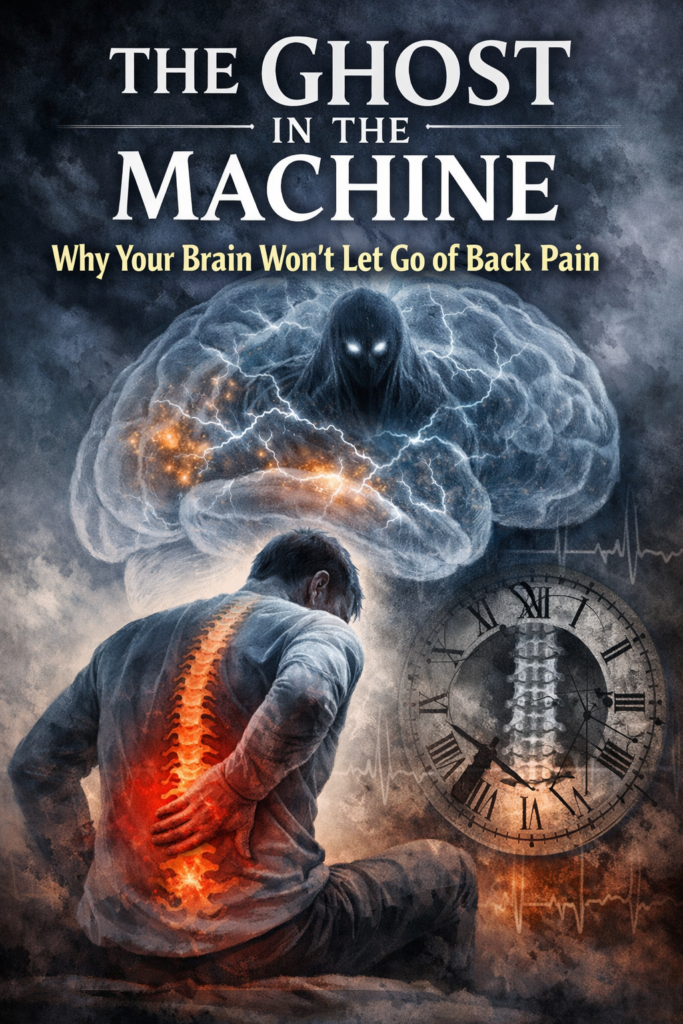
We’ve all been there: you lift a heavy box, feel a sharp “pop,” and spend the next week moving like a rusted Tin Man. That’s acute pain, and while it’s miserable, it makes sense. It’s your body’s alarm system telling you to stop, rest, and heal.
But what happens when the injury heals, the MRI looks clean, and the tissues are repaired—yet the pain remains? This is the frustrating reality of chronic pain. It’s the moment the alarm system gets stuck in the “on” position, long after the burglar has left the house.
To understand why your brain “remembers” back pain, we have to look at the fundamental differences between how our bodies process short-term injury versus long-term discomfort.
Acute Pain: The Necessary Alarm
Acute pain is a biological masterpiece. It is a direct response to tissue damage or the threat of it. When you stub your toe or strain a lumbar muscle, specialized nerve endings called nociceptors send a high-speed electrical signal through your spinal cord to your brain.
Your brain processes this as a “danger” signal and produces the sensation of pain to protect you. This system is:
Time-limited: It lasts as long as the tissue is healing (usually days to a few months).
Locally focused: The pain is usually felt exactly where the damage occurred.
A Symptom: It is a symptom of a physical injury.
Chronic Pain: When the Alarm Becomes the Disease
Chronic pain is generally defined as pain that persists for three to six months or longer. Unlike acute pain, chronic pain often loses its protective function. It’s no longer a helpful warning; it’s a glitch in the software.
In chronic back pain, the relationship between “damage” and “hurt” becomes decoupled. You can have a “healed” back that hurts more than the day you injured it. This is because chronic pain isn’t just a physical sensation—it’s a neurological state.
Why the Brain "Remembers": Central Sensitization
If you play the piano every day, the area of your brain responsible for finger movement grows and becomes more efficient. This is neuroplasticity—the brain’s ability to rewire itself based on experience.
Unfortunately, your brain can also become “pro-level” at processing pain. This phenomenon is known as Central Sensitization.
1. The Volume Knob is Stuck
When you experience intense or prolonged back pain, your nervous system undergoes a series of changes. The threshold for what constitutes “pain” drops. Imagine a motion-sensor light in your driveway. Normally, it only turns on when a car pulls in. In a sensitized state, that light starts flashing when a leaf blows by or a moth lands on the lens.
2. Rewiring the Spinal Cord
The “gates” in your spinal cord that regulate pain signals can become stuck open. Even light touch or simple movements that shouldn’t be painful are misinterpreted by the brain as a threat. This is why a simple walk or a gentle stretch can feel like a secondary injury to someone with chronic back pain.
3. The "Pain Memory"
Your brain’s limbic system (the emotional center) and the prefrontal cortex (the thinking center) are heavily involved in chronic pain. When you hurt your back, your brain stores the context: the fear you felt, the sound of the “pop,” the weeks of missed work.
Over time, the brain creates a pain map. Even after the physical tissues have healed, the brain can “replay” the pain sensation if it perceives a familiar threat—like sitting in the same chair where you first felt the tweak, or even just feeling stressed at work.
The Role of "Fear-Avoidance"
One of the biggest reasons back pain transitions from acute to chronic is the fear-avoidance cycle.
When your back hurts, you naturally stop moving to avoid further injury. However, if this avoidance continues after the initial healing phase, it backfires.
Physical Deconditioning: Muscles weaken, making future injury more likely.
Psychological Reinforcement: By avoiding movement, you teach your brain that “movement equals danger.”
This reinforces the brain’s “memory” of the pain. The less you do, the more the brain stays on high alert, scanning for the slightest hint of discomfort.
Breaking the Cycle: How to "Un-Learn" Pain
The good news is that if the brain can learn to be in pain, it can—to a significant extent—learn to be out of it. We call this retraining the pain system.
Cognitive Functional Therapy (CFT)
Instead of just focusing on “fixing” a disc or a muscle, CFT addresses the movement patterns and beliefs that keep the pain alive. It involves moving in ways you’ve been afraid of, showing your brain that these movements are safe.
Pain Neuroscience Education
Simply understanding that “hurt does not always equal harm” can lower the brain’s threat level. When you realize that your back isn’t actually “broken” or “falling apart,” but rather that your nervous system is over-sensitive, the fear decreases. And when fear decreases, the volume on the pain often follows suit.
Graded Exposure
This involves slowly and systematically reintroducing activities. If you’re afraid to bend over, you start by bending just a few inches while breathing deeply, proving to your nervous system that nothing bad happened. Over weeks, you go deeper. You are essentially “overwriting” the old pain memory with new memories of safe movement.