
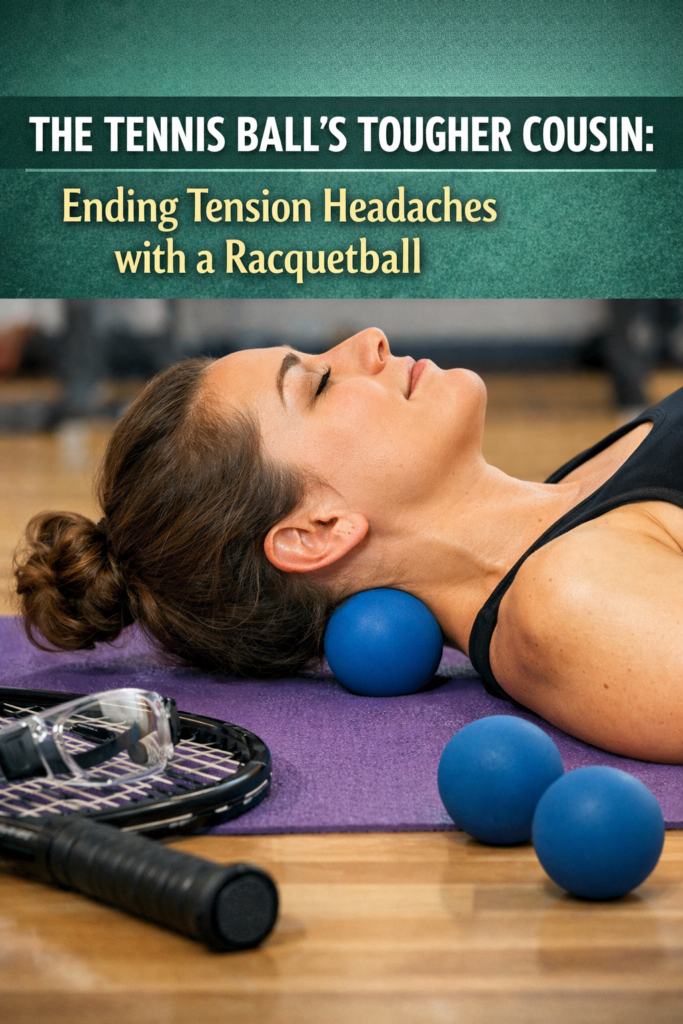
We’ve all been there: that tightening “vice” grip around your temples, the dull ache behind your eyes, and a neck that feels like it’s been replaced by a stack of rusted iron plates. It’s the classic tension headache, and while it feels like it’s living in your brain, the culprit is often hiding just below the skull in your neck and shoulders.
If you’ve tried stretching, hydration, and dark rooms to no avail, it’s time to reach for a surprising secret weapon: the racquetball.
Why a Racquetball?
You might have heard of using a tennis ball for self-massage, but for the delicate yet dense muscles of the neck, the racquetball is the “Goldilocks” tool.
The Grip: Racquetballs are made of rubber with a slightly “tacky” surface. Unlike a fuzzy tennis ball, it won’t slide against your skin or the wall, allowing you to “pin and stretch” the fascia.
The Density: It’s firmer than a tennis ball but has more “give” than a lacrosse ball. This is crucial for the suboccipital muscles (the tiny muscles at the base of your skull), where too much pressure can actually trigger more pain.
The Anatomy of a Tension Headache
To fix the pain, we have to understand where it’s coming from. Most tension headaches are “referred pain.” Your brain perceives pain in your forehead or temples, but the actual distress signals are coming from trigger points in three main areas:
The Suboccipitals: Four small muscles at the very top of the neck. When these get tight (usually from “tech neck” or staring at a screen), they compress nerves that wrap around to your forehead.
The Upper Trapezius: The meaty muscles between your neck and shoulders that hike up when you’re stressed.
The Levator Scapulae: The muscle that connects your neck to your shoulder blade. If this is tight, you’ll feel a “pulling” sensation every time you turn your head.
The 10-Minute Routine: Step-by-Step Release
Before you start, remember the Golden Rule of Self-Massage: Pain should be “productive.” On a scale of 1 to 10, aim for a 5 or 6. If you find yourself holding your breath or tensing up, you’re pressing too hard.
1. The Suboccipital "Basin" Release
This is the “Holy Grail” for headache relief.
The Setup: Lie on your back on a firm surface (a yoga mat or carpeted floor is better than a bed).
The Move: Place the racquetball directly under the base of your skull, just to the right of your spine.
The Action: Don’t roll. Just let the weight of your head sink into the ball. Slowly tuck your chin toward your chest as if you’re nodding “yes.” This creates a longitudinal stretch on those tiny, stubborn muscles.
Duration: Hold for 60 seconds, then switch to the left side.
2. The "Wall Pin" for the Traps
The “Upper Traps” are the body’s primary stress-absorbers.
The Setup: Stand with your back to a wall. Place the ball between the wall and the meaty part of your shoulder (above the shoulder blade).
The Move: Lean your weight into the ball.
The Action: Once you find a “hot spot” (a point that feels particularly tight), keep the pressure steady. While maintaining pressure, slowly move your arm on that side up and down in a “snow angel” motion. This forces the muscle to glide underneath the pressure of the ball.
Duration: 90 seconds per side.
3. The Levator Scapulae "Nudge"
This muscle is responsible for that “crick” in your neck.
The Setup: Still against the wall, move the ball slightly higher and closer to the base of the neck, where the neck meets the shoulder.
The Move: Lean in at a slight angle.
The Action: Slowly turn your head away from the ball, looking down toward your opposite armpit. This stretches the muscle while the ball pins the trigger point.
Duration: 1 minute per side.
Pro-Tips for Maximum Relief
Hydrate Immediately: Massage releases metabolic waste from the muscles. Drinking a large glass of water afterward helps your lymphatic system flush these toxins out.
The “Double Ball” Hack: If you find it hard to balance one ball, put two racquetballs inside a tube sock and tie a knot at the end. This “peanut” shape allows you to work both sides of the spine simultaneously without the balls rolling away.
Breathe into the Ball: If you hit a spot that makes you wince, exhale deeply. Your nervous system needs to know it’s safe to let that muscle relax.
When to Put the Ball Down
Self-massage is incredible, but your neck houses some pretty important “wiring.” Avoid the racquetball if:
You feel a sharp, electrical shooting pain (this is a nerve, not a muscle).
You feel a pulse under the ball (you’re on an artery).
You have a fever or sudden, “worst headache of your life” symptoms—in these cases, skip the ball and call a doctor.