
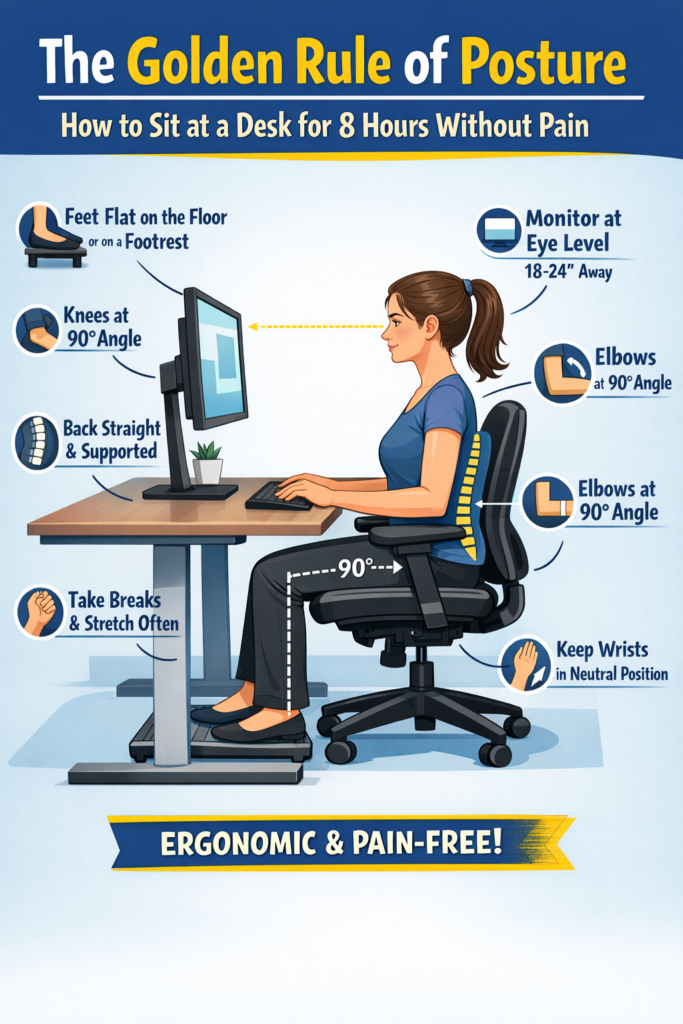
In the modern professional landscape, the desk is our primary “field of play.” Whether you are a digital marketing expert building global brands, a developer writing the next great app, or a student finishing a dissertation, the reality is the same: you likely spend at least eight hours a day tethered to a chair.
While we often focus on our productivity, our physical health—specifically the health of our spine—frequently takes a backseat. We start the day sitting upright and alert, but by 2:00 PM, most of us have collapsed into the “keyboard hunch.” This isn’t just a matter of looking lazy; it is a physiological strain that leads to chronic neck pain, lower back tension, and a significant drop in long-term energy.
To survive an eight-hour workday without pain, you must master the Golden Rule of Posture: The best posture is your next posture. —
Phase 1: The Geometry of a Pain-Free Desk Setup
Before we discuss how to sit, we must discuss where you sit. Ergonomics is the science of fitting the environment to the human, not forcing the human to fit the environment.
1. The 90-90-90 Rule
To minimize the load on your joints, aim for three 90-degree angles:
The Elbows: Your keyboard should be at a height where your elbows are bent at 90 degrees, and your forearms are parallel to the floor.
The Hips: Your hips should be at a 90-degree angle (or slightly more, around 100 degrees) with your torso.
The Knees: Your feet should be flat on the floor, with your knees bent at 90 degrees.
2. The Monitor’s Horizon
The most common cause of “Tech Neck” is a monitor that is too low. When you look down at a screen, your head (which weighs about 10–12 lbs) exerts significantly more force on your cervical spine. If your chin is tucked toward your chest, that weight can feel like 60 lbs to your neck muscles.
Solution: The top third of your monitor should be at eye level. This allows you to look straight ahead, keeping your ears aligned over your shoulders.
3. The Lumbar Support Factor
Your lower back (the lumbar spine) has a natural inward curve. Most office chairs fail to support this, leading to “slumping.” If your chair doesn’t have built-in support, a rolled-up towel or a dedicated lumbar pillow can keep that curve intact, preventing the vertebrae from compressing unevenly.
Phase 2: The Biological Cost of the "Sloppy Slump"
Why does it hurt so much? When you sit improperly, you aren’t just “resting.” You are engaging in a low-grade, high-repetition strain of your connective tissues.
Muscle Inhibition: When you slouch, your core muscles “turn off.” This forces your spinal ligaments and discs to take the entire weight of your upper body. Unlike muscles, ligaments aren’t meant to be under constant tension.
Reduced Lung Capacity: Slouching compresses the diaphragm. This leads to shallower breathing, which means less oxygen reaches your brain. That “afternoon brain fog” is often more about your posture than your lunch.
Nerve Compression: Chronic poor posture can lead to the narrowing of the spaces through which nerves travel. This manifests as tingling in the hands (often mistaken for Carpal Tunnel) or “Sciatica” in the legs.
Phase 3: The "Golden Rule" in Action – Dynamic Sitting
The term “Perfect Posture” is actually a bit of a myth. Even if you sit in a perfectly ergonomic position, if you stay there for four hours, you will still experience pain. Humans are biological machines built for movement.
The Golden Rule: Micro-Movements and Transitions To sit for 8 hours without pain, you must treat sitting as an active, rather than passive, activity.
1. The 20-8-2 Rule
A popular ergonomic framework suggests that for every 30 minutes of work:
20 Minutes: Sit in a neutral, supported position.
8 Minutes: Stand and work (using a standing desk if possible).
2 Minutes: Move. Walk to get water, stretch, or do a few air squats.
2. The Chin Tuck
To reset your neck throughout the day, perform a “Chin Tuck.” While looking straight ahead, draw your head straight back (creating a “double chin”). This aligns your skull over your spine and stretches the tight muscles at the base of your skull.
3. Shoulder Blade Retraction
Every hour, imagine trying to squeeze a pencil between your shoulder blades. Hold for five seconds. This counters the “internal rotation” caused by typing and opens up the chest cavity.
Phase 4: Ergonomic Exercises You Can Do at Your Desk
You don’t need a gym to maintain spinal health. Incorporate these “deskercises” to keep your blood flowing and your muscles engaged
Exercise Targeted Area Benefit Seated Spinal Twist Mid-back (Thoracic)Relieves tension in the torso from long-term static sitting. The Psoas Stretch Hip Flexors Counters the “shortening” of hip muscles that occurs when seated. Wrist Extensions Forearms Prevents repetitive strain injuries from typing/mousing. The Glute Squeeze Lower Body “Wakes up” the glutes, which often go dormant (Gluteal Amnesia) during long workdays.
Phase 5: The Psychological Aspect of Posture
Believe it or not, your mental state dictates your physical state. Stress often manifests as “shoulder shrugging”—bringing your shoulders toward your ears. Over eight hours, this creates massive tension in the trapezius muscles, leading to tension headaches.
Mindful Scanning: Every time you finish an email or a meeting, do a “body scan.” Start at your jaw (is it clenched?), move to your shoulders (are they relaxed?), and check your feet (are they flat?). Correcting these small tension points throughout the day prevents the cumulative “explosive” pain that usually hits by Friday afternoon.
Phase 6: Beyond the Desk – Recovery
How you spend your time away from the desk determines how well you perform at the desk.
Sleep Position: If you spend all day hunched forward and then sleep in a fetal position, your body never gets a chance to “open up.” Try sleeping on your back with a small pillow under your knees to neutralize the spine.
Hydration: Spinal discs are primarily made of water. Dehydrated discs are less elastic and more prone to compression. Drinking water isn’t just for your kidneys; it’s for your back.
Strength Training: A strong core and strong posterior chain (back, glutes, hamstrings) act as a natural corset, holding you upright with less effort.