
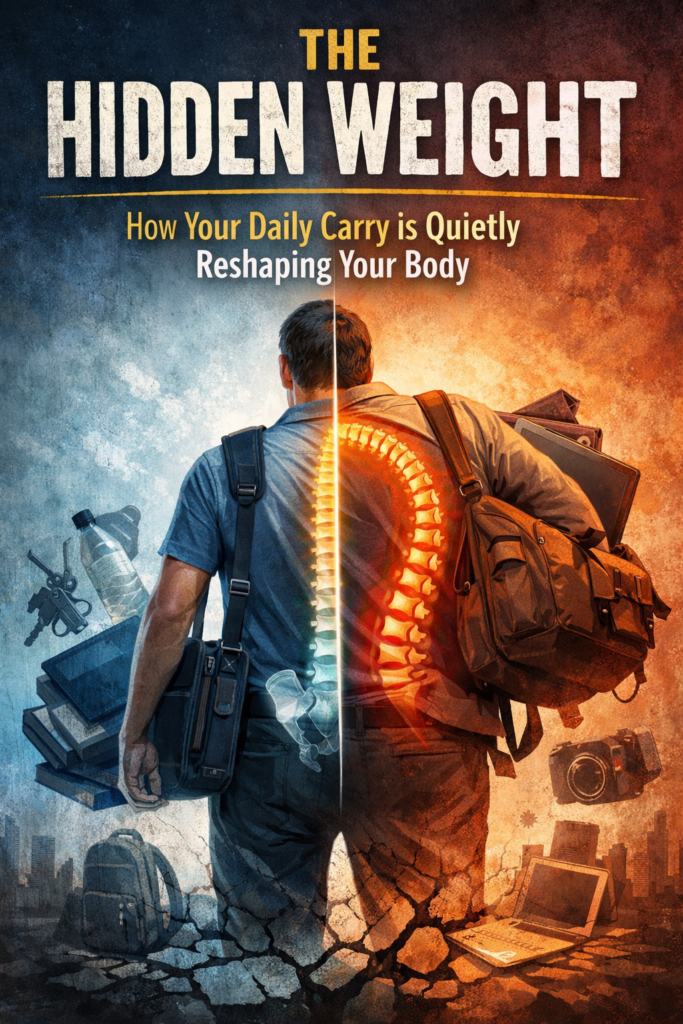
We’ve all been there: rushing out the door, grabbing a laptop, a charger, a water bottle, a “just-in-case” umbrella, and maybe a book we haven’t touched in three weeks. We hoist the bag over a shoulder, feel that familiar tug, and carry on with our day.
But while we focus on the convenience of having our lives packed into a single tote or backpack, our bodies are paying a silent tax. It isn’t just about a sore shoulder or a stiff neck. The real danger of a heavy bag lies much lower—at the literal foundation of your posture: the pelvis.
In this deep dive, we’ll explore the biomechanics of how your daily carry affects your alignment, why a tilted pelvis is a “gateway” injury, and how you can lighten the load without sacrificing your style or essentials.
1. The Anatomy of the Lean: Why Bags Matter
Your body is a masterpiece of balance. When you stand upright without any external weight, your center of gravity sits right around your second sacral vertebra, just below your navel. Your muscles and bones work in a delicate, vertical harmony to keep you stable.
When you add a heavy bag, you introduce an offset load. To keep you from literally falling over, your brain sends a frantic memo to your musculoskeletal system: “Compensate, now!”
The "One-Shoulder" Trap
Purses, messenger bags, and “cool” one-strap backpack wearing are the primary culprits. When 10 to 15 pounds hangs off your right shoulder, your body reacts in three specific ways:
Shoulder Elevation: Your right shoulder hikes up to keep the strap from slipping.
Lateral Spine Flexion: Your spine curves toward the weighted side.
Pelvic Hiking: To counteract the spinal curve, your hip on the opposite side often hikes up, while the hip on the weighted side drops.
This creates a “C” or “S” curve in your silhouette. Over months and years, this isn’t just a temporary lean—it becomes your neuromuscular default.
2. Understanding Pelvic Tilt
The pelvis is the “junction box” of the human body. It connects the spine to the legs. When it tilts, the effects ripple upward to your jaw and downward to your ankles.
Lateral Pelvic Tilt (The Side-to-Side Shift)
This is most common with purses and laptop bags. Carrying weight on one side causes one side of the pelvis to sit higher than the other.
The Result: One leg effectively becomes “shorter” than the other during movement. This leads to uneven wear on hip joints and can cause chronic IT band syndrome or knee pain.
Anterior Pelvic Tilt (The Forward Tip)
Overstuffed backpacks that hang too low pull the upper body backward. To stay upright, you lean your torso forward and arch your lower back.
The Result: This “tips” the front of your pelvis toward the floor. It creates a “pooched” belly appearance (even in fit individuals) and puts massive compressive pressure on the lumbar discs.
3. The Kinetic Chain: A Path of Destruction
A tilted pelvis is rarely a localized problem. Because the body is a kinetic chain, a misalignment in the hips forces every other joint to lie to keep you balanced.
| Body Part | How it Compensates for a Heavy Bag |
| Lower Back | Increased lumbar lordosis (arching) leads to nerve compression and “sciatica” symptoms. |
| Hips | Tight hip flexors and weakened glutes, making it harder to walk or run efficiently. |
| Knees | Uneven weight distribution leads to meniscus wear and “runner’s knee” even if you don’t run. |
| Neck/Head | “Forward Head Posture” (tech neck) as you lean forward to balance a heavy rear load. |
4. How Heavy is "Too Heavy"?
The general consensus among physical therapists and ergonomic experts is the 10% Rule.
The Golden Rule: Your loaded bag should never exceed 10% of your total body weight.
If you weigh 150 lbs, your bag should be no more than 15 lbs. For a child weighing 80 lbs, their school backpack should cap out at 8 lbs.
The “Red Flag” Checklist:
Do you have red marks or deep indentations on your shoulders?
Does your arm go numb or tingle (paresthesia) while carrying the bag?
Do you find yourself leaning forward or to one side to “brace” the weight?
Do you have frequent tension headaches?
If you checked any of these boxes, your bag is likely a structural hazard.
5. Backpacks vs. Purses: The Battle for Your Back
The Case for the Backpack
Backpacks are objectively superior for spinal health, but only if used correctly. Two straps distribute weight across the axial skeleton (the trunk), which is much better at handling loads than the appendicular skeleton (the limbs).
The Fix: Use both straps. Always. Wearing a backpack on one shoulder is actually worse than a purse because the weight is usually heavier and sits further away from your center of gravity.
The Problem with Purses
Purses are a mechanical nightmare. They encourage “static loading”—where the muscles on one side of your neck and shoulder stay perpetually contracted. This leads to trigger points and chronic myofascial pain.
The Fix: If you must use a purse, opt for a cross-body strap. This brings the weight closer to your midline and distributes the pressure across the torso rather than just one shoulder.
6. Practical Steps to Save Your Pelvis
1. The Weekly "Purge"
We tend to accumulate “ghost weight.” Receipts, spare change, half-empty water bottles, and three different lip balms add up. Once a week, empty your bag completely and only put back what you actually used that week.
2. Strategic Loading
Physics matters. Place the heaviest items (laptop, textbooks) closest to your back. If the heavy items are at the front of the bag, they pull your center of gravity backward, forcing that harmful anterior pelvic tilt.
3. The "Two-Inch" Rule
For backpacks, the bottom of the bag should sit about two inches above your waistline. If it’s bumping against your butt, it’s too low. This creates a lever effect that multiplies the felt weight on your shoulders.
4. Switch Sides
If you use a one-shoulder bag, switch sides every 10–15 minutes. It will feel awkward at first—almost like writing with your non-dominant hand—but this prevents your muscles from becoming “locked” into a tilted position.