
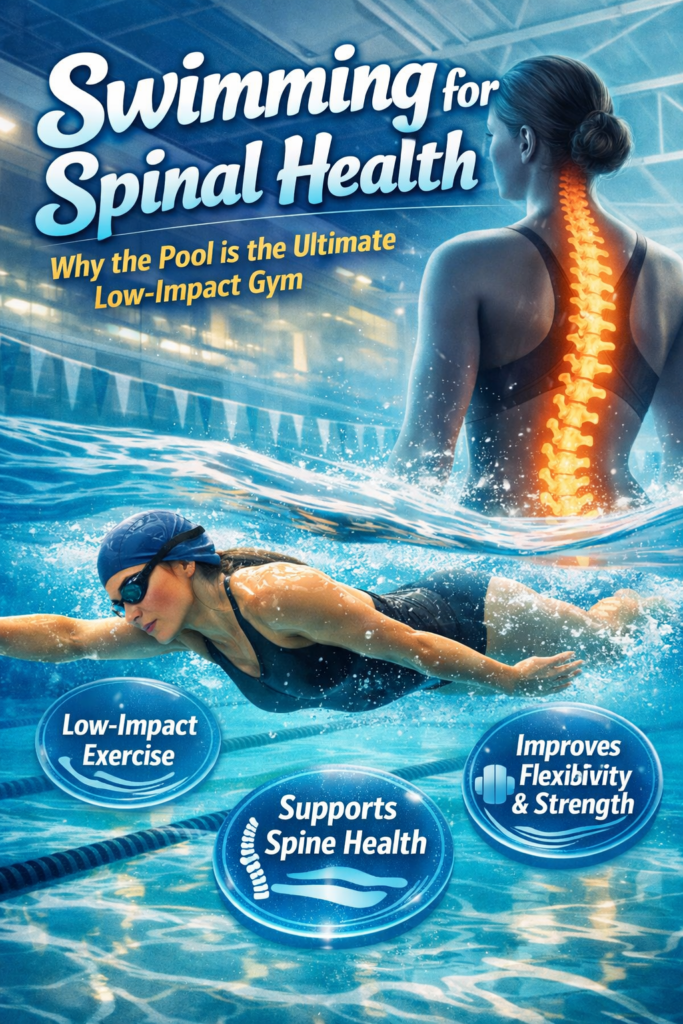
For many, the word “gym” conjures images of clanging iron plates, the rhythmic thud of treadmills, and the high-impact strain of HIIT sessions. While these environments are effective for building strength and cardiovascular health, they often come with a hidden tax on the human frame—specifically, the spine. For those managing chronic back pain, recovering from injury, or simply looking to preserve their skeletal integrity as they age, the traditional gym can feel like a minefield of potential flare-ups.
Enter the aquatic environment. Swimming and water-based exercise represent a fundamental shift in how we approach physical therapy and fitness. In the pool, the rules of physics change. Gravity is mitigated, impact is neutralized, and resistance is omnipresent. This makes the pool not just a place to cool off, but arguably the most sophisticated “gym” in existence for spinal health.
The Physics of the Pool: Buoyancy as a Medical Intervention
To understand why swimming is superior for the spine, we must first look at Archimedes’ Principle. When you submerge yourself in water up to your neck, the water displaces your body weight. You experience a state of “apparent weightlessness.”
Decompression: In a standing, land-based environment, gravity is constantly pulling downward, compressing the intervertebral discs. In the water, buoyancy counteracts this. If you are submerged to the chest, you are effectively bearing only 25% to 35% of your body weight. If submerged to the neck, that number drops to 10%.
-
Space for the Discs: This reduction in weight allows the spine to decompress. The gelatinous discs between your vertebrae—which act as shock absorbers—are given the space to rehydrate and move without the constant grinding pressure of upright movement.
For individuals with herniated discs, sciatica, or degenerative disc disease, this decompression provides immediate symptomatic relief while allowing for a range of motion that would be impossible—and painful—on land.
Resistance Without the Impact
In a traditional gym, adding resistance usually means adding weight. If you want a harder workout, you pick up a heavier dumbbell. The problem? That weight must be supported by your skeletal structure, often putting significant “axial loading” on the spine.
In the water, the resistance is hydrodynamic. Water is roughly 800 times denser than air. Every movement you make is met with resistance from every direction.
Isokinetic Exercise: Water provides “accommodating resistance.” The harder you push, the more the water pushes back. This allows you to engage in high-intensity muscle toning without the risk of dropping a weight or straining a joint at the end of a repetition.
Balanced Muscle Development: Because water surrounds you, movements require “agonist” and “antagonist” muscles to work equally. When you push your arm through the water, you use your chest and shoulders; when you pull it back, you use your back and triceps. This creates a balanced muscular “corset” around the spine, preventing the imbalances that often lead to back pain.
Key Strokes for a Healthier Spine
Not all swimming strokes are created equal when it comes to back health. If you are swimming specifically to help your spine, your technique matters.
1. Backstroke: The Gold Standard
The backstroke is widely considered the best for spinal health. Because you are lying flat on your back, the spine remains in a neutral, horizontal position. It encourages a “proud chest” and opens up the shoulders, directly counteracting the “hunched” posture many of us develop from sitting at desks or looking at phones.
2. Freestyle (Front Crawl)
Freestyle is excellent for building the core and the long muscles of the back (latissimus dorsi). However, it requires a proper “bilateral breathing” technique. If you only breathe to one side, you may create a repetitive twisting motion that can irritate certain spinal conditions. Utilizing a center-mount snorkel can eliminate the need to turn the head, allowing the spine to stay perfectly aligned.
3. The "Cautionary" Strokes: Butterfly and Breaststroke
While these are fantastic for fitness, they involve significant extension (arching) of the lower back. For those with spondylolisthesis or lower back facet joint pain, the undulating motion of the butterfly or the “kick and lift” of the breaststroke can exacerbate symptoms. If you have lower back issues, stick to the backstroke or modified vertical water exercises.
Beyond Laps: Vertical Water Training
You don’t need to be an Olympic-level swimmer to use the pool as a gym. In fact, some of the best spinal work happens vertically.
Water Walking/Running: Using a buoyancy belt to “run” in the deep end provides a massive cardiovascular workout with zero impact. It forces the core stabilizers—the deep muscles like the multifidus and transversus abdominis—to fire constantly to keep you upright.
- The “Superman” Stretch: Holding onto the edge of the pool and letting your body float outward while tucking your chin can create a gentle, traction-like stretch through the entire vertebral column.
Aquatic Core Rotations: Standing in chest-deep water and moving your arms in a “figure-eight” pattern creates a gentle rotational challenge for the core, building the stability needed to protect the spine during daily activities like lifting groceries or getting out of a car.
The Mind-Body Connection: Nervous System Regulation
Chronic back pain is often as much about the nervous system as it is about physical tissue. Constant pain puts the body in a “fight or flight” state, which leads to muscle guarding—where the muscles around the spine lock up to “protect” it, ironically causing more pain.
The hydrostatic pressure of water has a calming effect on the nervous system. Similar to the sensation of a weighted blanket, the uniform pressure of the water can reduce edema (swelling) and provide sensory input that “mutes” pain signals traveling to the brain. This relaxation allows muscles to let go of their protective guarding, facilitating better blood flow and faster healing.
Creating Your Aquatic Routine
If you’re ready to trade the sneakers for a swimsuit, here is how to start safely:
Warm Up Vertically: Spend 5 minutes walking in the water or doing gentle leg swings to let your body adjust to the temperature and pressure.
Focus on Length, Not Speed: Think about making your spine as “long” as possible in the water. Reach with your fingertips and point your toes gently.
Listen to the “Niggle”: While “no pain, no gain” is common in some gyms, it does not apply to spinal health. If a specific stroke causes a sharp or radiating pain, stop immediately and switch to a neutral float or a different movement.
Consistency is Key: Just 20 to 30 minutes, three times a week, can significantly improve the muscular support system of the spine.