
If you’ve ever dealt with lower back pain, you know the desperate search for relief. You’ve likely been told to “strengthen your core,” but many traditional exercises—like heavy sit-ups or aggressive leg raises—often leave your back feeling worse than when you started.
Enter the Dead Bug.
Despite its slightly morbid name, the Dead Bug is widely considered the “gold standard” of core rehabilitation. It is a foundational movement that teaches you how to decouple limb movement from spine movement. In this guide, we’ll dive deep into why this exercise is a game-changer for back health, how to master the form, and why it belongs in your daily routine.
Why "Core Strength" is Often Misunderstood
Before we get into the mechanics of the Dead Bug, we need to address a common myth. Many people think “core strength” means having visible six-pack abs (the rectus abdominis). While those look great at the beach, they aren’t the primary protectors of your spine.
True core stability comes from the deep stabilizers:
Transverse Abdominis (TVA): Your internal “weight belt.”
-
Multifidus: Small muscles along the spine.
-
Obliques: The rotators and lateral stabilizers.
-
Pelvic Floor: The base of your core canister.
Back pain often occurs because these deep muscles aren’t firing correctly, causing the lower back (the lumbar spine) to take on loads it wasn’t meant to carry. The Dead Bug specifically targets these deep layers by forcing them to maintain a “neutral spine” against the weight of your moving limbs.
The Anatomy of the Dead Bug
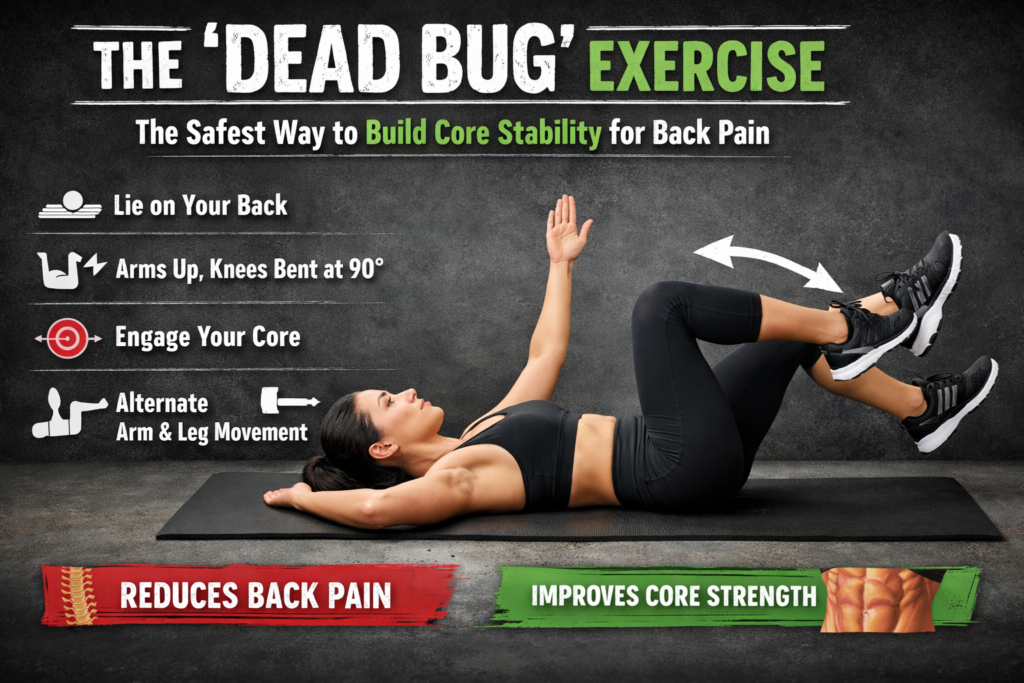
Why is it called the Dead Bug? Simply because when you’re in the starting position—lying on your back with your arms and legs in the air—you look like, well, a bug that has reached the end of its journey.
But the beauty of this position is gravity. By lying on the floor, your spine is supported. Unlike standing exercises, you don’t have to fight upright postural demands, allowing you to focus 100% on lumbopelvic stability.
The Physics of the Movement
The Dead Bug is an anti-extension exercise. As you reach your arm and opposite leg away from your center, the weight of those limbs creates a “long lever.” Naturally, your lower back will want to arch (extension) to compensate for that weight. Your goal is to use your core to resist that arching.
How to Perform the Perfect Dead Bug
Success with the Dead Bug isn’t measured by how many reps you do, but by how well you maintain the tension in your midsection.
1. The Setup
Lie flat on your back on a firm surface (a yoga mat is ideal).
Raise your arms straight up toward the ceiling, stacked directly over your shoulders.
Lift your legs into a “tabletop” position—knees bent at 90 degrees, shins parallel to the floor, and knees directly over your hips.
2. The "Rib Down" Check
Before you move a muscle, take a deep breath in. As you exhale, imagine pulling your bottom ribs down toward your hip bones. You should feel your entire lower back flatten against the floor. This “closed” position is your home base. If a hand could slide under your back, you’ve lost the engagement.
3. The Execution
- Slowly lower your right arm behind your head while simultaneously straightening and lowering your left leg toward the floor.
- Go only as low as you can without letting your lower back lift off the ground.
- Pause for a second at the bottom of the movement.
- Exhale forcefully as you return both the arm and leg to the starting tabletop position.
- Switch sides (left arm, right leg) and repeat.
Common Mistakes (And How to Fix Them)
Even though it looks simple, the Dead Bug is incredibly easy to “cheat.” If you feel this in your lower back rather than your abs, you’re likely making one of these errors:
| Mistake | The Fix |
| Arching the Back | Don’t lower your legs as far. Stop the moment you feel your spine wanting to lift. |
| Moving Too Fast | Slow down. The slower you move, the harder the core has to work to stabilize. |
| Holding Your Breath | Use “diaphragmatic breathing.” Inhale as you expand, exhale as you bring the limbs back. |
| Losing the Tabletop | Make sure the “stationary” leg stays perfectly still at 90 degrees. Don’t let it drift toward your chest. |
Progressions: From Beginner to Advanced
The Dead Bug is highly scalable. Whether you are recovering from a disc herniation or you’re an elite athlete, there is a version for you.
Level 1: The "Leg Only" Dead Bug
If keeping your back flat is too difficult, keep your arms reaching toward the ceiling and only move one leg at a time. Tap your heel on the floor with a bent knee, then progress to a straight leg.
Level 2: The Standard Dead Bug
Opposite arm and opposite leg move simultaneously. This introduces a diagonal (contralateral) challenge to your nervous system.
Level 3: The Wall-Press Dead Bug
Lie with your head near a wall. Reach back and press your palms firmly into the wall. This engages the latissimus dorsi and helps force the ribs down, making it much easier to keep the lower back flat while moving the legs.
Level 4: Weighted or Resistance Band
Hold a light dumbbell in each hand or loop a resistance band around your feet. Adding external resistance forces the core to work exponentially harder to maintain stability.
The Science of Back Pain Relief
Why does this specific movement help back pain so much? It comes down to neuromuscular re-education.
Most chronic back pain stems from “instability.” When the brain senses that the spine isn’t stable, it sends signals to the surrounding muscles (like the erector spinae) to tighten up. This is why your back feels “tight” or “locked.”
By practicing the Dead Bug, you are teaching your brain that your core can support your spine even when your limbs are moving. Once the brain feels “safe” and realizes the deep core is doing its job, it will often “let go” of that protective muscle guarding, leading to a significant reduction in pain and stiffness.