
Understanding Intrathecal Pain Pumps: A Lifeline for Chronic Pain Management
Chronic pain can alter every facet of a person’s existence. For individuals battling persistent conditions that fail to respond to standard treatments—such as oral medications, physical therapy, or localized injections—the search for relief can feel exhausting. When conventional pathways hit a dead end, advanced interventions can offer a new path forward.
One of the most innovative and impactful options available in modern medicine is the intrathecal pain pump (also known as a targeted drug delivery system). This comprehensive guide explores how intrathecal pain pumps work, who qualifies for them, their benefits, and what patients can expect throughout the process.
What is an Intrathecal Pain Pump?
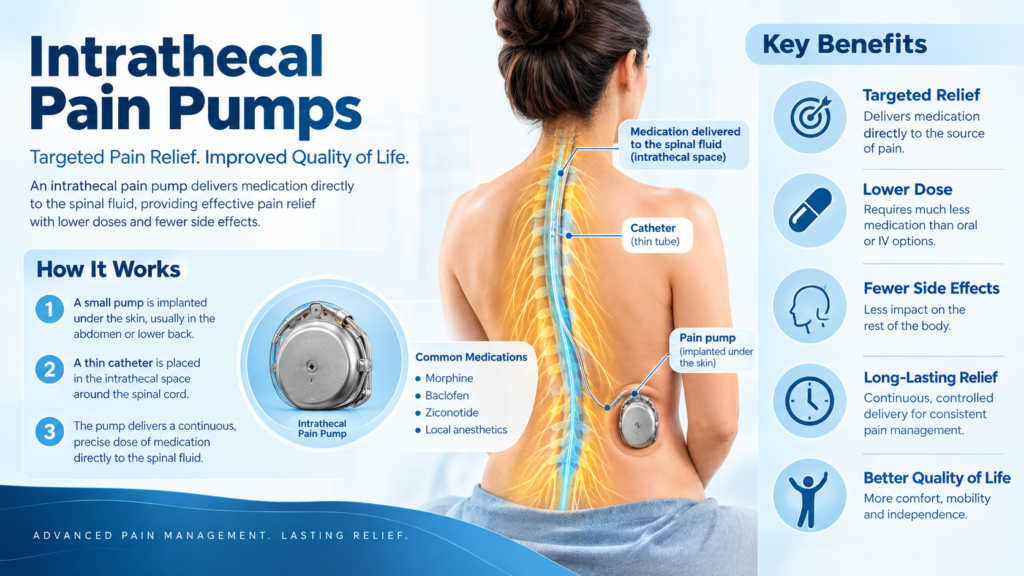
An intrathecal pain pump is a small, computerized medical device surgically implanted beneath the skin, typically in the abdominal wall. It is attached to a thin, flexible tube called a catheter, which is threaded into the intrathecal space (the fluid-filled subarachnoid space surrounding the spinal cord).
Instead of routing medication through the digestive tract and bloodstream like a traditional pill, an intrathecal pump infuses micro-doses of medication directly into the cerebrospinal fluid. Because the medication interacts directly with opioid and other receptors on the spinal cord, it intercepts pain signals before they ever reach the brain.
Types of Pumps
Programmable Pumps: Battery-operated devices that can be adjusted externally via telemetry programming. They allow doctors to modify the flow rate or dose schedule to match a patient’s changing pain levels.
Fixed-Rate (Non-programmable) Pumps: Mechanical devices powered by a gas-driven propellant that deliver a steady, continuous stream of medication without a battery.
Who is a Candidate for Intrathecal Therapy?
Intrathecal pain pumps are rarely used as a first-line therapy. Instead, they are typically reserved for patients suffering from severe, chronic, refractory pain—pain that has not responded adequately to more conservative measures.
Common conditions treated with intrathecal pumps include:
Failed Back Surgery Syndrome (FBSS): Persistent back and leg pain following one or more spinal surgeries.
Neuropathic Pain and Complex Regional Pain Syndrome (CRPS): Severe nerve-based pain conditions characterized by burning or shooting sensations.
Cancer-Related Pain: Advanced illnesses where systemic pain management causes intolerable sedation or side effects.
Severe Spasticity: Muscle stiffness and spasms stemming from multiple sclerosis, spinal cord injuries, or cerebral palsy (often utilizing medications like baclofen).
The Evaluation and Trial Phase
Before a permanent device is implanted, patients undergo a rigorous screening process. This typically involves a psychological evaluation to ensure the patient is mentally prepared for a surgically implanted device, alongside a crucial intrathecal trial phase.
During the trial, a small dose of medication is introduced into the spinal fluid via a lumbar puncture (spinal tap) or a temporary catheter. Doctors monitor the patient over the next several hours to evaluate how well the medication reduces pain and whether it is well-tolerated. A successful trial—usually defined as achieving substantial pain relief (typically 50% or greater) with minimal side effects—greenlights the permanent implantation surgery.
The Implantation Procedure
The surgical procedure to place an intrathecal pump is usually performed under general anesthesia by an experienced neurosurgeon or interventional pain specialist.
Catheter Placement: The surgeon makes a small incision in the lower back and carefully threads the catheter into the intrathecal space surrounding the spinal cord.
Pump Pocket Creation: A second small incision is made in the abdomen, and a shallow “pocket” is created beneath the skin and fat layer to hold the pump.
Tunneling and Connection: The spinal catheter is tunneled safely under the skin from the back to the abdominal pocket, where it is securely connected to the pump.
Closure: Both incisions are closed with sutures or staples and sterile dressings are applied.
The entire surgery typically takes a couple of hours, and many patients return home either the same day or after a short 1-to-3-day hospital stay.
Major Benefits of Intrathecal Pain Pumps
When compared to traditional oral pain regimens, targeted drug delivery offers several distinct advantages:
Drastically Lower Doses: Because the medication is delivered right to its target site, the required dose is a fraction (often 1/100th to 1/300th) of an oral equivalent.
Fewer Systemic Side Effects: Lower overall doses mean patients experience significantly fewer body-wide side effects, such as severe mental clouding, constipation, nausea, and drowsiness.
Superior Pain Relief for Nerve Pain: Conditions like neuropathic pain respond much better to direct spinal application than to systemic medications floating through the bloodstream.
Convenience and Control: Programmable pumps automate delivery, eliminating the need to remember scheduled pill times. Furthermore, doctors can fine-tune dosages non-invasively using an external programmer.
Risks, Complications, and Maintenance
While intrathecal pumps change lives, they are medical devices carrying inherent surgical and mechanical risks that require lifelong commitment.
Surgical Risks: As with any operation, there is a risk of infection, bleeding, or cerebrospinal fluid leaks (which can trigger severe headaches).
Mechanical Complications: Catheters can occasionally kink, disconnect, or migrate out of position, and pumps can experience mechanical or battery failures requiring revision surgery.
Granuloma Formation: Rarely, an inflammatory mass (granuloma) can form at the tip of the catheter inside the spinal canal, which may require medical intervention or device removal.
Routine Maintenance: The pump reservoir is not infinite. Patients must visit their specialist every 1 to 3 months for a simple, quick clinic procedure where the pump is refilled via a tiny needle inserted through the skin into the pump’s reservoir. Programmable batteries also eventually require complete device replacement every 5 to 7 years.
Conclusion
Intrathecal pain pumps represent a triumph of modern interventional medicine, offering renewed hope and functionality to individuals trapped in cycles of unrelenting chronic pain. By shifting the delivery paradigm from systemic saturation to precise, localized spinal infusion, these devices reclaim quality of life for patients who thought options had run out.
If you or a loved one are struggling to manage severe chronic pain through conventional means, consult a specialized pain management physician to discuss whether an intrathecal evaluation might be right for you.
Are you or someone you care for currently exploring advanced interventional treatments for chronic pain, or do you have questions about the pump refill process?