
Breaking New Ground: Modern Advancements in Vertebroplasty and Kyphoplasty
Vertebral compression fractures (VCFs)—often driven by osteoporosis, trauma, or spinal tumors—can turn everyday movements into a source of chronic, debilitating agony. For decades, traditional management meant painful recovery periods, bed rest, or complex open surgeries that carried high risks for frail or elderly patients.
Fortunately, minimally invasive spine procedures like vertebroplasty and kyphoplasty have transformed the landscape of orthopedic and pain care. Recent technological and clinical advancements are making these procedures safer, more precise, and remarkably effective at restoring patients’ mobility and quality of life.
Understanding the Core Procedures
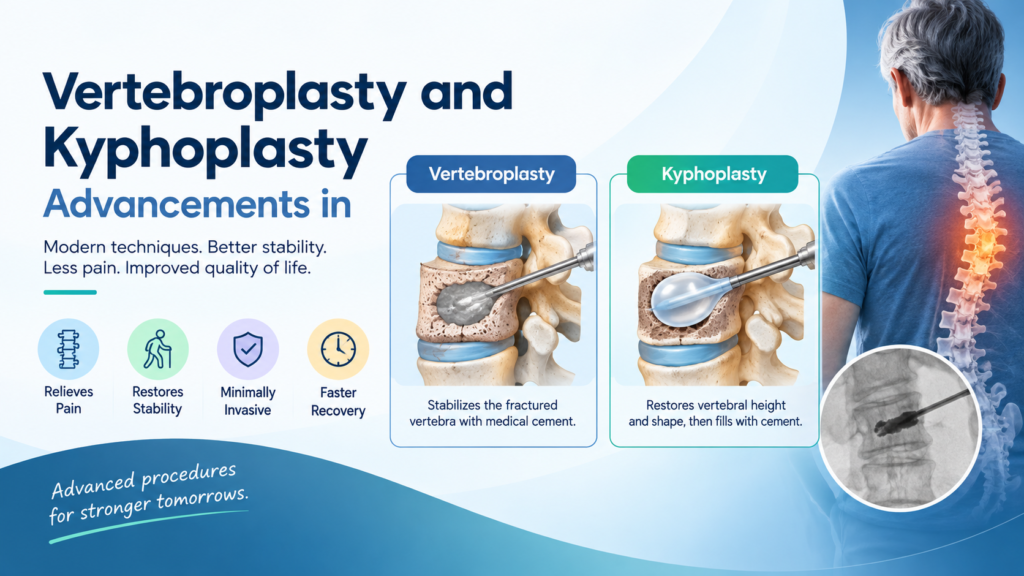
Both procedures are designed to stabilize weakened or fractured spinal bones (vertebrae) using medical-grade bone cement:
-
Vertebroplasty: A hollow needle is guided via imaging directly into the fractured vertebra, where bone cement is injected to stabilize the bone and eliminate painful micro-motions.
-
Kyphoplasty: This technique adds a restorative step. Before injecting the cement, a specialized balloon tamp is inserted and inflated to gently lift the collapsed vertebra back toward its natural height, correcting spinal alignment and reducing forward curvature (kyphosis).
Cutting-Edge Advancements Shaping the Future
Medical engineering has taken these life-changing procedures to the next level. Several key innovations are driving modern success:
1. Advanced 3D Imaging and Navigation
Gone are the days of relying solely on basic two-dimensional fluoroscopy. Modern operating rooms utilize advanced 3D imaging, computer-assisted navigation, and robotic integration. These tools give surgeons a real-time, high-definition “GPS” map of the spine, allowing for pinpoint needle placement and significantly lowering the risk of complications.
2. Smart Bone Cements and Biologics
Traditional polymethylmethacrylate (PMMA) cement has served patients well, but material science is evolving rapidly. Newer formulations boast optimized viscosity, lower curing temperatures (reducing thermal stress on surrounding tissues), and enhanced bioactivity. Some experimental and newer cements are designed to encourage bone ingrowth, seamlessly integrating the synthetic material with the patient’s natural bone over time.
3. Low-Pressure Delivery Systems
A primary historical concern with vertebral augmentation was cement leakage outside the targeted bone. Modern kyphoplasty balloon systems and refined vertebroplasty delivery instruments utilize advanced pressure-monitoring technology. By creating precise cavities beforehand and controlling injection flow, physicians can drastically minimize the risk of cement extravasation into the spinal canal.
4. Ambulatory and Outpatient Innovations
Because techniques have become cleaner, faster, and less traumatic to surrounding tissue, the vast majority of vertebroplasty and kyphoplasty procedures are now performed on an outpatient basis. Patients often walk out of the clinic within hours and experience significant pain relief in just 24 to 48 hours, sharply reducing the risks associated with prolonged hospital stays.
Why These Advancements Matter
For aging populations and individuals battling severe osteoporosis, these breakthroughs mean more than just technological progress—they represent independence and restored dignity. By rapidly halting pain, correcting spinal deformities, and preventing secondary collapses, modern vertebroplasty and kyphoplasty keep patients active, mobile, and engaged in the lives they love.
Are you or a loved one exploring options for managing chronic back pain from a compression fracture? Share your thoughts or questions in the comments below!