
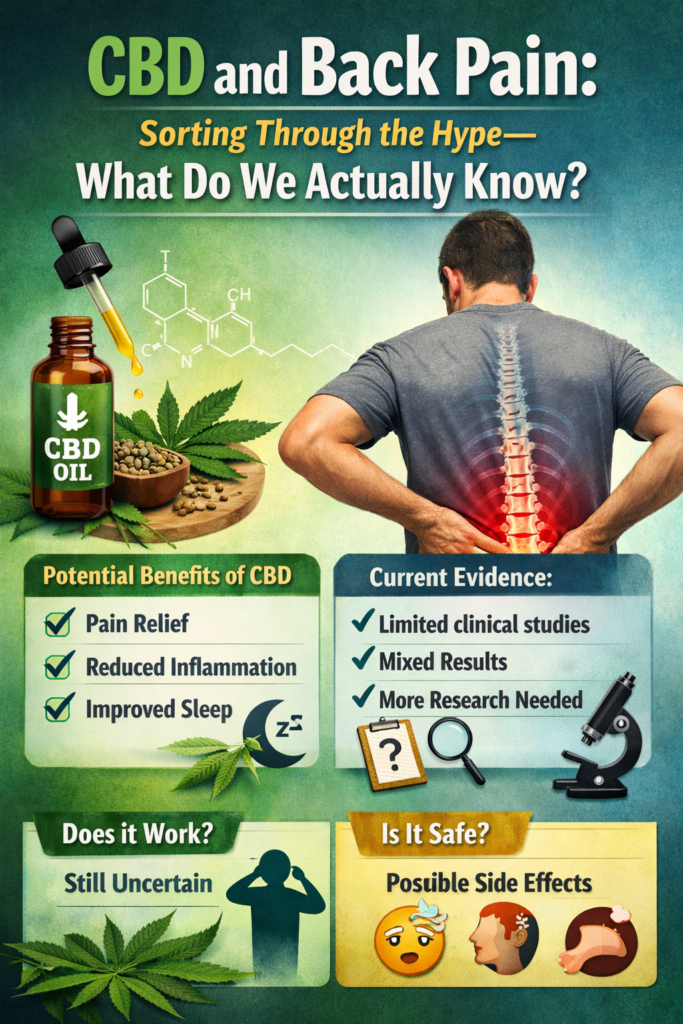
If you’ve spent more than five minutes searching for ways to manage back pain, you’ve likely been bombarded with advertisements for CBD (Cannabidiol). From tinctures and gummies to cooling creams and even CBD-infused pillows, the industry is booming. Promoters claim it’s a “miracle cure” for everything from bulging discs to chronic sciatica, often positioning it as a safe, non-addictive alternative to opioids.
But as with any “miracle” product, it is essential to separate the marketing gloss from the medical reality. As of early 2026, the scientific community has more data than ever before, but the results are more nuanced than a flashy Instagram ad might suggest.
Here is the deep dive into what we actually know about CBD and back pain, the latest clinical evidence, and what you should consider before adding it to your medicine cabinet.
What is CBD, and Why the Hype for Back Pain?
CBD is one of over 100 chemical compounds, known as cannabinoids, found in the Cannabis sativa plant. Unlike its more famous cousin, THC (tetrahydrocannabinol), CBD is non-psychoactive. In plain English: it won’t get you high.
The hype around CBD for back pain stems from its relationship with the Endocannabinoid System (ECS). This is a complex cell-signaling network in your body. That regulates essential functions like sleep, mood, appetite, and—most importantly for back pain sufferers—pain and immune system response.
How CBD is Thought to Work
Research suggests that CBD doesn’t necessarily “block” pain in the way an ibuprofen might. Instead, it interacts with receptors (specifically CB1 and CB2) and various neurotransmitters to:
Reduce Inflammation: It may suppress the inflammatory response in the muscles and nerves.
Modulate Pain Signals: It can potentially “dial down” the volume of pain signals being sent to the brain.
Improve Sleep and Anxiety: By reducing the stress and insomnia often caused by chronic pain, CBD may help improve a patient’s overall “pain threshold.”
Sorting Through the Science: 2025-2026 Clinical Updates
For years, doctors had to rely on animal studies (mostly involving rats with arthritis) to guess how CBD might help humans. However, a wave of new human clinical trials and systematic reviews published in 2025 and 2026 has provided a clearer—if slightly more cautious—picture.
1. The "Modest Benefit" Reality
A major Cochrane Review updated in early 2026 analyzed over 20 studies involving 2,000+ participants. The conclusion? While many people report feeling better, there is no clear evidence that CBD-dominant products provide a “clinically significant” (50% or greater) reduction in chronic neuropathic pain for the majority of users.
Instead, most successful trials show a modest reduction—usually 1 to 2 points on a 10-point pain scale. For a chronic sufferer, this 20% reduction can be the difference between staying in bed and going for a walk, but it is rarely the “total cure” promised by marketing teams.
2. The Full-Spectrum Edge (The "Entourage Effect")
One of the most significant breakthroughs in 2025 came from a Phase III trial published in Nature Medicine. Researchers found that a full-spectrum extract (containing CBD along with trace amounts of THC and other minor cannabinoids) was significantly more effective than CBD isolate for chronic lower back pain.
This supports the theory of the “Entourage Effect”—the idea that the compounds in the cannabis plant work better together than they do alone. This study showed that participants taking the full-spectrum extract reported better sleep and physical function compared to a placebo group.
3. Acute vs. Chronic Pain
If you just pulled your back lifting a box today, CBD might not be your best bet. The CANBACK study and subsequent reviews have shown that CBD is largely ineffective for acute (sudden, short-term) back pain in emergency settings. It seems to work much better as a long-term management tool for chronic conditions (pain lasting longer than 3 months) rather than a “quick fix” for a muscle strain.
The Reality Check: What CBD Can't Do
It is vital to manage expectations. A common misconception—often reinforced by influencers—is that CBD can “heal” the structural issues in the spine.
Important Note: CBD is a symptom manager, not a structural repair tool. It will not fix a herniated disc, reverse spinal stenosis, or realign a scoliosis curve.
If your pain is caused by a physical compression of a nerve, CBD may help dull the burning sensation, but it won’t remove the pressure on the nerve.
Potential Risks and Side Effects
While CBD is generally considered safe and has a much lower risk profile than opioids or even long-term NSAID (ibuprofen) use, it is not without side effects.
Common Side Effects:
Dry mouth (often called “cottonmouth”)
Drowsiness or fatigue
Diarrhea or changes in appetite
Dizziness (especially with higher doses)