
If you’ve ever sat in a doctor’s office and heard the words “Degenerative Disc Disease” (DDD), your mind likely raced to a dark place. The word disease suggests a progressive, perhaps contagious, or certainly abnormal ailment. It sounds like something that shouldn’t be there—a breakdown that needs “fixing.”
But here is the medical world’s little secret: Degenerative Disc Disease isn’t actually a disease, and for many people, it isn’t even “abnormal.”
In the world of spinal health, few terms are as controversial or as frequently misunderstood. To understand what is happening in your back, we need to peel back the layers of terminology, biology, and the inevitable reality of time. Is your spine failing you, or is it just showing its age?
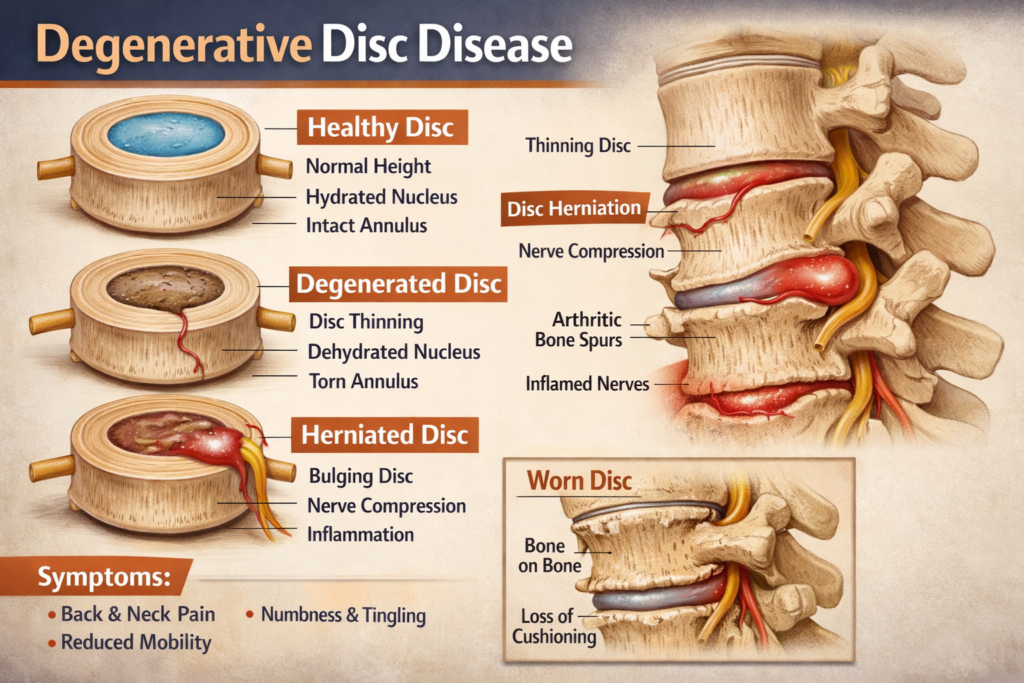
The Anatomy of a Shock Absorber
To understand why discs “degenerate,” we first have to understand what they do. Your spine is a marvel of engineering, a stack of bones (vertebrae) separated by soft, rubbery cushions called intervertebral discs.
The Two-Part Structure
Each disc is composed of two primary components:
The Annulus Fibrosus: The tough, flexible outer ring made of stacked layers of collagen fibers.
The Nucleus Pulposus: The soft, jelly-like center. This core is mostly water and provides the hydraulic “bounce” that allows you to jump, run, and twist without your bones grinding together.
As we age, these discs undergo a predictable transformation. They lose water content (desiccation), become thinner, and the outer ring can develop small cracks or tears. This is the “degeneration” in question.
The Great Debate: Disease vs. Natural Aging
The crux of the issue lies in the name. In medicine, a “disease” usually implies an impairment of normal function. However, if a condition is present in 90% of a population over a certain age, can we truly call it a disease? Or is it simply “wrinkles on the inside”?
The “Wrinkles” Analogy
Think about your skin. When you are twenty, your skin is elastic and smooth. By sixty, you likely have wrinkles, sun spots, and a loss of elasticity. We don’t call this “Degenerative Skin Disease”; we call it aging.
Radiological studies have shown that a staggering number of people with no back pain have significant disc degeneration on their MRIs. A famous study published in the American Journal of Neuroradiology found that over 50% of asymptomatic 40-year-olds had disc degeneration, and that number climbed to 80% by age 50.