
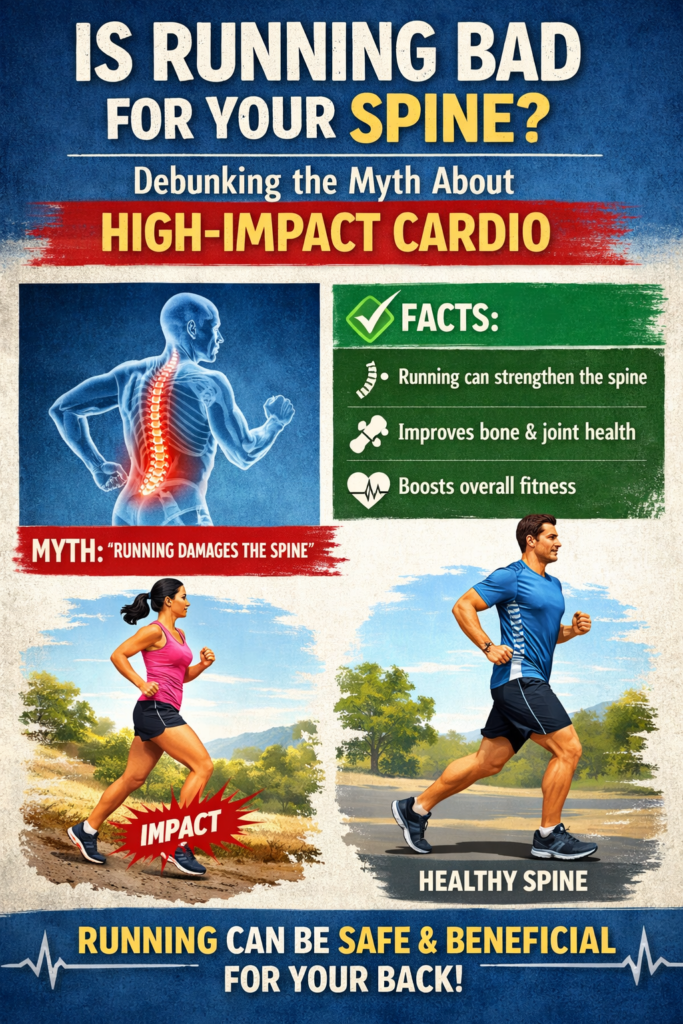
For decades, a persistent shadow has loomed over the local 5K start line and the morning jog: the belief that running is a slow-motion wrecking ball for your spine. You’ve likely heard it from a well-meaning relative or a concerned friend: “All that pounding is going to turn your discs into pancakes.”
It sounds logical, right? If you hit a piece of equipment over and over again, eventually, it breaks. But the human body isn’t a piece of static equipment; it’s a living, adapting biological system.
Today, we’re lace-up our shoes and diving into the science to settle the score. Is running actually bad for your spine, or is it one of the best things you can do for it?
The Origin of the Myth: Why Do We Blame Running?
The “running is bad for you” narrative usually stems from a misunderstanding of impact forces. When you run, your body absorbs a force roughly 2.5 to 3 times your body weight with every stride. In a single mile, that’s thousands of repetitions.
Critics of high-impact cardio argue that this constant compression leads to:
-
Intervertebral Disc Degeneration: The “shock absorbers” between your vertebrae wearing out.
Osteoarthritis: Wear and tear on the spinal joints.
-
Chronic Lower Back Pain: Resulting from repetitive strain.
While these concerns come from a place of caution, they overlook a fundamental law of biology: Wolff’s Law. This principle states that bone (and by extension, connective tissue) adapts to the loads under which it is placed. If loading increases, the bone will remodel itself over time to become stronger.
What the Science Actually Says
Recent peer-reviewed research has flipped the “running ruins your back” script on its head. Let’s look at the heavy hitters in the data.
1. The "Stronger Discs" Discovery
A landmark study published in Scientific Reports examined the intervertebral discs (IVDs) of long-distance runners, joggers, and sedentary individuals. The findings were revolutionary.
Researchers found that runners actually had healthier, larger, and more hydrated discs than the non-runners. Specifically, the runners showed higher levels of glycosaminoglycans (a molecule that helps discs retain water and resist compression). Instead of wearing the discs down, the rhythmic loading of running seemed to “pump” nutrients into the discs, strengthening them over time.
2. The Arthritis Paradox
There is a common misconception that running causes “bone-on-bone” friction. However, large-scale longitudinal studies (like those published in the Journal of Bone and Joint Surgery) have shown that runners are actually less likely to develop symptomatic osteoarthritis compared to sedentary individuals.
Why? Because running helps manage body weight (reducing chronic load on joints) and strengthens the musculature that supports the spine, creating a natural “brace” for the vertebrae.
When Running Can Be a Problem
To be fair and balanced, running isn’t a magic bullet for everyone. While the activity itself isn’t “bad” for the spine, how you run and who is running matters. Running can exacerbate spinal issues under certain conditions:
Poor Biomechanics and Form
If your gait involves heavy heel-striking or excessive “lumbar extension” (arching your back too much), the spine absorbs force in ways it wasn’t designed to. This can lead to stress fractures or muscle strains.
Overtraining
The spine needs time to recover and remodel. If you jump from 0 miles a week to 30 miles a week, you aren’t giving your discs time to adapt to the new stimulus. This is where most “running injuries” actually come from—not the act of running, but the sudden change in volume.
Pre-existing Structural Issues
If someone has a severe herniated disc, spinal stenosis, or spondylolisthesis, the high-impact nature of running may aggravate the condition. In these cases, it’s not that running caused the problem, but that the spine is currently too compromised to handle the load.
How to Protect Your Spine While Running
If you want to reap the spine-strengthening benefits of running without the risks, follow these pillars of “Spinal Hygiene” for runners:
1. Focus on Cadence
Instead of taking long, plunging strides, aim for a higher cadence (steps per minute). A shorter stride ensures your foot lands closer to your center of gravity, which significantly reduces the peak impact force sent up your legs to your lower back.
2. Strengthen Your "Chassis"
Your spine doesn’t exist in a vacuum. It relies on your core, glutes, and hips. If your glutes are weak, your lower back often takes over to stabilize your pelvis.
Key Exercises: Planks, Bird-Dogs, and Dead Bugs.
3. Invest in Proper Footwear
While “minimalist” running has its fans, most road runners benefit from shoes that provide adequate cushioning to dampen the initial shock of pavement. Replace your shoes every 300–500 miles to ensure the foam hasn’t lost its structural integrity.
4. Listen to the "Yellow Lights"
Pain is a signal. A little muscle soreness is fine, but sharp, radiating pain, or numbness in your legs (sciatica) is a “red light.” Stop, rest, and consult a professional.
The Verdict: Run for Your Life (and Your Back)
The myth that running is inherently bad for the spine is officially debunked. For the average healthy person, running is a protective activity. It promotes disc hydration, builds bone density, and strengthens the supporting musculature of the posterior chain.
Sedentary lifestyles are arguably far more dangerous for your spine. Prolonged sitting causes discs to lose fluid and muscles to atrophy. In the battle between the “Pound of the Pavement” and the “Slump of the Sofa,” the pavement wins every time.
The takeaway? Your spine is not a fragile stack of china; it is a robust, living pillar. Treat it with respect, build up your mileage gradually, and don’t let the myths keep you off the trail.