
Congratulations! You’ve reached the third trimester. You’re in the “home stretch,” quite literally. While this is an exciting time filled with nursery prep and baby showers, it’s also the phase where your body starts to feel the full weight of the incredible work it’s doing.
If you’re experiencing a dull ache in your lower back or a sharp twinge in your hips, you aren’t alone. Roughly 50% to 70% of pregnant women report back pain, particularly as the due date approaches. Your center of gravity has shifted, your ligaments are loosening, and your muscles are working overtime.
The good news? You don’t have to just “tough it out” until delivery. Here is a comprehensive guide to understanding why your back is protesting and, more importantly, how to find gentle, effective relief.
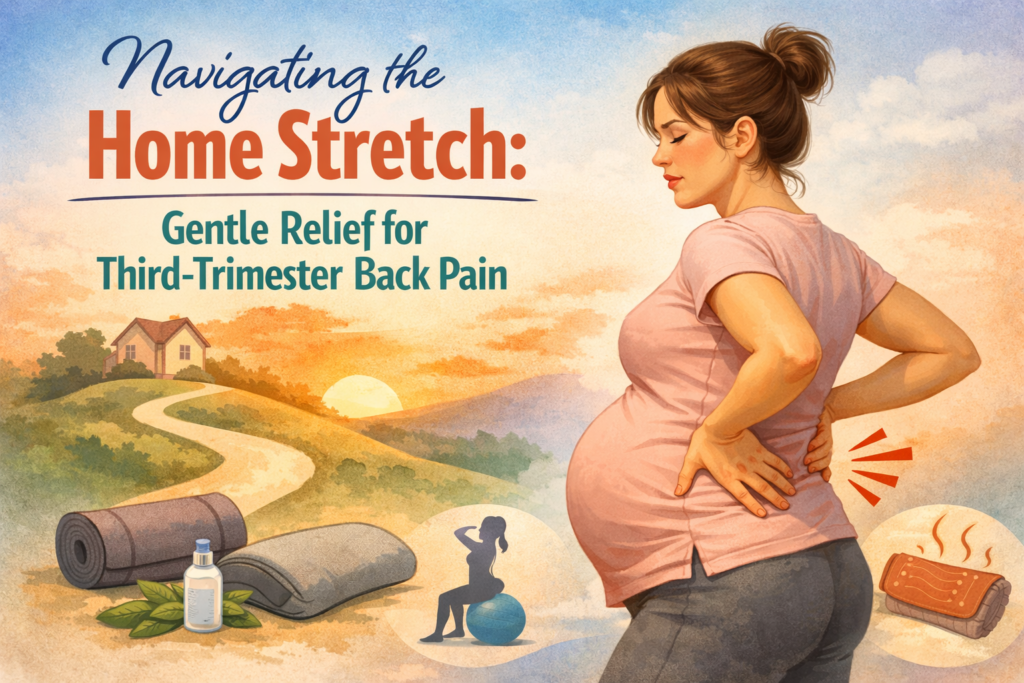
Why Does the Third Trimester Hit the Back So Hard?
Before we dive into the solutions, it helps to understand the “why.” Knowledge is power—and in this case, it helps you realize that your body isn’t breaking; it’s adapting.
The Shift in Gravity: As your baby grows, your uterus expands upward and outward. To keep from toppling forward, most women instinctively lean back. This creates an exaggerated curve in the lower spine (lumbar lordosis), putting massive strain on the lower back muscles.
- Hormonal Changes: Your body is producing a hormone called relaxin. Its job is to loosen the ligaments in your pelvic area to allow the baby to pass through the birth canal. However, relaxin doesn’t just target the pelvis; it affects all your joints, making the spine less stable and more prone to discomfort.
-
Muscle Separation: The rectus abdominis muscles (your “six-pack” muscles) may begin to separate along the center seam (diastasis recti). When your core loses its structural integrity, your back has to pick up the slack.
- Weight Gain: A healthy pregnancy involves gaining weight, but that extra load (including the baby, placenta, and amniotic fluid) is concentrated right in the front, stressing the joints and nerves.
1. Master the Art of "Pillow Architecture"
Sleep is often the first casualty of the third trimester. Between frequent bathroom trips and a restless baby, the last thing you need is a backache keeping you awake.
The Side-Lying Position: Experts recommend sleeping on your side (ideally the left side to improve circulation to the placenta).
Strategic Support: Place a firm pillow between your knees. This keeps your hips stacked and prevents your upper leg from pulling your spine into a twist.
The “Wedge”: A small, C-shaped or wedge pillow tucked under your “bump” can take the downward pressure off your back muscles while you sleep.
Don’t Forget the Back: If you find yourself rolling onto your back, tuck a long body pillow behind you to create a physical barrier.
2. Movement as Medicine: Gentle Exercises
While you might feel like lounging on the sofa, sedentary behavior can actually make back pain worse. Movement keeps the joints lubricated and the muscles engaged.
elvic Tilts (The “Angry Cat”)
This is the gold standard for pregnancy back pain.
Get on your hands and knees (all fours).
Inhale and let your belly drop slightly (don’t over-arch).
As you exhale, tuck your tailbone under and round your back toward the ceiling, like a cat stretching.
Hold for a few seconds and release. Repeat 10 times.
Prenatal Yoga
Yoga emphasizes stretching the hip flexors and strengthening the pelvic floor. Poses like Child’s Pose (with knees wide to accommodate the belly) can provide an immediate release for the lower back.
Aquatic Therapy
Swimming is arguably the best third-trimester exercise. The buoyancy of the water offsets your body weight, taking 100% of the pressure off your spine and joints. Even just walking laps in chest-deep water can provide immense relief.
3. The Daily Habits: Posture and Ergonomics
Sometimes the smallest changes yield the biggest results. How you move through your day dictates how your back feels by 6:00 PM.
The “Tripod” Stand: Avoid standing with your weight shifted onto one hip. Stand with your feet hip-width apart and your weight evenly distributed.
Sit with Purpose: Avoid soft, deep couches that you “sink” into. Choose chairs with firm back support. Use a small rolled-up towel or a lumbar roll behind the small of your back.
The Log Roll: When getting out of bed, do not do a “sit-up” motion. Roll onto your side, drop your legs over the edge of the bed, and use your arms to push yourself up to a sitting position.
Wear the Right Shoes: This isn’t the time for high heels or completely flat, unsupportive flip-flops. Look for shoes with good arch support and a slight heel (about an inch) to help balance your weight.
4. External Supports: Belts and Tapes
If your muscles are simply too tired to hold the weight, there is no shame in using a “helper.”
| Support Type | How it Works | Best For |
| Maternity Support Belt | A velcro belt that sits under the bump and wraps around the back. | Long walks, grocery shopping, or standing for more than 20 minutes. |
| SI Joint Belt | A thinner belt that focuses specifically on the hips/sacrum. | Sharp, stabbing pain in the “dimples” of your lower back. |
| Kinesiology Tape | Elastic tape applied by a professional to “lift” the belly. | Constant dull aches or those who find belts too hot/bulky. |
5. Therapeutic Interventions
Sometimes you need a professional touch. Always clear these with your OB-GYN or midwife first.
Prenatal Massage: A certified prenatal massage therapist knows how to work the glutes and lower back safely. They will use side-lying positioning or special tables with cutouts.
Chiropractic Care: Many women swear by “Webster Technique” certified chiropractors. They focus on pelvic alignment, which can reduce back pain and potentially make labor smoother.
Heat and Cold: A heating pad on the lower back for 15 minutes can soothe cramped muscles. Alternatively, an ice pack can help if the pain feels “hot” or inflammatory (like sciatica). Note: Never apply heat directly to your abdomen.