
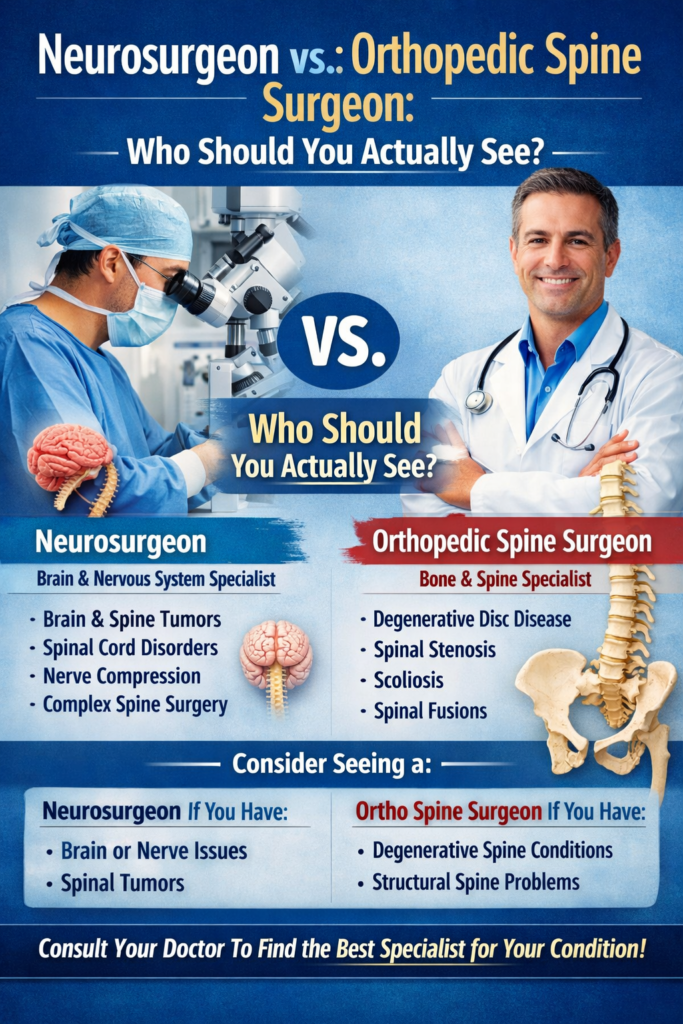
When you’re staring down a diagnosis of a herniated disc, chronic sciatica, or spinal stenosis, the search for a surgeon can feel like navigating a medical maze. You’ll likely encounter two distinct specialists: Neurosurgeons and Orthopedic Spine Surgeons.
The old-school thinking was that neurosurgeons handle “nerves” and orthopedic surgeons handle “bones.” However, modern medicine has blurred those lines significantly. Today, both specialties are highly qualified to treat the spine, but there are nuances in their training and approach that might influence your decision.
Here is a deep dive into the similarities, differences, and practical tips for choosing the right specialist for your back or neck.
1. The Core Training: Where They Come From
To understand who you should see, you first need to understand how they were built.
The Neurosurgeon
Neurosurgeons complete a residency focused entirely on the brain and spine. Because the spinal cord is an extension of the brain, their training is rooted in protecting the delicate neural structures.
Training Focus: Roughly 70% to 80% of a modern neurosurgeon’s practice is spine-related, while the rest involves brain tumors, aneurysms, and head trauma.
The “Nerve First” Lens: They are trained to operate inside the dura (the lining of the spinal cord).
The Orthopedic Spine Surgeon
Orthopedic surgeons complete a residency focused on the musculoskeletal system. They are the masters of bones, joints, and ligaments.
Training Focus: They spend years mastering fractures, joint replacements, and limb reconstruction before sub-specializing in the spine via a “Spine Fellowship.”
The “Structure First” Lens: They are experts at spinal stability, bone fusion, and the mechanics of the “pillars” that hold you up.
2. Where the Expertise Overlaps
For about 90% of common spinal procedures, both types of surgeons are equally capable. If you need one of the following, you can generally see either specialist:
Microdiscectomy: Removing a piece of a herniated disc.
Laminectomy: Decompressing the spinal canal to treat stenosis.
Spinal Fusion: Joining two vertebrae together to stop painful movement.
In modern medicine, many hospitals have “Spine Centers” where neurosurgeons and orthopedic surgeons work side-by-side, sharing techniques and even scrubbing into the same cases.
3. When to Choose a Neurosurgeon
While the overlap is huge, certain conditions fall more squarely into the neurosurgical camp. You should lean toward a neurosurgeon if your condition involves the internal workings of the nervous system:
Intramedullary Tumors: Tumors located inside the spinal cord itself.
Arteriovenous Malformations (AVMs): Abnormal tangles of blood vessels on or in the spinal cord.
The Dura: If a procedure requires opening the protective sac of the spinal cord, a neurosurgeon is often the more “at home” specialist.
Syringomyelia: Fluid-filled cysts within the spinal cord.
4. When to Choose an Orthopedic Spine Surgeon
Orthopedic surgeons often have the edge when the problem is primarily structural or mechanical. You might prioritize an orthopedic specialist for:
Severe Scoliosis: Complex spinal deformities that require massive structural realignment.
Kyphosis: A forward rounding of the back.
Pediatric Spine Issues: Children’s bones grow differently, and orthopedic surgeons are heavily trained in pediatric bone development.
Complex Bone Reconstruction: If the primary issue is a “bone-on-bone” mechanical failure or a complex fracture.
5. Key Factors to Consider (The "Patient Checklist")
Instead of focusing solely on the “Neuro vs. Ortho” label, use these criteria to vet your surgeon:
Fellowship Training
Regardless of their base specialty, ensure they have completed a Spine Fellowship. This is an extra year (or more) of intensive training dedicated only to the spine. A fellowship-trained orthopedic surgeon is often more qualified to do spine surgery than a general neurosurgeon who spends half their time on brain trauma.
Case Volume
Ask the blunt question: “How many times have you performed this specific procedure in the last year?” Data consistently shows that surgeons who perform a high volume of a specific surgery have lower complication rates and better outcomes. You want the person who does 100 fusions a year, not the one who does five.
Minimally Invasive Capabilities
If you want a faster recovery, ask if they utilize Minimally Invasive Spine Surgery (MISS) techniques. These involve smaller incisions and less muscle disruption. Both specialties can be trained in MISS, but it requires specific equipment and experience.
Bedside Manner and Philosophy
Spine surgery is a big deal. You want a surgeon who:
Explains the “Why” behind the surgery.
Exhausts all non-surgical options (PT, injections, weight loss) before suggesting the knife.
Makes you feel heard, not like a number on a chart.
6. The Verdict: Who Should You See?
If your issue is a standard herniated disc or spinal stenosis, the individual surgeon’s skill and reputation matter more than the letters after their name.
The Secret: In many top-tier medical institutions, the “Spine Team” is integrated. The best surgeon for you is the one who specializes in your specific pathology—be it a “nerve” problem or a “bone” problem—and has a track record of success with patients just like you.
Final Thoughts
Don’t be afraid to get a second opinion. If an Orthopedic surgeon recommends a three-level fusion, see a Neurosurgeon to hear their take—and vice-versa. A good surgeon will never be offended by your desire to be fully informed.
Your spine is the highway of your central nervous system and the literal backbone of your mobility. Choosing the right “road crew” to fix it is the most important step in your recovery journey.