
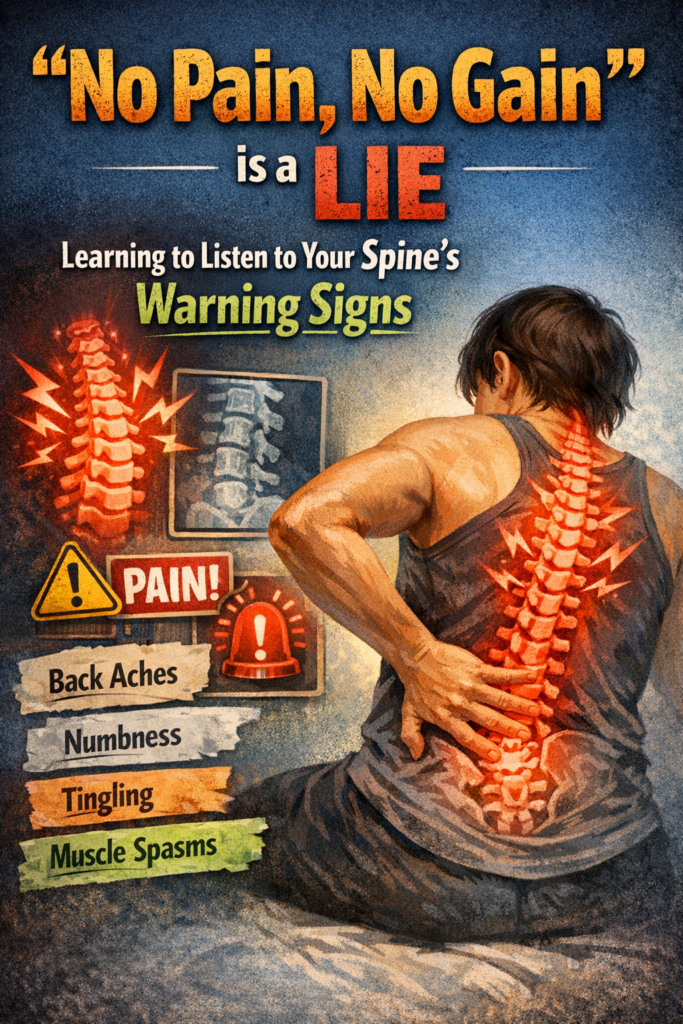
We’ve all heard the mantra. It’s plastered on gym walls, screamed by high-octane fitness influencers, and etched into our collective subconscious: “No Pain, No Gain.”
It’s a philosophy that suggests progress is built on the ruins of discomfort—that if you aren’t hurting, you isn’t working. While that might apply to the “burn” of lactic acid in your quads or the mental fatigue of a long workday, applying it to your spine is a dangerous, high-stakes gamble.
When it comes to your back, pain isn’t a badge of honor. It’s a distress signal. Ignoring it doesn’t make you tougher; it makes you a candidate for chronic injury. Let’s dismantle this myth and learn how to actually communicate with the biological pillar that holds you upright.
The Anatomy of the Lie
To understand why “pushing through” back pain is a recipe for disaster, we have to look at what’s actually happening under the skin. Your spine is a marvel of engineering—a stack of 33 vertebrae protected by shock-absorbing discs and stabilized by a complex web of ligaments and muscles.
When you feel a sharp twinge or a dull ache in your lumbar region, your body is providing real-time data.
Muscle Soreness (The “Good” Pain): This is Delayed Onset Muscle Soreness (DOMS). It’s a dull, wide-spread ache in the fleshy parts of your back that happens 24–48 hours after a workout. This is “gain” territory.
Spinal Warning Signs (The “Bad” Pain): This is sharp, electric, localized, or radiating. It’s your nervous system yelling that a structure—a disc, a nerve root, or a facet joint—is under threat.
Why Your Spine is Different
Unlike a bicep, which has plenty of blood flow and heals relatively quickly, the structures of your spine—specifically the intervertebral discs—have a very limited blood supply. Once you damage a disc through “gritting your teeth” during a heavy lift or a bad postural habit, the healing process is slow and often incomplete.
By the time you feel “pain” in your spine, you are often already at the threshold of structural damage. Pushing further isn’t training; it’s eroding.
Decoding the Red Flags: What Your Spine is Trying to Tell You
If we want to ditch the “No Pain, No Gain” mentality, we need a new vocabulary. Your spine doesn’t speak English; it speaks in sensations. Here is how to translate:
1. The "Lightning Bolt" (Radiculopathy)
If you feel a sharp, electric shock traveling down your leg (Sciatica) or into your arms, your spine isn’t saying “work harder.” It’s saying “Something is touching a nerve.” This is often a sign of a herniated disc or spinal stenosis.
The Rule: Stop immediately. Radiating pain is a non-negotiable “End Session” signal
2. The Morning Stiffness
Do you feel like a “Tin Man” for the first 30 minutes of the day? While we often chalk this up to “getting older,” it’s frequently a sign of chronic inflammation or the early stages of disc degeneration. Your spine is telling you that your movement patterns or your sleep ergonomics are failing you.
3. The "Catch" or Sudden Weakness
If your back “goes out” or you feel a sudden loss of strength in your foot (drop foot), your nervous system is essentially pulling the emergency brake. It has detected instability and is “locking down” muscles to prevent a catastrophic injury.
The Modern Culprits: Beyond the Gym
The “No Pain, No Gain” lie isn’t just for athletes. It’s also the mantra of the “Workaholic Desk Warrior.” We tell ourselves we can push through a 10-hour session in a cheap chair because we have a deadline.
Static Loading is the silent killer. When you sit hunched over a laptop, you aren’t “resting.” You are placing immense pressure on the posterior structures of your discs. If your back feels “tight” at 2:00 PM and you keep typing until 6:00 PM, you are practicing the sedentary version of “No Pain, No Gain.”
How to Build a "Gain" Without the "Pain"
If we discard the old mantra, what do we replace it with? The answer is Progressive Overload within Biological Limits.
Step 1: Neutral Spine is King
Whether you are picking up a grocery bag or a 200lb barbell, maintaining the natural curves of your spine is essential.
Cervical Curve: Neck
Thoracic Curve: Mid-back
Lumbar Curve: Lower back
Step 2: The 24-Hour Rule
If a movement causes a “twinge,” wait 24 hours. If the sensation is gone, it was likely a minor soft-tissue protest. If it’s still there or worse, that movement is currently “expensive” for your body. Don’t buy it.
Step 3: Invest in the "Core," Not Just the "Abs"
Most people think a strong core means a six-pack. Your spine wants a 360-degree brace. This includes the obliques, the multifidus (tiny muscles along the spine), and the transverse abdominis. A stable spine allows for pain-free gain.