
If you’ve ever woken up feeling like your lower back has been fused into a question mark overnight, you aren’t alone. Lower back pain (LBP) is a global titan of discomfort, affecting roughly 619 million people worldwide. While we spend plenty of time obsessing over ergonomics at our desks, we often ignore the eight hours we spend horizontal.
Sleep is meant to be the body’s primary recovery phase. However, if your posture is poor, sleep becomes a repetitive strain injury. This guide dives deep into the biomechanics of sleep, the “why” behind the ache, and how the right combination of pillows and positions can turn your bed back into a sanctuary.

Why Your Back Hurts More in the Morning
The spine isn’t a straight rod; it’s a delicate “S” curve consisting of the cervical (neck), thoracic (mid-back), and lumbar (lower back) regions. When you lie down, gravity still acts on your body. If your mattress is too soft, your hips sink, creating a “hamstring effect” that pulls the lumbar spine out of alignment. If it’s too hard, it creates pressure points that force the spine to buckle.
The goal of “Sleep Hygiene” for the back is Neutral Spinal Alignment. This means your ears, shoulders, and hips should stay in a relatively straight line, preserving the natural curve of the lower back without overextending it.
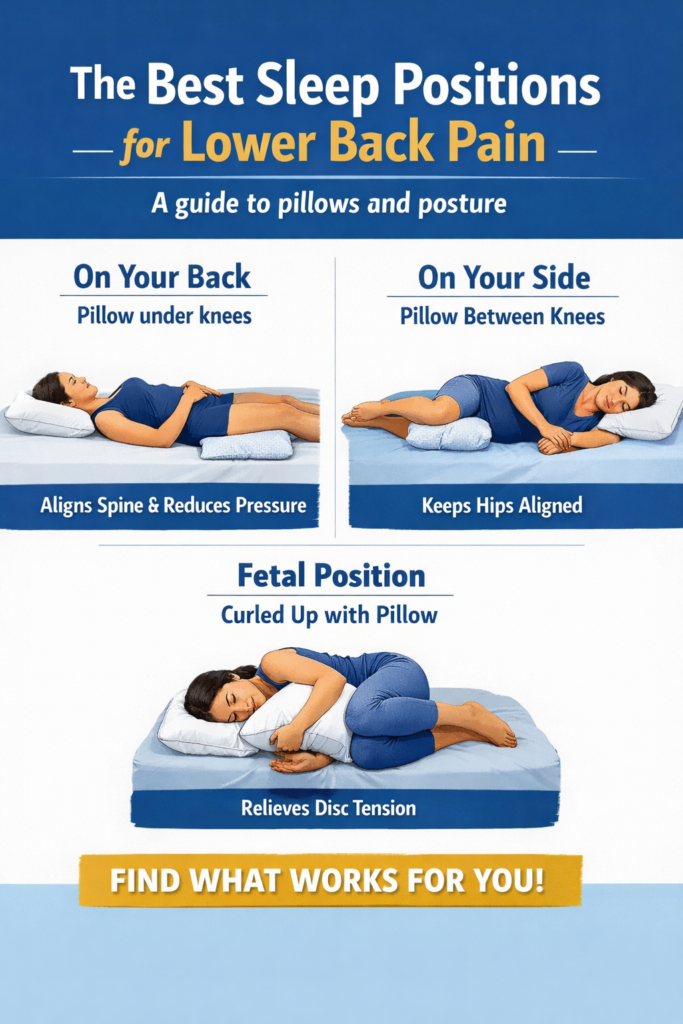
1. The Gold Standard: Side Sleeping with Knee Support
Side sleeping is the most popular position, but it comes with a hidden trap: pelvic rotation. When the top leg falls forward, it pulls on the hip, which twists the lower spine.
The Technique
The Position: Lie on your side with your knees slightly bent (the fetal position, but not tucked too tightly).
The Pillow Fix: Place a firm pillow between your knees.
Why it Works
The pillow keeps your hips, pelvis, and spine in better alignment. By keeping the knees separated, you prevent the top leg from rotating your spine during the night.
Pro Tip: If there is a gap between your waist and the mattress, tuck a small, rolled-up towel there for extra lumbar support.
2. The Back Sleeper’s Savior: The Under-Knee Bolster
Sleeping on your back is often recommended by doctors because it distributes weight evenly. However, it can cause the lower back to arch excessively (hyperextension), especially if you have tight hip flexors.
The Technique
The Position: Lie flat on your back, facing the ceiling.
The Pillow Fix: Place a bolster or two plush pillows under your knees.
Why it Works
Elevating the knees flattens the lumbar spine against the mattress, reducing the “hollow” in your back. This takes the pressure off the facet joints in your spine and allows the muscles to fully relax.
3. The "Stomach Sleeper" Survival Guide
Generally, physical therapists advise against stomach sleeping. It forces the neck to turn at a 90-degree angle and encourages the lower back to sag toward the mattress. But habits are hard to break. If you must sleep on your stomach, you need to mitigate the damage.
The Technique
-
The Position: Face down.
-
The Pillow Fix: Place a flat pillow under your pelvis and lower abdomen.
-
The Head Hack: Use a very thin pillow for your head, or no pillow at all.
Why it Works
The pelvic pillow lifts the hips, preventing the “swayback” effect that crushes the lower vertebrae together. Keeping the head flat reduces the strain on the upper spine.
The Role of the Mattress
You can have the best pillow strategy in the world, but if you’re sleeping on a 15-year-old “marshmallow” mattress, your back will suffer.
Medium-Firm is King: Research suggests that medium-firm mattresses are generally best for chronic lower back pain. They provide enough “give” for the shoulders and hips while supporting the lumbar region.
The Plywood Test: If your mattress is too soft and you can’t afford a new one, try placing a piece of plywood between the mattress and the box spring for temporary firmness.
Morning Rituals: How to Get Out of Bed
Believe it or not, many back injuries happen in the first 30 seconds of the day. Your discs are extra hydrated and “plump” in the morning, making them more sensitive to sudden movements.
The Log Roll: Instead of “sitting up” like a crunch, roll onto your side.
The Lever: Use your arms to push your upper body up while simultaneously swinging your legs off the side of the bed.
The Stretch: Once standing, do a gentle “cat-cow” or a standing chest stretch to open up the body.