
We are living in an era where the “Century Mark” is no longer a statistical anomaly; it is a burgeoning demographic. However, there is a massive difference between lifespan (how long you live) and healthspan (how long you live well).
If you plan on being a centenarian, your primary objective isn’t just heart health or cognitive sharpness—it’s the integrity of your “chassis.” Your spine is the central pillar of your nervous system and the literal backbone of your independence. Without a mobile spine, the world shrinks.
1. The Architecture of Longevity: Understanding the "Wear and Tear" Myth
The most common misconception about the spine is that it has a “mileage limit.” We often treat our backs like car tires—thinking that if we use them too much, they’ll bald and pop.
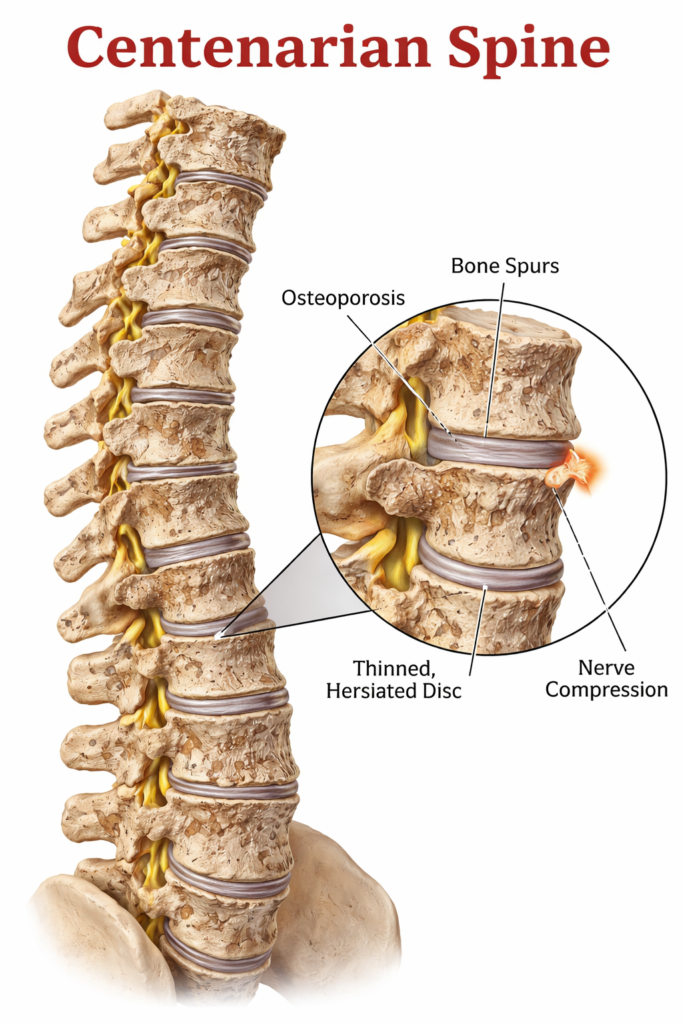
In reality, the spine is more like a biological machine that self-optimizes through stress. The “wear and tear” we see in 80-year-olds is often actually “rust from disuse.” The intervertebral discs—the shock absorbers between your vertebrae—do not have a direct blood supply. They rely on a process called imbibition, which is essentially a sponge-like mechanism where movement pumps nutrients in and waste out.
2. The Three Pillars of Spinal Youth
To maintain a 100-year spine, you must address three specific mechanical areas: Thoracic Extension, Hip Dissociation, and Deep Core Pressurization.
Pillar I: Thoracic Extension (Fighting the “C” Curve)
As we age, gravity wants to pull us into a fetal position. This “hyper-kyphosis” (the hunchback look) isn’t just an aesthetic issue; it restricts lung capacity and increases the risk of falls.
The Goal: Maintain the ability to open the chest and extend the upper back.
The Practice: Use a foam roller daily. Position it horizontally across your mid-back and gently lean back over it, supporting your neck. This reverses the “tech-neck” posture we adopt over screens.
Pillar II: Hip Dissociation
A “bad back” is often actually a “frozen hip” problem. If your hips cannot rotate or hinge, your lower back (lumbar spine) is forced to do the movement for them. The lumbar spine is designed for stability, not massive rotation.
The Goal: Keep the ball-and-socket joints of the hips greased.
The Practice: Incorporate 90/90 hip switches and deep bodyweight squats. If you can sit on the floor and get back up without using your hands at age 70, you are statistically much more likely to hit 90.
Pillar III: Intra-Abdominal Pressure (IAP)
Your spine isn’t held up by bones alone; it’s held up by a pressurized canister of muscle. This is your “inner weight belt.”
The Goal: Move beyond “six-pack” muscles and train the Transverse Abdominis (the deep corset).
The Practice: Master the Dead Bug exercise. It teaches you how to move your limbs while keeping your spine perfectly neutral and pressurized.
3. The "Micro-Dosing" Movement Strategy
The greatest enemy of the spine is the Sedentary Death Spiral. Sitting for 8 hours and then hitting the gym for 1 hour does not undo the damage. The spine thrives on frequency.
The 30/2 Rule
For every 30 minutes you spend sitting, you owe your spine 2 minutes of “movement snacks.”
Standing Cat-Cow: Arch and round your back while standing.
Bruegger’s Relief Position: Sit at the edge of your chair, spread your knees, turn your palms out, and squeeze your shoulder blades together.
Neck Retractions: Gently tuck your chin (creating a double chin) to reset the cervical spine.
4. Nutrition and Hydration: Feeding the Discs
Your discs are roughly 80% water at birth. By the time many people reach age 70, that percentage drops significantly, leading to “degenerative disc disease.”
Hydration: Water is the lubricant of the spine. If you are chronically dehydrated, your discs lose height, which puts more pressure on the facet joints of the spine, leading to arthritis.
Collagen and Vitamin C: The spinal ligaments are made of collagen. Supplementing with high-quality collagen peptides and ensuring adequate Vitamin C intake (a co-factor for collagen synthesis) helps maintain the “snap” in your spinal tissues.
Anti-Inflammatory Protocol: Systemic inflammation makes joint pain worse. A diet rich in Omega-3 fatty acids (found in fatty fish) acts like an internal “grease” for spinal inflammation.
5. The Psychological Component: The "Fear-Avoidance" Trap
Perhaps the most dangerous thing for a 100-year spine isn’t an injury—it’s the fear of injury.
When people experience a “twinge” in their back, they often stop moving altogether. This leads to muscle atrophy, which leads to more instability, which leads to more pain. This is the Fear-Avoidance Cycle.
To reach 100, you must develop a resilient mindset. Understand that back pain is a part of the human experience, like a headache or a cold. It is rarely a sign of “damage” and usually a sign of “sensitivity.”