
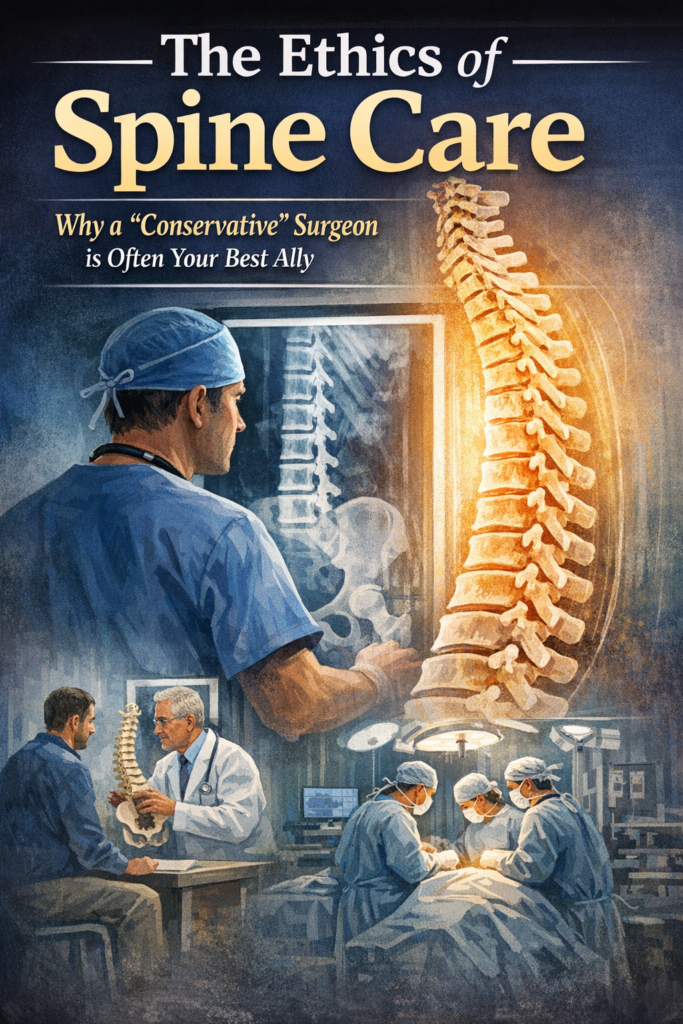
The word “surgeon” usually conjures a specific image: a highly skilled professional in scrubs, scalpel in hand, ready to fix a problem through direct intervention. We tend to associate surgical expertise with the act of operating.
However, in the complex world of spine health, the most profound expertise often lies in knowing when not to operate. This philosophy defines the “conservative” surgeon—a specialist who views surgery as a final resort rather than a first response.
Choosing a surgeon who is hesitant to rush you into the OR isn’t a sign of indecision; it is often the highest expression of medical ethics and patient advocacy. Here’s why a conservative approach is your greatest asset when your back is against the wall (literally).
1. The Reality of Spinal Anatomy
The human spine is a masterpiece of biological engineering, but it is also incredibly sensitive. It is a stack of 24 movable bones (vertebrae), cushioned by intervertebral discs and threaded with a delicate “electrical cord” of nerves—the spinal cord.
Because the spine is the central highway for your nervous system, any surgical entry involves navigating past muscles, ligaments, and nerves. A conservative surgeon respects this complexity. They understand that while surgery can “fix” a structural issue like a herniated disc, the process itself creates scar tissue and alters the natural biomechanics of your back.
The Golden Rule of Spine Surgery
Surgery should only be performed when the risk of the condition exceeds the risk of the procedure.
In many cases, the body has a remarkable ability to heal itself. For instance, many disc herniations naturally resorb (shrink) over time through the body’s inflammatory response. A conservative surgeon gives your body the window it needs to do its own work.
2. Navigating the "Placebo" of the MRI
One of the biggest ethical challenges in modern spine care is the over-reliance on imaging. If you take 100 people off the street who have zero back pain and give them an MRI, a significant percentage will show “bulging discs,” “degenerative changes,” or “arthritis.” As we age, these findings are as normal as gray hair or wrinkles—they are signs of life, not necessarily signs of disease.
The Aggressive Approach: Sees a “spot” on an MRI and offers to “fix” it.
The Conservative Approach: Treats the patient, not the image.
A conservative surgeon will spend more time testing your reflexes and listening to your pain patterns than looking at a black-and-white scan. They want to ensure that your symptoms actually match the image before suggesting an invasive fix.
3. The Hierarchy of Conservative Care
A surgeon committed to ethical care will guide you through a “stepped” approach. Before discussing a fusion or a laminectomy, they will likely exhaust these options:
If a surgeon skips these steps without a clear emergency (like progressive neurological loss), it’s a red flag.
4. Avoiding "Adjacent Segment Disease"
One of the most significant risks in spine surgery, particularly spinal fusions, is something called Adjacent Segment Disease (ASD).
When two vertebrae are fused together, they stop moving. This is great for stability, but that lost motion has to go somewhere. The segments directly above and below the fusion now have to work twice as hard to compensate. Over time, this leads to rapid wear and tear on those neighboring discs, often leading to more surgery down the road.
An ethically-minded conservative surgeon understands the “domino effect” of spine surgery. They strive to preserve as much natural motion as possible to protect your future health, not just your immediate comfort.
5. When Surgery Is the Conservative Choice
It sounds like a paradox, but sometimes the most “conservative” thing a surgeon can do is operate quickly. An ethical surgeon knows how to spot the “red flags” where waiting could lead to permanent damage:
Cauda Equina Syndrome: Loss of bowel/bladder control (a surgical emergency).
Progressive Weakness: If you can’t “foot drop” or are losing grip strength, waiting could mean the nerve dies.
Myelopathy: Compression of the spinal cord itself, leading to balance issues and coordination loss.
The Surgeon-Patient Partnership
At the end of the day, spine care is about quality of life. A surgeon who says, “Let’s wait six weeks and see how you feel after PT,” isn’t brushing you off. They are protecting you from the risks of anesthesia, infection, and failed back surgery syndrome. They are acting as a gatekeeper for your long-term mobility.
The hallmark of a great spine surgeon isn’t how fast they operate—it’s how much they care about your life outside the operating room.