
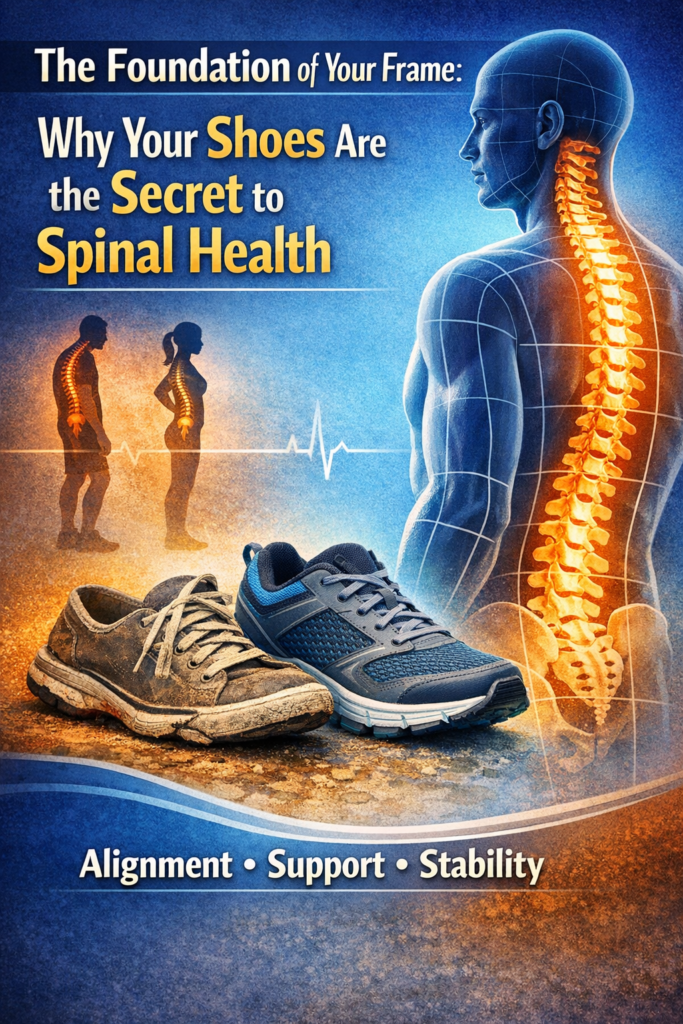
We often think of back pain as a “top-down” issue. We blame our heavy backpacks, our ergonomic (or lack thereof) office chairs, or that awkward twist we made while lifting a grocery bag. But in reality, spinal health is a “bottom-up” phenomenon.
Your feet are the foundation of your entire skeletal structure. When that foundation is tilted, unstable, or poorly cushioned, the repercussions travel upward through your ankles, knees, and hips, ultimately settling in your spine. Choosing the right shoe isn’t just about fashion or preventing blisters; it’s about maintaining the delicate $S$-curve of your back.
1. The Kinetic Chain: From Pavement to Posture
To understand how a shoe affects your neck, you have to understand the Kinetic Chain. In biomechanics, the body is viewed as a system of linked segments.
When your foot strikes the ground, it sends a shockwave up this chain. A healthy foot acts as a natural shock absorber through a process called pronation (the slight inward roll of the foot).
If your shoes don’t support this movement correctly, the chain reacts:
Overpronation: Your foot rolls too far inward, causing the lower leg to rotate internally. This tilts the pelvis forward (anterior pelvic tilt), increasing the curve in your lower back (lumbar lordosis).
Supination: Your foot doesn’t roll inward enough, failing to absorb shock. That impact travels directly into your vertebrae, leading to compressed discs and joint fatigue.
2. The High Heel Hazard: A Spinal Architect’s Nightmare
It’s no secret that high heels aren’t “comfortable,” but the physiological damage goes deeper than sore toes.
When you wear heels, your center of gravity is pushed forward. To keep from falling on your face, your body compensates by leaning the upper body backward. This creates an unnatural arch in the lower back and puts immense pressure on the facet joints of the spine.
The Math of the Heel
Even a modest 2-inch heel can increase the pressure on the forefoot by up to 75%. This shift forces the calf muscles to shorten and the hip flexors to tighten. Over time, this “postural compensation” can lead to:
Spondylolisthesis: The slipping of one vertebra over another.
Foraminal Stenosis: A narrowing of the spaces where nerves exit the spine, causing shooting pain or numbness.
3. The Flat Shoe Fallacy
If heels are the villain, are flat shoes the hero? Not necessarily.
Cheap flip-flops and ultra-flat ballet flats often provide zero arch support. Without support, the plantar fascia (the tissue along the bottom of your foot) stretches and collapses. This collapse causes the “knock-knee” effect, which pulls on the psoas muscle.
The psoas is the only muscle that connects your spine to your legs. When it’s constantly strained by flat footwear, it pulls on the lumbar vertebrae, leading to chronic lower back tightness.
4. What to Look For: The Anatomy of a Spine-Friendly Shoe
When shopping for your next pair of shoes, look past the brand name and evaluate these four critical components:
A. Arch Support
The “medial longitudinal arch” is your body’s primary spring. A good shoe should fill the gap under your arch to prevent it from collapsing.
Test: If you can press down on the inside of the shoe’s sole and it collapses easily, it won’t support your spine.
B. Heel Contouring (The Heel Counter)
The “heel counter” is the stiff cup at the back of the shoe. It stabilizes the heel bone (calcaneus). If your heel slides around, your gait becomes unstable, forcing your core and back muscles to overwork just to keep you upright.
C. Sole Flexibility
A shoe should be firm in the midfoot but flexible at the metatarsophalangeal joints (where your toes bend). If a shoe bends in the middle of the arch, it’s a recipe for plantar fasciitis and subsequent back pain.
D. Cushioning vs. Stability
There is a sweet spot between a cloud-like marshmallow sole and a concrete slab. Too much cushion can actually destabilize the foot (like walking on a mattress), while too little fails to protect your discs from hard surfaces.
5. The Role of Orthotics
Sometimes, even the best off-the-rack shoe isn’t enough. If you have structural issues like scoliosis or significant leg-length inequality, custom orthotics can be a game-changer.
Orthotics act as a corrective wedge, re-aligning the “foundation” so the spine can sit in its neutral position. Think of it like shimming a table leg to keep the surface level.
6. Practical Tips for Healthy Feet and a Happy Back
Shop in the Afternoon: Your feet swell throughout the day. A shoe that fits at 9:00 AM might be too tight by 5:00 PM, altering your gait.
Measure Both Feet: Most people have one foot slightly larger than the other. Always fit the shoe to the larger foot.
The “Rule of Thumb”: Ensure there is about a half-inch (a thumb’s width) between your longest toe and the end of the shoe.
Replace Regularly: Most athletic shoes lose their structural integrity after 300–500 miles. Even if they look clean, the internal foam may have collapsed, leaving your spine unprotected.