
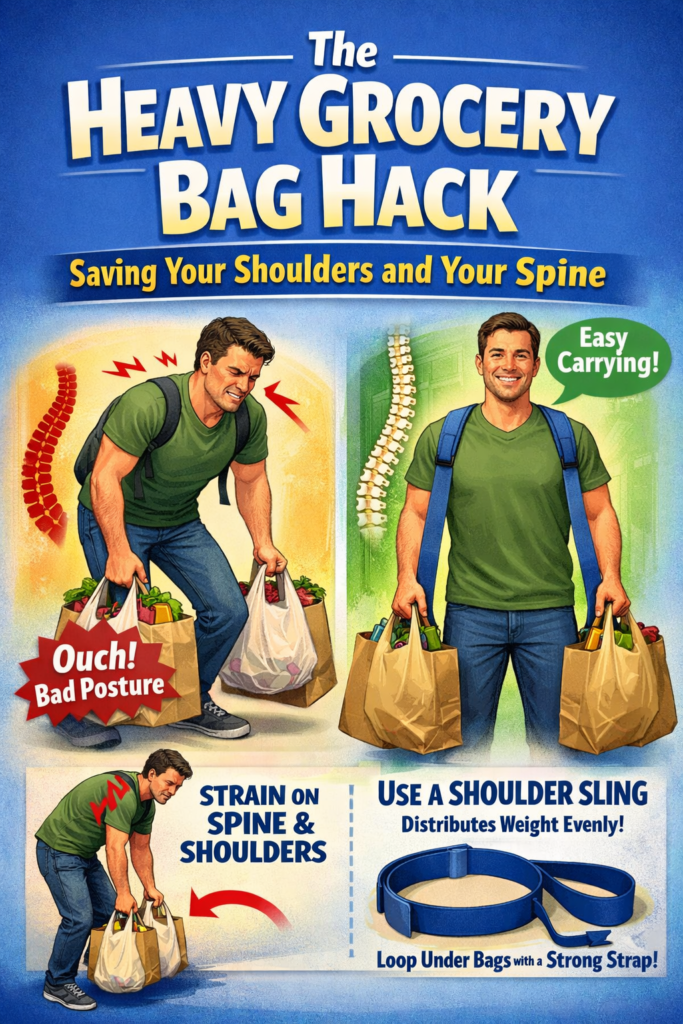
We’ve all been there. You’re standing at the trunk of your car, staring down ten plastic bags filled with everything from organic kale to a four-pack of almond milk. You have two choices: make three trips like a “reasonable person,” or load every single loop onto your forearms and make a desperate, vein-popping dash for the front door.
Most of us choose the latter. We call it the “One-Trip Challenge.” But while your ego might feel boosted as you kick the door shut behind you, your shoulders, neck, and lower back are screaming for a ceasefire.
The way we carry groceries isn’t just a minor daily inconvenience; it’s a biomechanical disaster waiting to happen. However, with a bit of physics and some strategic “hacking,” you can transform the way you move weight. Here is the ultimate guide to mastering the heavy grocery bag hack.
1. The Anatomy of the Struggle: Why Your Shoulders Hurt
Before we fix the problem, we have to understand why “just carrying bags” feels so draining. When you carry heavy loads in your hands with your arms hanging at your sides, several things happen:
Scapular Depression: The weight pulls your shoulder blades down and forward, overstretching the trapezius muscles.
Nerve Compression: The “brachial plexus”—a bundle of nerves running from your neck to your arm—can get compressed, leading to that tingling “pins and needles” feeling.
Grip Fatigue: Your forearm muscles are small. When they give out, you compensate by shrugging your shoulders, which leads to tension headaches.
2. The Golden Rule: The 50/50 Split
The biggest mistake people make is asymmetry. Carrying 15 lbs in your right hand and nothing in your left forces your spine to tilt. Your core muscles on the opposite side have to fire like crazy just to keep you upright.
The Hack: Always ask for an even number of bags, or split your heavy items (liquids, canned goods) between two bags of equal weight. By balancing the load, you create a “human scale.” The downward force on the right cancels out the tipping force on the left, allowing your spine to remain neutral.
3. The "Carabiner" Method: A Game Changer
If you have a long walk from the parking garage or the bus stop, your fingers are your weakest link. Plastic and thin fabric handles cut into the skin, restricting blood flow.
The Hack: Keep two large, cushioned climbing carabiners or specialized grocery grips in your car or reusable bag.
Clip 3–4 bags onto one carabiner.
Hold the carabiner handle rather than the bag loops.
This distributes the pressure across your entire palm rather than focusing it on the joints of your fingers.
4. The Physics of the "High Carry" vs. "Low Hang"
Physics tells us that the further a weight is from your center of gravity, the heavier it feels. This is known as torque.
The Elbow Hook
For mid-weight bags, don’t let them hang at the ends of your fingers. Instead, slide the handles up past your wrist to the crook of your elbow.
Why it works: It brings the weight closer to your torso and utilizes the strength of your biceps and skeletal structure rather than just your grip.
Caution: Don’t do this with extremely heavy bags, as it can strain the tendons in the elbow.
The "Hug" Technique
If you have one or two incredibly heavy bags (like those 20 lb bags of rice or cat litter), stop trying to carry them by the handles. Hug them to your chest. By keeping the mass centered over your midsection, you engage your core and legs rather than putting the entire strain on your rotator cuffs.
5. Strategic Bagging: The "Foundation" Strategy
A successful carry starts at the checkout counter. If you bag your items haphazardly, you’ll end up with “leakers” and “crushers” that force you to hold bags at awkward angles to prevent damage.
| Item Type | Placement | Strategy |
| Heavy (Milk, Cans) | Bottom Center | Creates a stable base and keeps the bag from swinging. |
| Medium (Boxes, Jars) | Mid-Layer | Stabilizes the heavy items. |
| Light/Fragile (Bread, Eggs) | Top | Prevents crushing and keeps the center of gravity low. |
6. The "Core" Secret: Engagement
Even with the best hack, your shoulders will suffer if your core is “off.” When carrying groceries, imagine pulling your belly button slightly toward your spine. This creates intra-abdominal pressure, which acts like a natural weightlifting belt, protecting your lower back and giving your shoulders a stable platform to rest on.
7. The Post-Carry Recovery
Once the groceries are on the counter, don’t just collapse onto the couch. Your muscles have been in a “shortened” state.
-
Doorway Stretch: Place your forearms on a door frame and lean forward to open up the chest muscles that were pulled forward.
-
Shoulder Rolls: Roll your shoulders up, back, and down five times to reset the scapula.
-
Hydrate: Carrying heavy loads is a mini-workout. Drink water to help flush out the lactic acid built up from the isometric hold.