
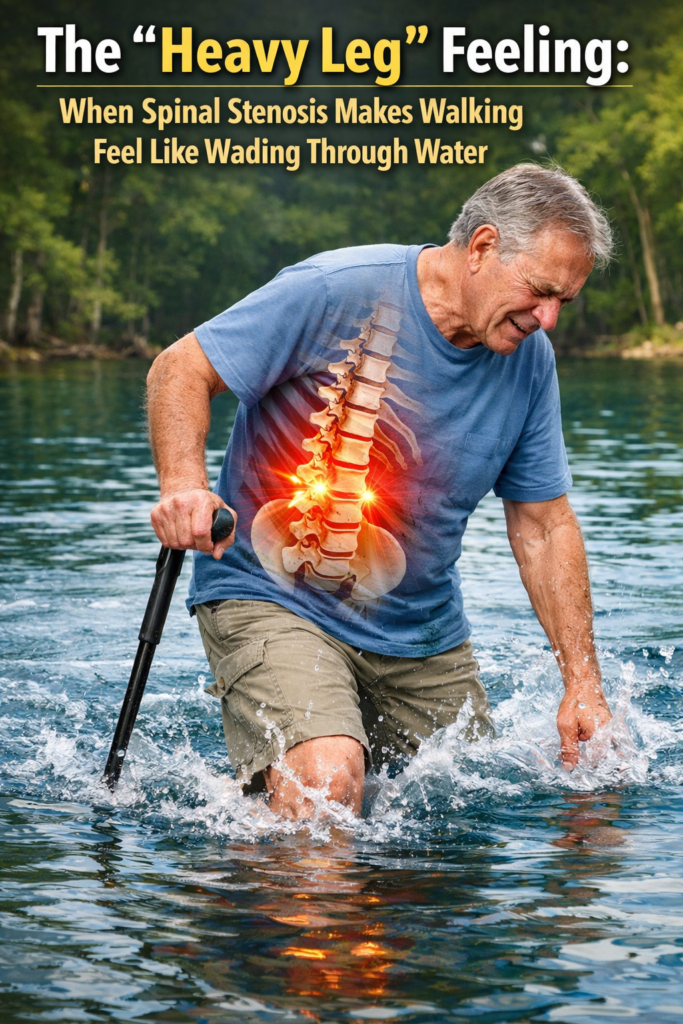
We’ve all had those dreams—the ones where you’re trying to run away from something, but your legs feel like they’re made of lead. You’re pumping your muscles with everything you’ve got, but you’re moving through a thick, invisible syrup.
For millions of people living with Lumbar Spinal Stenosis (LSS), that dream isn’t a nighttime fluke. It’s their Tuesday morning walk to the mailbox.
If you’ve started noticing that your legs feel inexplicably heavy, weak, or “clumsy” after just a few minutes of standing, you aren’t just getting tired. You’re likely experiencing a hallmark symptom of spinal compression. Let’s dive deep into why this happens, what it feels like, and—most importantly—how to get your stride back.
Understanding the Anatomy: The "Clogged Pipe" Analogy
To understand the heavy leg sensation, we have to look at the architecture of the lower back. Your spine is a marvelous feat of engineering, but it’s a tight squeeze in there.
The spinal cord and the nerve roots that branch off it live in a bony tunnel called the spinal canal. In a healthy spine, there is plenty of room for these nerves to “breathe” and receive blood flow. However, as we age, several things can happen:
-
Osteoarthritis can cause bone spurs (osteophytes) to grow into the canal.
Ligaments(specifically the ligamentum flavum) can thicken and buckle inward.
-
Discs can bulge or herniate, taking up precious real estate.
Spinal Stenosis is essentially the narrowing of this tunnel. Think of it like a pipe that has accumulated mineral deposits over decades. The water (the nerve signals) can still get through, but the pressure is higher, and the flow is restricted.
Why Does it Feel Like "Wading Through Water"?
The medical term for this heavy-legged, tired sensation is Neurogenic Claudication.
When you sit down, your spine flexes forward, opening up the spinal canal and giving the nerves space. But the moment you stand up and walk, your spine moves into “extension.” This naturally narrows the canal further.
As you walk, your leg muscles demand more oxygen and blood flow. However, because the nerves are being pinched, the “electrical signals” from your brain to your legs become garbled and sluggish. At the same time, the blood vessels that nourish those nerves are compressed.
The result? Your brain interprets this lack of efficiency as heaviness.
Your feet feel like they are “slapping” the ground.
Your thighs feel like they’ve just finished a marathon when you’ve only walked a block.
You feel an urgent need to lean forward over a grocery cart or sit down to “reset” the sensation.
The "Shopping Cart Sign": A Classic Clue
Doctors often ask patients if they feel better when leaning over a shopping cart. If the answer is a resounding “Yes!”, it’s a classic indicator of spinal stenosis.
By leaning forward, you are physically opening the space in your lower back. This tiny bit of extra room—sometimes just a few millimeters—is enough to restore blood flow to the nerves and lift that “lead-weight” feeling from your calves and thighs.
Beyond the Heaviness: Other Symptoms to Watch For
While the “wading through water” feeling is the most descriptive symptom, LSS rarely travels alone. You might also experience:
Numbness and Tingling: That “pins and needles” feeling that starts in the buttocks and radiates down to the feet.
Sciatica: A sharp, shooting pain that follows the path of the sciatic nerve.
Cramping: Specifically nocturnal leg cramps or cramping that occurs only when standing.
Balance Issues: Because your brain isn’t getting clear feedback from your feet, you might feel unsteady or prone to tripping.
Management and Treatment: Lightening the Load
The good news? A diagnosis of spinal stenosis doesn’t mean you’re destined for a wheelchair. There is a spectrum of care designed to reduce that heavy sensation and improve your mobility.
1. Physical Therapy: The Foundation
A physical therapist can teach you “flexion-biased” exercises. The goal isn’t just to get stronger, but to strengthen the core muscles that help keep your spine in a more “open” position. Strengthening the abdominal muscles can help prevent the excessive arching of the back that triggers the heaviness.
2. Activity Modification
This isn’t about doing less; it’s about doing things differently.
Cycling instead of walking: Lean-forward positions (like on a stationary bike) are usually much better tolerated than walking on a treadmill.
Aquatic Therapy: The buoyancy of water takes the pressure off the spine while allowing you to strengthen your legs. (The irony: walking in actual water helps you stop feeling like you’re walking in water!)
3. Medications and Injections
Anti-inflammatories can help reduce the swelling around the nerves. In some cases, an epidural steroid injection can provide a “window of relief” by calming the inflammation inside the spinal canal, allowing you to progress in physical therapy.
4. Minimally Invasive Procedures
If conservative measures fail, modern medicine offers “gap-filler” treatments. Procedures like the MILD (Minimally Invasive Lumbar Decompression) or the insertion of an interspinous spacer (a tiny device that keeps the vertebrae separated) can provide significant relief without the recovery time of major surgery.
5. Decompression Surgery
In more advanced cases, a laminectomy—where a small piece of the bone is removed to “unroof” the spinal canal—can provide the nerves with the permanent space they need.
When to See a Doctor Immediately
While the “heavy leg” feeling is frustrating, it is usually a chronic, slow-moving condition. However, there are “Red Flags” that require immediate medical attention:
Sudden loss of bowel or bladder control.
“Saddle anesthesia” (numbness in the areas that would touch a horse saddle).
Sudden, profound weakness where you cannot lift your foot (foot drop).
These can be signs of Cauda Equina Syndrome, a rare but serious surgical emergency.