
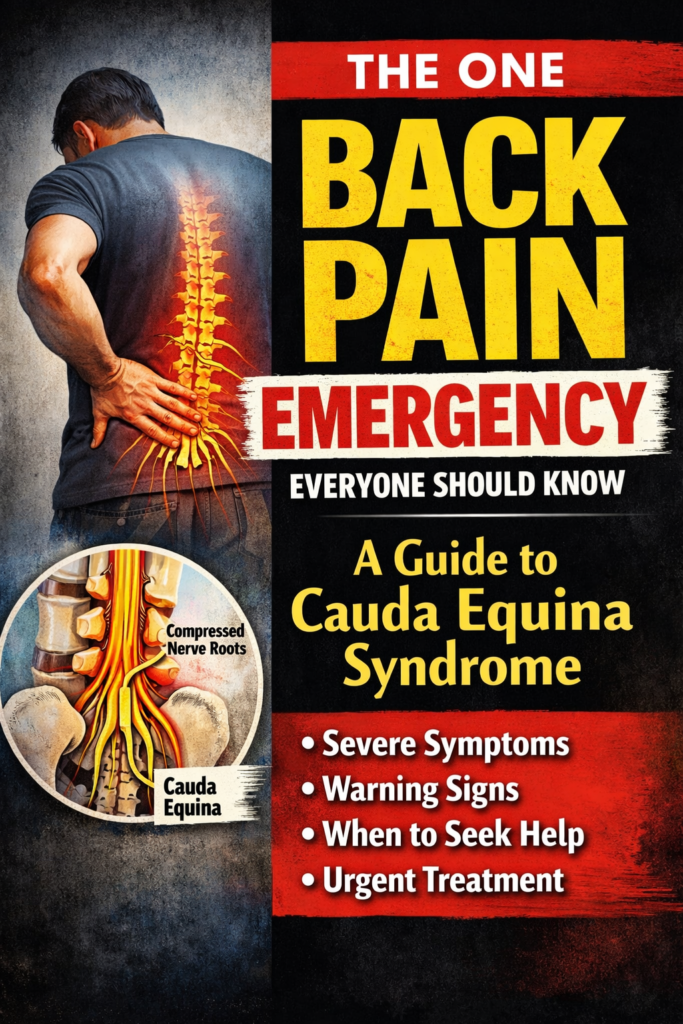
Most of us have experienced back pain at some point. Usually, it’s a dull ache from sitting too long or a sharp twinge from lifting a grocery bag the wrong way. We pop an ibuprofen, grab a heating pad, and wait for it to pass.
But there is one specific type of back pain that doesn’t just require a rest day—it requires an immediate trip to the emergency room. It’s called Cauda Equina Syndrome (CES).
While rare, CES is a true surgical emergency. If caught early, patients can recover fully. If ignored, it can lead to permanent paralysis, loss of bladder control, and sexual dysfunction. Here is everything you need to know about the red flags you can’t afford to miss.
What Exactly is the "Cauda Equina"?
To understand the syndrome, you have to understand the anatomy. Your spinal cord doesn’t actually run the full length of your back. It typically ends around the upper lumbar spine (the small of your back).
From that point downward, the nerve roots continue through the spinal canal in a bundle. Because this bundle looks remarkably like a horse’s tail, early anatomists named it the Cauda Equina (Latin for “horse’s tail”).
These nerves are responsible for:
Sending messages to your legs and feet.
Controlling your bladder and bowel functions.
Providing sensation to your “saddle area” (the parts of your body that would touch a horse’s saddle).
Cauda Equina Syndrome occurs when something—usually a massive herniated disc—compresses these nerve roots so severely that they stop functioning.
The "Red Flags": Symptoms You Should Never Ignore
CES is often misdiagnosed in its early stages because it starts with “normal” back pain. However, as the compression worsens, specific neurological symptoms appear. Doctors refer to these as Red Flags.
1. Saddle Anesthesia
This is perhaps the most classic sign of CES. It refers to a loss of sensation (numbness or “pins and needles”) in the areas that would touch a saddle: the groin, buttocks, inner thighs, and perineum. If you wipe after using the bathroom and can’t feel the toilet paper, that is a major warning sign.
2. Recent Bladder or Bowel Dysfunction
We aren’t talking about a simple UTI or constipation. We are looking for:
Incontinence: Losing control of your bladder or bowels.
Retention: Feeling like your bladder is full but being unable to “go.”
Loss of Sensation: Not being able to feel when your bladder is full.
3. "Sciatica" in Both Legs
While typical sciatica usually affects one leg, CES often involves bilateral symptoms. This includes radiating pain, numbness, or weakness in both legs simultaneously.
4. Sudden Sexual Dysfunction
A sudden inability to achieve an erection or a total loss of sensation during intercourse can indicate that the nerves in the cauda equina are being crushed.
5. Motor Weakness (The "Foot Drop")
If you suddenly find yourself tripping over your own feet or unable to stand on your heels or toes, your motor nerves are being compromised.
What Causes the Compression?
While a variety of issues can trigger CES, the most common culprit is a massive lumbar disc herniation.
Imagine your spinal discs as jelly donuts. If the “jelly” (the nucleus pulposus) leaks out significantly, it can fill the spinal canal and put immense pressure on the nerve bundle. Other causes include:
Spinal Stenosis: A narrowing of the spinal canal.
Trauma: A fall, car accident, or gunshot wound.
Tumors: Malignant or benign growths pressing on the nerves.
Infections: An abscess in the spinal canal.
The Clock is Ticking: Why Speed Matters
In the world of spinal surgery, there is a concept known as the “Golden Window.” Most surgeons agree that for the best chance of recovering bladder and leg function, surgery should ideally happen within 24 to 48 hours of the onset of acute symptoms. Once those nerves have been crushed for too long, the damage becomes irreversible.
Diagnosis and Treatment
If you show up at the ER with these symptoms, the medical team will perform a physical exam, focusing on your muscle strength and reflexes. They will likely perform a Digital Rectal Exam (DRE) to check for anal muscle tone—a key indicator of nerve function.
The “Gold Standard” for diagnosis is an MRI. This allows doctors to see exactly what is pressing on the nerves and how much space is left in the canal.
The Treatment: Decompression
If CES is confirmed, the only treatment is emergency surgery, usually a laminectomy or discectomy. The surgeon removes whatever is pressing on the nerves (the disc material, bone, or tumor) to give the “horse’s tail” room to breathe again.