
If you’ve ever watched a parent struggle to stand up straight after an afternoon of gardening, or heard a sibling complain about a “thrown-out back” for the third time this year, you’ve probably wondered: Is this my future?
Back pain is one of the most common human ailments, affecting roughly 80% of adults at some point in their lives. While we often blame heavy lifting, poor desk ergonomics, or “just getting old,” science is increasingly looking at the blueprint we were born with.
So, did you truly inherit your bad back, or is it just a byproduct of your lifestyle? Let’s dive into the complex world of spinal genetics.
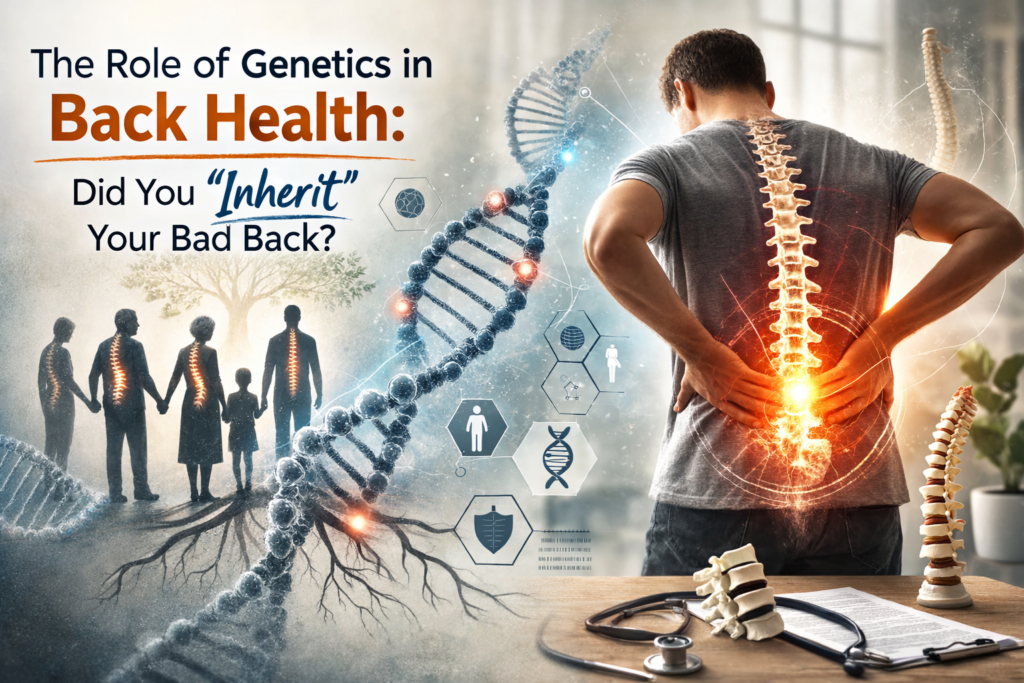
1. The Genetic Blueprint of the Spine
Your spine is a mechanical masterpiece, composed of 33 vertebrae, cushioned by intervertebral discs, and supported by a complex web of ligaments and muscles. This structure isn’t just a random assembly; it is built according to instructions found in your DNA.
Research suggests that heritability—the proportion of variation in a trait due to genes—plays a significant role in several spinal conditions. While there isn’t a single “back pain gene,” hundreds of small genetic variations can influence the structural integrity of your spine.
The Breakdown of Genetic Influence
Disc Composition: Genes dictate the production of collagen and proteoglycans, the “stuffing” that keeps your spinal discs hydrated and bouncy.
Bone Density: Your risk for osteoporosis and vertebral fractures is heavily influenced by parental history.
Inflammatory Response: Some people are genetically predisposed to higher levels of systemic inflammation, which can exacerbate nerve pain and joint wear.
2. Degenerative Disc Disease (DDD): The Family Connection
For a long time, doctors believed that Degenerative Disc Disease was purely “wear and tear”—the result of a hard life or physical labor. However, the famous “Twin Spine Study” changed everything.
By comparing identical twins (who share 100% of their DNA) with fraternal twins, researchers found that physical loading and lifestyle factors accounted for surprisingly little of the difference in disc degeneration. Instead, genetics accounted for up to 75% of the variation in disc degeneration in the lumbar spine.
How Genes Affect Your Discs
If you have a family history of “slipped” or herniated discs, you may have inherited specific variations in the COL9A2 or COL11A2 genes. These genes are responsible for the strength of the collagen fibers in your discs. If these fibers are weaker, the disc is more prone to dehydrating, thinning, and eventually bulging or rupturing under normal daily pressure.
3. Structural Conditions with a Genetic Link
Beyond the discs, several structural “quirks” of the spine are known to run in families.
Scoliosis
Adolescent Idiopathic Scoliosis (AIS) is the most common form of spinal curvature. While the exact cause remains “idiopathic” (unknown), it is well-documented that it clusters in families. If a parent has scoliosis, their children are significantly more likely to develop it, leading researchers to believe that multiple genes involved in bone growth and estrogen metabolism are at play.
Ankylosing Spondylitis (AS)
This is perhaps the clearest example of “inheriting” a bad back. AS is an inflammatory arthritis that can cause the vertebrae to fuse over time. A specific genetic marker, HLA-B27, is found in the vast majority of people with this condition. While having the marker doesn’t guarantee you’ll get the disease, it drastically increases the risk.
4. The "Nature vs. Nurture" Tug-of-War
Before you call your parents to complain about your “faulty” DNA, it’s important to understand Epigenetics. This is the study of how your behaviors and environment can cause changes that affect the way your genes work.
Think of your DNA as a piano. Your parents gave you the instrument (the hardware), but you are the one playing the music (the lifestyle). You might have inherited a “piano” with a few sticky keys, but with the right technique, you can still play a beautiful song without much noise.
Factors That "Turn On" Bad Genes:
Smoking: Nicotine constricts blood vessels, starving spinal discs of the nutrients they need to repair themselves. This accelerates any genetic predisposition to DDD.
Obesity: Excess weight puts mechanical stress on a spine that might already be structurally vulnerable.
Sedentary Behavior: “Sitting is the new smoking.” Without movement, the muscles supporting your “inherited” spine weaken, leaving the bones and discs to take all the heat.
5. Can You Outrun Your DNA?
If your family tree is full of people with chronic back issues, you aren’t doomed to the same fate. You simply have a lower margin for error.
Proactive Strategies for the Genetically Prone
Core Stability: If your spinal “hardware” is weak, you must over-invest in your “software” (the muscles). A strong transverse abdominis and multifidus act as a natural brace for the spine.
Weight Management: Keeping your BMI in a healthy range reduces the “load” on your lower back.
Ergonomic Awareness: If you know your discs are prone to thinning, be religious about your desk setup and lifting techniques.
Early Screening: If scoliosis or AS runs in your family, early intervention and physical therapy can prevent long-term deformity.
6. The Psychological Inheritance: Pain Perception
Interestingly, you might also inherit how you perceive and respond to pain. Some studies suggest that the way our brains process pain signals has a genetic component.
Furthermore, “pain behavior” is often learned. If you grew up in a household where back pain was treated as a catastrophic, life-ending event, you may be more likely to develop kinesiophobia (fear of movement), which ironically makes back pain worse by leading to muscle stiffness and atrophy.