
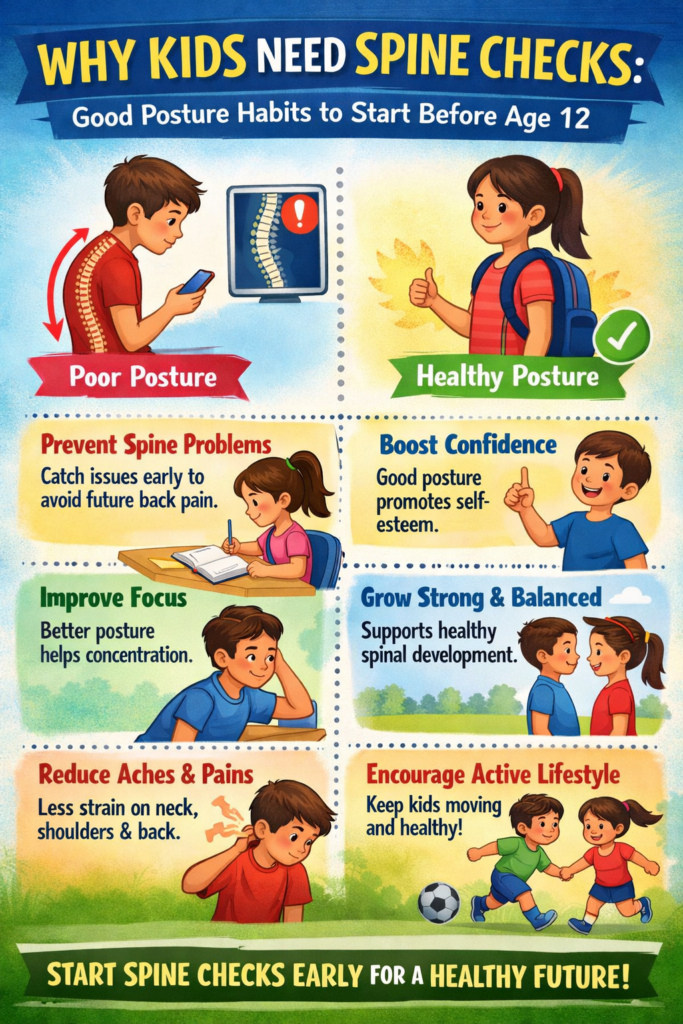
When we think about childhood health, our minds usually jump to vaccinations, dental checkups, and annual physicals. We track their height on the doorframe and their weight at the pediatrician’s office. However, there is a silent architect of your child’s health that often goes overlooked until a problem arises: the spine.
The period between birth and age 12 is the most critical window for spinal development. During these years, a child’s skeletal system is highly “plastic”—it is growing rapidly and is incredibly responsive to the physical stresses placed upon it.
As digital devices become permanent fixtures in children’s lives and heavy backpacks remain a school staple, the “bent-over” generation is facing spinal challenges earlier than ever before. This guide explores why spinal health is a pillar of childhood development and how you can instill habits before age 12 that will last a lifetime.
The Developing Spine: A Race Against Time
A child’s spine isn’t just a smaller version of an adult’s. At birth, a baby has a single C-shaped curve. As they learn to lift their head, crawl, and eventually walk, the secondary curves—the cervical (neck) and lumbar (lower back) curves—begin to develop.
By age 12, the spine begins to transition into its more permanent adult shape. This makes the pre-teen years a “golden window.” If we can encourage proper alignment and movement patterns now, we can prevent structural issues like scoliosis or hyper-kyphosis (slouching) from becoming permanent fixtures of their anatomy.
Why "Wait and See" is a Risky Strategy
Many parents believe that kids will simply “grow out” of bad posture. Unfortunately, the opposite is often true. Because the bones are still ossifying (hardening), the spine actually grows into the shapes we hold most often. If a child spends four hours a day hunched over a tablet, their vertebrae can actually begin to wedge into a forward-leaning shape. Early intervention via spine checks ensures that these minor functional shifts don’t become permanent structural deformities.
The Modern Threats to Childhood Spinal Health
The challenges facing a child’s spine in the 2020s are significantly different from those of previous generations.
1. "Tech Neck" and Digital Strain
The average head weighs about 10–12 pounds. However, when a child leans their head forward at a 60-degree angle to look at a phone or gaming console, the effective weight on the cervical spine jumps to nearly 60 pounds. Over time, this strain:
Stretches the ligaments in the back of the neck.
Flattens the natural curve of the neck.
Leads to “tension headaches” and irritability in children who may not know how to describe the discomfort.
2. The Backpack Burden
It is a common sight: a 70-pound child carrying a 20-pound backpack. Pediatric guidelines suggest a backpack should never exceed 10% to 15% of a child’s body weight. Heavy bags cause children to lean forward to compensate for the weight, straining the mid-back and compressing the spinal discs.
3. Sedentary "Couch Slumping"
Core strength is the “internal brace” for the spine. With the decline of unstructured outdoor play, many children lack the abdominal and back muscle strength required to hold their spine upright effortlessly. When the muscles tire, the child “hangs” on their ligaments, leading to a slumped posture.
What Happens During a Pediatric Spine Check?
A professional spine check is a non-invasive assessment designed to ensure the nervous system and the musculoskeletal frame are working in harmony. Here is what a typical screening looks like:
Postural Analysis: Looking for uneven shoulders, tilted hips, or a head that leans forward.
The Adam’s Forward Bend Test: A primary screen for scoliosis where the child leans forward to see if one side of the ribcage is higher than the other.
Gait Assessment: Watching how the child walks. Issues in the feet or knees often “telegraph” up into the spine.
Range of Motion: Ensuring the neck and back can move freely without restriction or pain.
These checks are vital because children are notoriously bad at reporting “dull aches.” They often assume everyone feels a little tight or sore, so they don’t speak up until the pain is acute.
5 Essential Posture Habits to Start Before Age 12
The goal isn’t to make your child sit like a statue. The goal is variability and alignment. Here are the habits that make the biggest difference:
1. The "Eyes Up" Rule for Tech
Instead of bringing the head to the device, bring the device to the eyes.
The Habit: Use a tablet stand or prop the device up on a stack of books. If using a phone, encourage them to lift their elbows so the screen is at eye level.
2. The Two-Strap Rule
It might not look “cool” to some middle-schoolers, but wearing a backpack on both shoulders is non-negotiable for spinal health.
The Habit: Always use both straps and tighten them so the bag sits snugly against the back, not sagging down toward the buttocks.
3. "Motion is Lotion" (The 20/20 Rule)
The spine thrives on movement. Disc health depends on the “pump” action of movement to bring in nutrients.
The Habit: For every 20 minutes of sitting or gaming, the child must get up and move for at least 20 seconds. A quick stretch or a lap around the room resets the postural muscles.
4. Dynamic Sitting
Encourage “active” sitting positions. Sitting cross-legged on the floor is often better for a child’s hip and lower back development than slouching in a soft, deep sofa.
The Habit: If they are doing homework, ensure their chair allows their feet to touch the floor (or a footrest) and their knees to be at a 90-degree angle.
5. Strengthening the "Power House"
The core muscles (abdominals, obliques, and back extensors) are the body’s natural corset.
-
The Habit: Engage in “spinal-friendly” play. Climbing on monkey bars, swimming, and gymnastics are fantastic for developing the upper body strength needed to maintain an upright posture.