
We’ve all seen it: the “Costanza Wallet.” It’s that overstuffed, leather-bound brick bulging out of a back pocket, filled with three-year-old receipts, expired coupons, and every loyalty card imaginable. While a thick wallet might feel like a badge of preparedness, your spine and hips see it as a structural hazard.
If you’ve been dealing with nagging lower back pain, a tingling sensation down your leg, or a dull ache in your hip, the culprit might not be your age or your gym routine. It might be that slab of leather you’re sitting on for hours a day. In the world of physical therapy, we call this “Wallet Sciatica” (or Hip-Pocket Syndrome). Here is why your wallet is a recipe for chronic pain and how to fix it.
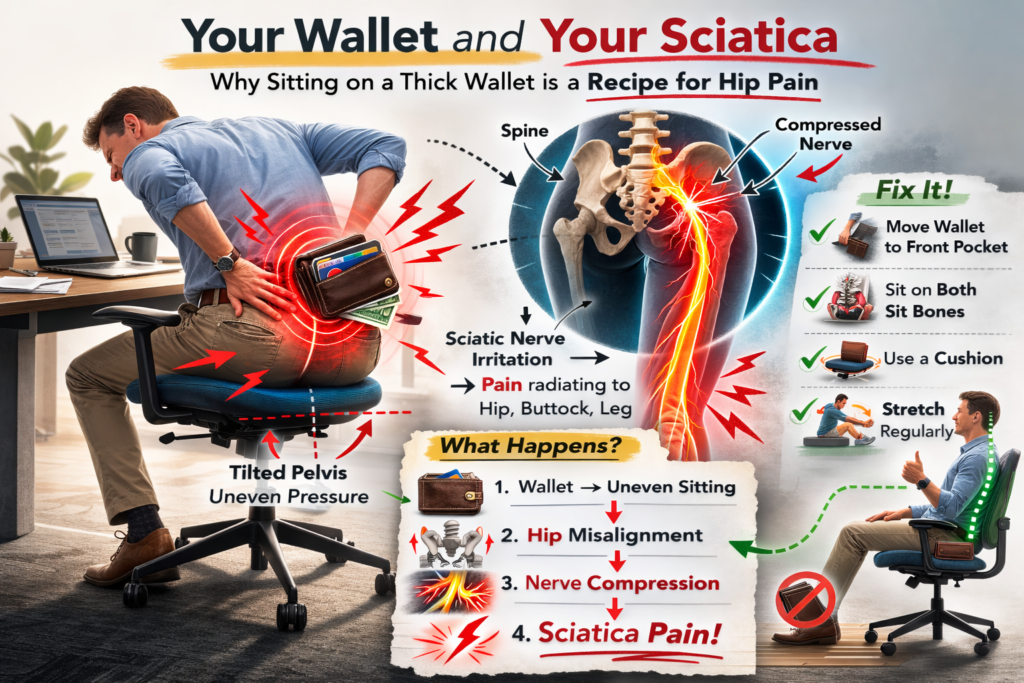
The Biomechanics of the "Wallet Lean"
To understand why a simple wallet causes so much trouble, we have to look at the geometry of sitting. When you sit on a flat chair, your “sit bones” (the ischial tuberosities) are designed to take the weight of your torso evenly. Your pelvis stays level, and your spine rises straight up from that level base, much like the mast of a ship.
When you stick a thick wallet in one back pocket, you are essentially placing a wedge under one side of your pelvis. This creates a chain reaction of postural disasters:
Pelvic Tilt: One side of your pelvis is jacked upward. Your foundation is no longer level.
Spinal Compensation: Because your pelvis is tilted, your spine has to curve to keep your head upright. This creates a functional scoliosis (a side-to-side curve) that puts immense pressure on your intervertebral discs.
Muscle Imbalance: The muscles on one side of your back (the quadratus lumborum) are forced to shorten and tighten, while the muscles on the other side are overstretched.
The Piriformis: The Tiny Muscle with a Big Attitude
While the spinal curve is bad enough, the real “villain” in this story is a small, pear-shaped muscle located deep in your buttock called the piriformis.
The piriformis helps rotate your hip and stabilize the joint. However, it has a very famous neighbor: the sciatic nerve. In most people, the sciatic nerve runs directly underneath the piriformis. In about 15% of the population, the nerve actually travels through the muscle.
When you sit on a thick wallet, you are applying direct, sustained pressure to the piriformis muscle. This compression reduces blood flow and causes the muscle to go into a protective spasm. As the muscle tightens, it pinches the sciatic nerve against the bone of the pelvis.
Symptoms of Piriformis Syndrome
If your wallet is winning the war against your hip, you might notice:
A dull ache deep in the buttock.
Pain that gets worse after sitting for long periods (especially while driving).
Tingling or “pins and needles” running down the back of your thigh.
Reduced range of motion in the hip or difficulty crossing your legs.
Why Driving is the "Danger Zone"
For many people, the worst damage happens behind the wheel. When you drive, your right leg is active—moving between the gas and the brake. This requires your hip muscles to be dynamic and flexible.
If you have a thick wallet in your right pocket, you are compressing the sciatic nerve while the leg is in motion. Furthermore, the “bucket seats” in many modern cars are designed to wrap around you, which can actually intensify the pressure from the wallet by wedging it tighter against your hip.
The Solution: A Digital and Physical De-Clutter
The good news? Unlike many medical conditions, “Wallet Sciatica” is almost entirely preventable and often reversible with a few simple lifestyle shifts.
1. Move it to the Front
The simplest fix is the most effective: move your wallet to your front pocket. It might feel awkward for the first two days, but your lower back will thank you instantly. If you can’t stand front-pocket carry, get into the habit of taking your wallet out of your pocket the moment you sit down at your desk or get into your car.
2. Transition to a Minimalist Wallet
Do you really need that punch card for a sandwich shop that closed in 2019?
Audit your cards: Carry only the essentials (ID, primary credit card, insurance).
Go Digital: Use apps like Apple Wallet or Google Pay to store loyalty cards and digital versions of your credit cards.
Switch Materials: Look for “slim” wallets made of carbon fiber or thin elastic that aren’t physically capable of holding enough “junk” to hurt your back.
3. The "Figure-Four" Stretch
If the damage is already done, you need to release that tight muscle.
The Stretch: While sitting, cross your right ankle over your left knee. Keep your back straight and gently lean forward from the hips until you feel a stretch in your right glute. Hold for 30 seconds and switch sides.