
As the temperature drops and the days grow shorter, many people notice a familiar, unwelcome guest: a persistent ache in their lower back or a stiffness in their neck that wasn’t there during the summer. While it might seem like an old wives’ tale that “the cold gets into your bones,” there is significant physiological evidence explaining why chilly weather and joint pain go hand-in-hand.
Understanding the relationship between barometric pressure, circulation, and musculoskeletal health is the first step toward managing winter discomfort and maintaining mobility year-round.
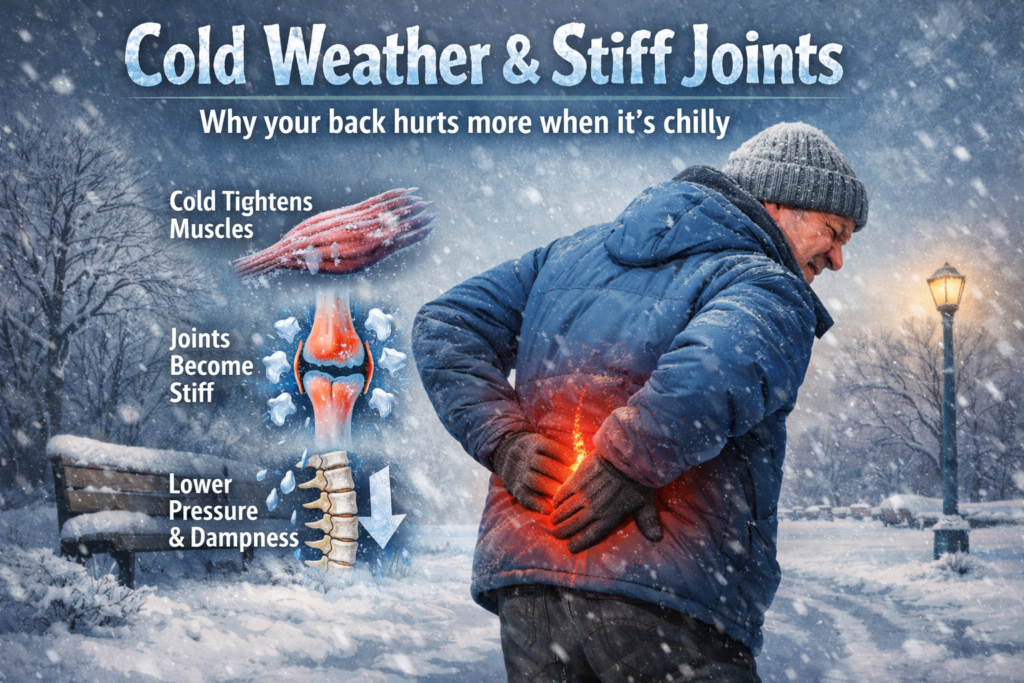
The Science of the "Winter Ache"
To understand why your back hurts more when it’s chilly, we have to look beneath the skin at how our bodies react to environmental stressors. It isn’t just the temperature itself; it’s a combination of physical, chemical, and behavioral changes.
1. Barometric Pressure and Tissue Expansion
One of the primary culprits isn’t the cold, but the drop in barometric pressure (the pressure of the air around us) that often precedes a cold front or a storm.
When the atmospheric pressure drops, it exerts less “push” against our bodies. This allows the soft tissues—muscles, tendons, and the sensitive tissues surrounding the joints—to expand slightly. In a confined space, like the structures surrounding the vertebrae of your spine, even microscopic expansion can increase pressure on nerves, leading to heightened pain signals.
2. Blood Flow and Vasoconstriction
Our bodies are designed to prioritize the survival of internal organs. When exposed to cold, the body undergoes vasoconstriction, narrowing the blood vessels in the extremities and the skin to divert warm blood toward the core.
While this keeps your heart and lungs warm, it reduces blood flow to the muscles and tendons in your back and limbs. Decreased circulation means these tissues receive less oxygen and fewer nutrients, making them less pliable and more prone to spasms.
3. Synovial Fluid Viscosity
Inside your joints is a “lubricating oil” known as synovial fluid. This fluid allows the cartilage-covered ends of your bones to glide smoothly over one another. Just like engine oil in a car on a freezing morning, synovial fluid can become thicker and more viscous in cold temperatures. When the fluid doesn’t flow easily, the joint feels stiff and “creaky,” requiring more effort to move.
The Spine: A Vulnerable Target
The spine is a complex structure of 33 vertebrae, intervertebral discs, and a massive network of ligaments and muscles. Because it is the central support beam for your entire body, it is particularly sensitive to the physiological changes caused by cold weather.
The Role of Spinal Discs
The discs between your vertebrae act as shock absorbers. They have a jelly-like center (nucleus pulposus) surrounded by a tough outer ring. Cold weather can affect the hydration and elasticity of these discs. When the surrounding muscles are tight due to the cold, they pull on the spine, compressing these discs and potentially aggravating conditions like herniated discs or degenerative disc disease.
Muscle Guarding and Posture
Have you ever noticed how you hunch your shoulders and tighten your core when you step out into a freezing wind? This is called muscle guarding. It’s an involuntary reaction to keep heat in, but holding this “hunched” position for long periods creates significant tension in the trapezius muscles and the lumbar region. This sustained contraction leads to muscle fatigue and lactic acid buildup, resulting in that dull, heavy back pain associated with winter.
Common Conditions Aggravated by Cold
While anyone can feel the “winter blues” in their joints, certain conditions are particularly susceptible to flare-ups during the colder months:
Osteoarthritis: The breakdown of cartilage is sensitive to pressure changes and temperature-driven stiffness.
Rheumatoid Arthritis: Inflammatory responses can feel more intense when circulation is sluggish.
Previous Injuries: Scar tissue is less elastic than healthy tissue. In cold weather, scar tissue doesn’t expand or contract at the same rate as the surrounding muscle, causing a “tugging” sensation and localized pain.
Fibromyalgia: Many patients report that cold and humidity act as primary triggers for widespread muscle pain.
How to Protect Your Back This Winter
You don’t have to accept back pain as an inevitable part of the season. By taking proactive steps to keep your musculoskeletal system warm and mobile, you can significantly reduce discomfort.
1. Layering for Core Warmth
It isn’t enough to just wear a heavy coat. Focus on keeping your core warm to prevent the body from initiating the vasoconstriction reflex. Thermal undershirts that tuck into your waistband help keep the lumbar region protected. If your lower back stays warm, the muscles are less likely to seize up.
2. Stay Hydrated
People often forget to drink water when it isn’t hot outside. However, hydration is vital for spinal health. The intervertebral discs are largely composed of water; staying hydrated ensures they maintain their height and cushioning properties, even when the air is dry.
3. Dynamic Stretching
Before heading outside, engage in five minutes of “dynamic” stretching. Unlike static stretching (holding a pose), dynamic stretching involves movement. Gentle torso twists, cat-cow stretches, and arm circles “wake up” the nervous system and increase blood flow to the spinal muscles before they are hit by the cold air.
4. Heat Therapy
If you come home feeling stiff, use heat to your advantage. A warm bath or a heating pad on the lower back for 15-20 minutes can dilate blood vessels, relax spasming muscles, and restore flexibility to the connective tissues.
5. Winter-Safe Exercise
It’s tempting to hibernate, but inactivity is the enemy of joint health. When you stop moving, your joints stiffen further. Consider indoor activities such as:
Yoga or Pilates: These focus on core strength and spinal alignment.
Swimming in a heated pool: Provides resistance without the impact on sensitive joints.
Walking: Even a brisk walk in a mall or large indoor space keeps the blood pumping.