
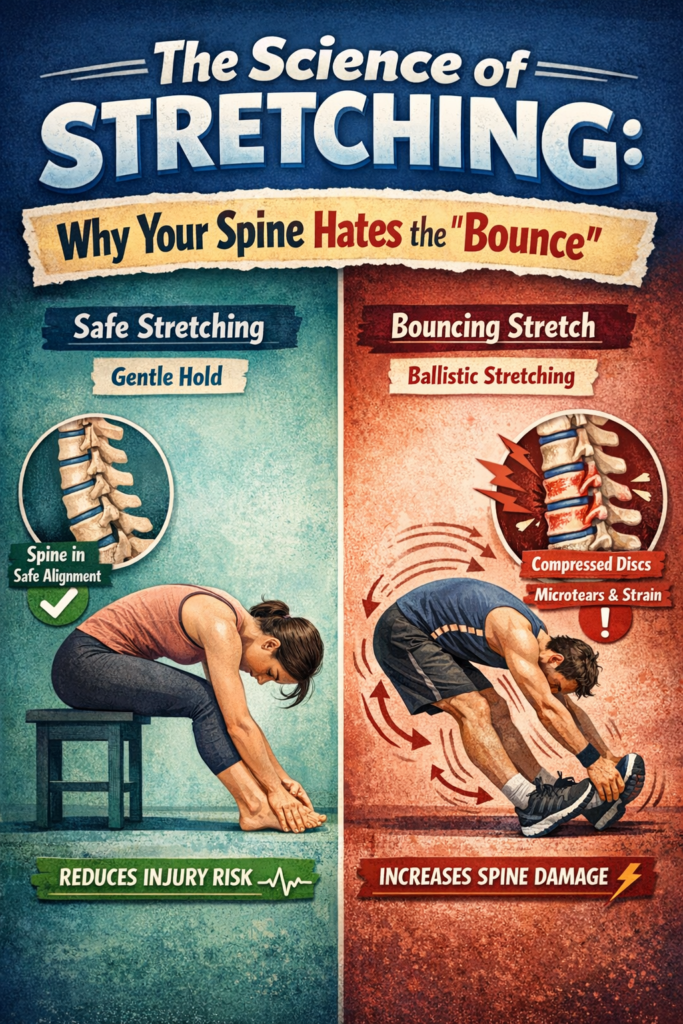
We’ve all seen it at the local track or in a throwback 80s aerobics video: someone leaning over to touch their toes, pulsing their torso up and down in a rhythmic, jerky motion. It looks productive, right? It feels like you’re “forcing” your muscles to go just a little bit further with every rhythmic tug.
In the world of exercise science, this is known as ballistic stretching. While it might seem like a shortcut to flexibility, it is actually one of the most counterproductive—and potentially dangerous—ways to treat your body, particularly your spine.
If you want to protect your back and actually improve your range of motion, it’s time to put the “bounce” to rest. Here is the deep dive into the physiology of why bouncing hurts and how you should be stretching instead.
1. The Biology of the "Stretch Reflex"
To understand why bouncing is bad, you first have to understand your body’s built-in security system: the Myotatic Reflex (or stretch reflex).
Deep within your muscle fibers are specialized sensory receptors called muscle spindles. Their primary job is to monitor the speed and intensity of a muscle’s change in length.
The Scenario: When you bounce or “jerk” a muscle into a stretch, the muscle spindles sense a rapid, high-velocity change.
The Reaction: The brain interprets this sudden movement as a threat—it thinks the muscle is about to tear.
The Result: To prevent a tear, the brain sends an immediate signal to the muscle to contract.
This creates a physiological paradox: you are trying to lengthen a muscle while your nervous system is simultaneously forcing it to shorten. This “tug-of-war” is where injuries happen.
2. Why the Spine is Especially Vulnerable
Your spine isn’t just a column of bone; it’s a complex stack of vertebrae cushioned by intervertebral discs and held together by a delicate web of ligaments and small stabilizing muscles (like the multifidus).
The Momentum Problem
When you bounce during a hamstring stretch or a seated forward fold, you are using momentum rather than muscle control. Because the spine is a kinetic chain, that force doesn’t just stay in your legs. It travels up into the lumbar (lower) region.
Disc Compression and Shearing
The rapid, repetitive loading of a ballistic stretch can create “shearing forces” on the spinal discs. Think of a spinal disc like a jelly donut. If you apply slow, steady pressure, the jelly stays put. If you hit it with a hammer (or a high-velocity bounce), the internal pressure spikes, which can lead to micro-tears in the outer ring of the disc (the annulus fibrosus) or even a herniation over time.
3. Connective Tissue: The "Creep" Factor
Stretching isn’t just about muscles; it’s about fascia and ligaments. These tissues are “viscoelastic,” meaning they behave like a mix of honey and a rubber band.
Static Stretching allows for a phenomenon called “Creep.” This is when the tissue slowly elongates under a constant, low-level load.
Ballistic Bouncing doesn’t give the tissue time to adapt. Instead of “creeping” into a longer state, the ligaments—which are meant to stabilize your spine—can become overstretched or “lax.” Once a ligament loses its tension, it’s very difficult for it to snap back, leading to permanent spinal instability and chronic back pain.
4. Better Alternatives: The Right Way to Stretch
If bouncing is off the table, how do you actually get flexible? The answer lies in working with your nervous system instead of against it.
A. Static Stretching (The Post-Workout Recovery)
This is the “gold standard” for increasing long-term flexibility. You move into a stretch until you feel mild tension and hold it for 30–60 seconds.
Pro Tip: By holding for at least 30 seconds, you trigger the Autogenic Inhibition Reflex. This tells the muscle spindles to “relax” and allows the muscle to finally lengthen without the fear of a tear.
B. Dynamic Stretching (The Pre-Workout Warm-up)
Unlike ballistic stretching, dynamic stretching involves controlled, fluid movements through a full range of motion. Think of leg swings or torso twists. There is no “snap” or “bounce” at the end of the movement, so the stretch reflex isn’t triggered.
C. PNF Stretching (The Bio-Hack)
Proprioceptive Neuromuscular Facilitation (PNF) involves contracting the muscle you’re trying to stretch against resistance before relaxing into the stretch. This “tricks” the nervous system into a deeper state of relaxation.