
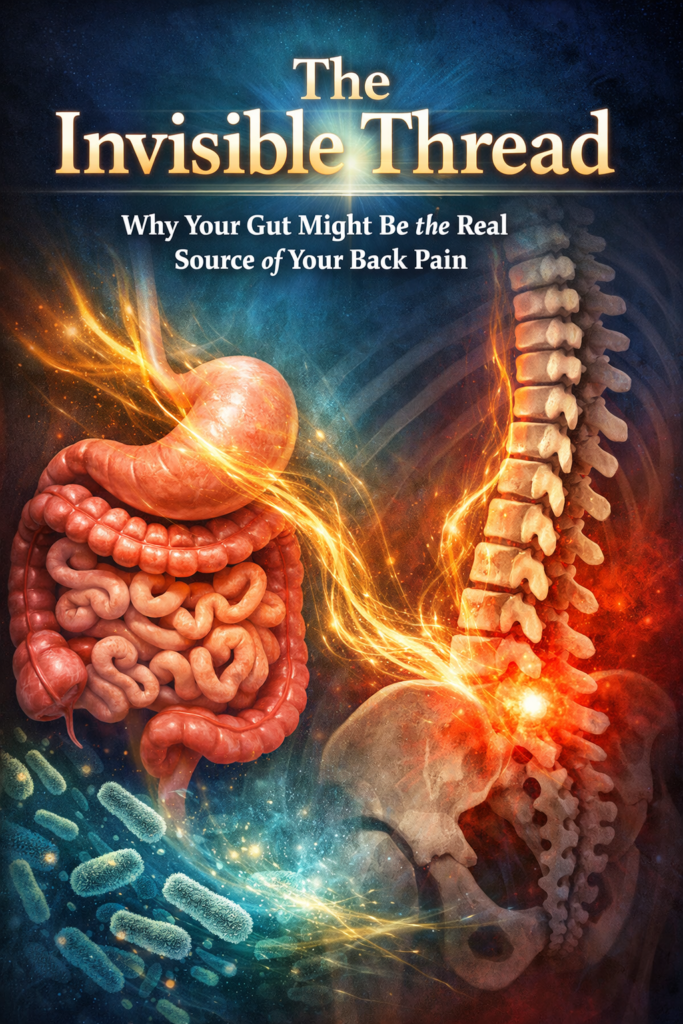
For years, the standard approach to chronic back pain has been mechanical. If your back hurts, we look at the back: we scan the discs, we massage the muscles, and we adjust the spine. But what if the source of your agony isn’t actually in your back?
Emerging research is uncovering a profound connection between the microbiome—the trillions of bacteria living in your digestive tract—and the structural integrity of your spine. This is the “Gut-Spine Axis,” and understanding it might be the key to finally finding relief from persistent aches that physical therapy alone can’t touch.
1. The Inflammation Highway
To understand how the gut affects the spine, we first have to talk about systemic inflammation.
Your gut houses about 70-80% of your immune system. When the delicate balance of bacteria in your gut is disrupted—a state known as dysbiosis—the intestinal wall can become permeable. This is often referred to as “Leaky Gut Syndrome.”
How it reaches your back:
When the gut lining is compromised, toxins, undigested food particles, and bacteria “leak” into the bloodstream. The immune system views these as invaders and triggers a widespread inflammatory response.
Pro-inflammatory cytokines (signaling molecules) travel through the blood.
These molecules have a “preference” for joint tissue and spinal discs.
Once they settle in the low back, they can sensitize nerves and degrade collagen, leading to chronic pain.
2. The Anatomy of the Connection: Viscersomatic Reflexes
The relationship isn’t just chemical; it’s neurological. Your internal organs (viscera) and your musculoskeletal system (soma) share the same nerve pathways.
When an organ like the colon is inflamed due to poor gut health, it sends distress signals to the spinal cord. Because the nerves from the gut enter the spine at the same levels as the nerves from the lower back muscles, the brain can get “confused.” This is called a viscersomatic reflex. Your brain perceives the internal distress as muscle tightness or sharp pain in the lumbar region.
Key Insight: You might spend hundreds on lumbar pillows and ergonomic chairs, but if your colon is chronically irritated, your brain will continue to “clamp down” your back muscles as a protective (but painful) reflex.
3. The Microbiome and Disc Degeneration
Perhaps the most startling discovery in recent years is the link between gut bacteria and Intervertebral Disc Degeneration (IDD).
Your spinal discs are the shock absorbers of your body. They don’t have a direct blood supply, meaning they rely on diffusion to get nutrients and clear out waste.
Metabolic Stress: Chronic gut inflammation disrupts the metabolic processes needed to maintain disc health.
Bacterial Translocation: Some studies have actually found traces of gut-derived DNA and bacteria inside herniated discs. It is theorized that bacteria can travel from a “leaky” gut and colonize the low-oxygen environment of a spinal disc, causing low-grade infection and rapid wear and tear.
4. The Role of the Psoas Muscle
The psoas is the deepest muscle of your core. It connects your lumbar spine to your femur (thigh bone) and is essential for walking and posture.
The psoas sits directly behind your digestive organs—specifically the small intestine and colon. When the intestines are inflamed or distended (bloating), the psoas can become irritated or “locked” in a state of contraction.
A tight psoas pulls the lumbar spine forward.
This creates an exaggerated curve in the lower back (lordosis).
The result? Compressed joints, pinched nerves, and that familiar “dull ache” after standing.
5. Serotonin: The Mental-Physical Bridge
Did you know that 95% of your body’s serotonin is produced in the gut? While we often think of serotonin as a “brain chemical” for mood, it plays a massive role in pain modulation.
If your gut health is poor, your serotonin production drops. This lowers your pain threshold. In simpler terms, a healthy gut helps you “ignore” minor physical stresses, while an unhealthy gut makes your nervous system hypersensitive, turning a minor muscle twitch into an agonizing spasm.
6. Healing the Gut to Heal the Back
If you suspect your back pain is linked to your digestion, addressing the root cause requires a “bottom-up” approach.
Dietary Interventions
Eliminate Inflammatory Triggers: Sugar, highly processed vegetable oils, and excessive alcohol are the primary drivers of gut permeability.
Prioritize Fiber: Fiber feeds the beneficial bacteria that produce Short-Chain Fatty Acids (SCFAs) like butyrate. Butyrate is a powerful anti-inflammatory that has been shown to protect spinal tissues.
Bone Broth: Rich in collagen and glutamine, bone broth helps “seal” the gut lining and provides the building blocks for spinal disc repair.
Targeted Supplementation
- Probiotics: Strains like Lactobacillus and Bifidobacterium can help rebalance the microbiome.
- Omega-3 Fatty Acids: High-quality fish oil acts as a natural ibuprofen, dampening the systemic inflammation that irritates spinal nerves.
- Magnesium: Essential for both muscle relaxation (psoas) and bowel regularity.
7. Lifestyle: The Vagus Nerve Connection
The Vagus Nerve is the superhighway of the gut-brain axis. It regulates digestion and the “rest and digest” parasympathetic nervous system.
When you are chronically stressed, the Vagus nerve loses “tone,” digestion slows, and inflammation rises. Practices like deep diaphragmatic breathing serve a dual purpose: they stimulate the Vagus nerve to improve gut health and physically massage the psoas muscle, releasing tension in the lower back.