
A sneeze is a powerful, involuntary bodily function designed to clear the nasal cavity of irritants. While it usually brings a sense of relief, for some, it is preceded by a moment of dread. If a simple “achoo” sends a sharp, stabbing pain or a dull, lingering ache through your back, you are not alone.
The mechanical force of a sneeze is surprisingly intense. When you sneeze, your core muscles contract violently, your diaphragm moves rapidly, and there is a sudden spike in intra-abdominal pressure. For a healthy spine, this is a routine event. However, if there is an underlying structural issue or muscle weakness, that sudden burst of pressure can become a painful trigger.
Here is a deep dive into why your back hurts when you sneeze, the common triggers involved, and how to manage the discomfort.
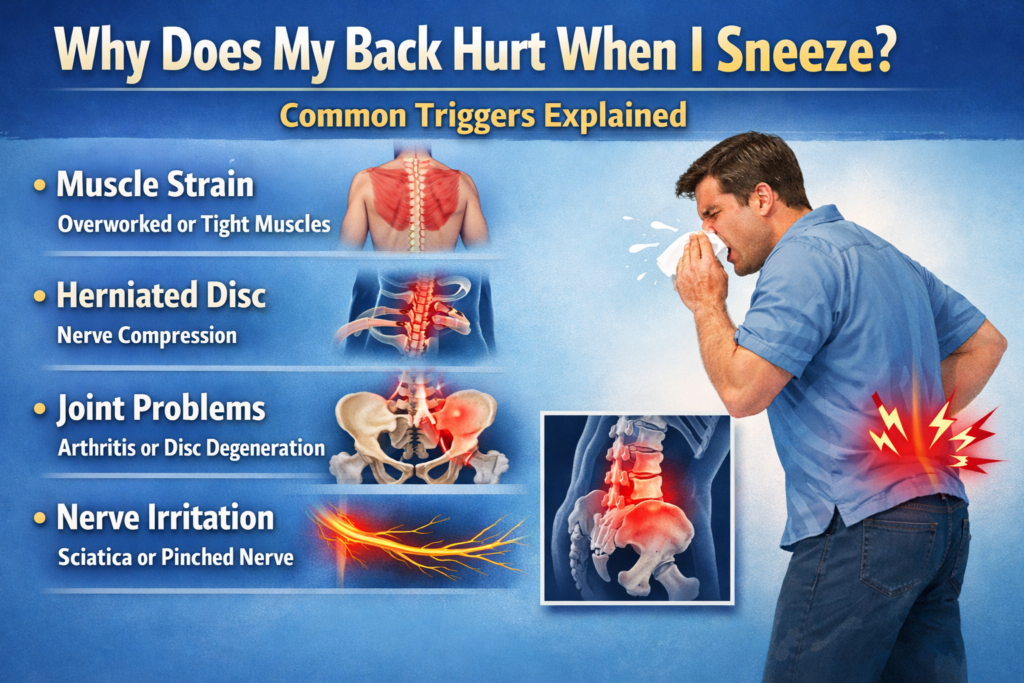
1. The Anatomy of a Sneeze: Why the Back is Involved
To understand the pain, we first have to look at the physics of the sneeze itself. A sneeze involves a coordinated “blast” of air from the lungs. To achieve this:
Intra-abdominal pressure (IAP) increases instantly.
-
The diaphragm and intercostal muscles (between the ribs) contract sharply.
-
The pelvic floor and abdominal wall tighten to create the necessary force.
Because the spine acts as the central pillar for all these muscle attachments, any sudden contraction or shift in pressure is felt directly by the vertebrae, discs, and supporting ligaments.
2. Common Structural Triggers
When back pain occurs during a sneeze, it is rarely the sneeze itself that is the “cause.” Rather, the sneeze is the “trigger” that reveals an existing underlying condition.
A. Herniated or Bulging Discs
This is perhaps the most common reason for sharp, shooting pain during a sneeze. Your spinal discs act as shock absorbers between the vertebrae. They have a tough outer layer and a jelly-like center.
The Sneeze Effect: The sudden spike in pressure during a sneeze can push the disc material further out. If that material touches a nearby nerve (like the sciatic nerve), it causes immediate, intense pain.
Symptoms: Pain that shoots down one leg (sciatica), numbness, or a “lightning bolt” sensation.
B. Muscle Strains and Spasms
If the muscles supporting your spine—the erector spinae or the multifidus—are already overworked, tight, or weakened, a sneeze can act as a “micro-trauma.”
The Sneeze Effect: The violent contraction can overstretch or tear muscle fibers, leading to an acute spasm. This is often described as the back “locking up.”
Symptoms: A dull, aching pain that worsens with movement and a feeling of stiffness in the lower or mid-back.
C. Spinal Stenosis
Spinal stenosis is the narrowing of the spaces within your spine, which can put pressure on the nerves.
The Sneeze Effect: Because a sneeze causes a momentary shift in spinal alignment and pressure, it can temporarily compress those already crowded nerve pathways.
Symptoms: Pain that may be accompanied by cramping or weakness in the legs.
D. Osteoarthritis and Facet Joint Syndrome
As we age, the cartilage that cushions the facet joints (the joints that connect the vertebrae) can wear down.
The Sneeze Effect: The rapid movement of a sneeze can cause these joints to grind or compress, triggering an inflammatory pain response.
Symptoms: Localized pain in the spine that feels sharp during the sneeze and achy afterward.
3. The Role of Posture During a Sneeze
How you sit or stand when a sneeze hits can determine whether you feel pain. Many people instinctively “hunch over” or round their back when they sneeze. This is actually the worst position for your spine.
The Flexion Problem: Rounding the spine (flexion) puts the maximum amount of pressure on the anterior (front) part of the spinal discs. When you add the force of a sneeze to a rounded back, you create a “nutcracker” effect on the discs.
The Twist: If you turn your head or torso to sneeze “away” from someone while sitting, you add rotational stress to the pressure. This combination of twisting and high pressure is a leading cause of acute disc injury.
4. When to See a Professional
While a mild ache from a sneeze might just be a sign of a tight muscle, certain “red flag” symptoms indicate that the sneeze may have aggravated a serious condition. Seek medical advice if you experience:
Saddle Anesthesia: Numbness in the groin or “saddle” area.
Loss of Bladder or Bowel Control: This can indicate Cauda Equina Syndrome, a medical emergency.
Progressive Weakness: If your leg feels heavy or you find yourself tripping (foot drop).
Pain that Prevents Sleep: Chronic pain that does not subside with rest or over-the-counter anti-inflammatories.
5. Practical Tips: How to Sneeze "Safely"
If you are currently dealing with back sensitivity, you can change your mechanics to protect your spine.
The “Log” Technique: Keep your back straight. Instead of hunching forward, try to maintain the natural curve of your lower back.
Support Yourself: If you are near a table or a wall, place one hand on it to offload some of the weight and pressure from your spine.
The “Sneeze Standing” Rule: If you feel a sneeze coming while sitting, try to stand up. Standing allows your hips and knees to act as additional shock absorbers, taking the brunt of the force away from your lumbar spine.
Look Up: Gently tilting your chin up can help prevent the reflexive “rounding” of the spine.
6. Long-Term Solutions for Back Resilience
To stop the sneeze-pain cycle, the goal is to build a spine that can handle sudden pressure.
Core Strengthening
The “core” isn’t just the six-pack muscles; it includes the deep stabilizers like the transverse abdominis. A strong core acts as a natural corset, stabilizing the spine against internal pressure. Exercises like Bird-Dogs, Planks, and Dead Bugs are excellent for building this stability.
Flexibility and Mobility
Tight hamstrings and hip flexors can pull the pelvis out of alignment, making the lower back more vulnerable to injury. Incorporating daily stretching or yoga can improve the “give” in your system.
Posture Awareness
In a digital world, many of us suffer from “tech neck” or slumped shoulders. This chronic misalignment weakens the back over time. Regular movement breaks and ergonomic setups ensure that when a sneeze happens, your spine is in its strongest, most neutral position.