
Waking up with a stiff, achy back is a common experience that can cast a shadow over your entire day. Whether it’s the result of an awkward sleeping position, a sedentary lifestyle, or the natural aging process, spinal morning “cobwebs” are a signal from your body that it needs movement.
The transition from a state of rest to activity is critical. A dedicated morning stretching routine acts as a mechanical “reset button,” lubricating the facet joints of the spine, increasing blood flow to the intervertebral discs, and lengthening muscles that have shortened during hours of stillness.
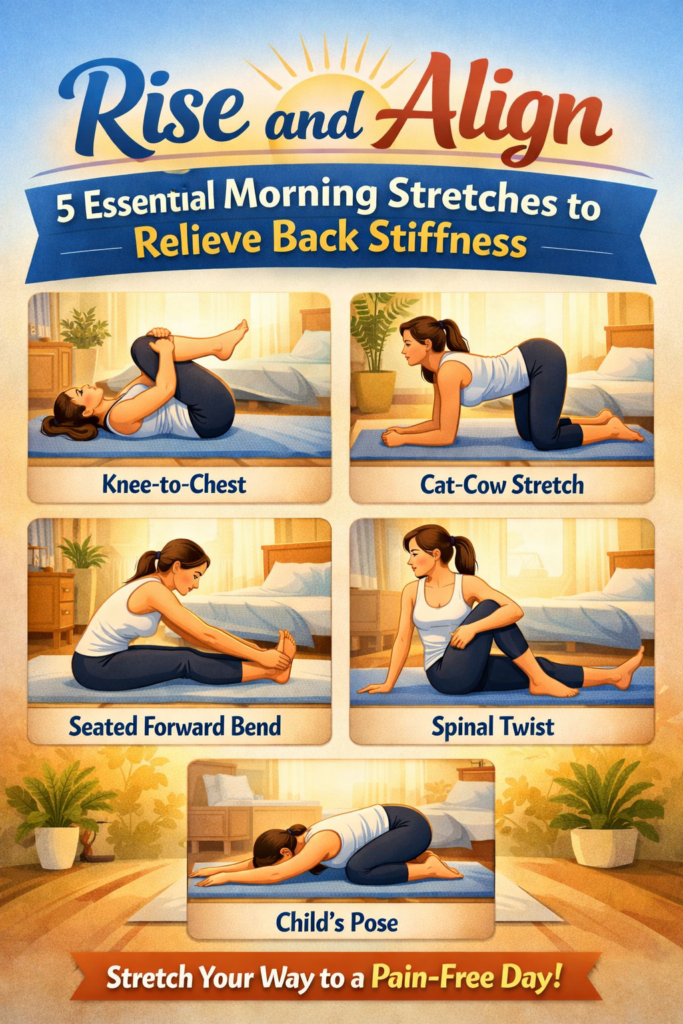
Below is a comprehensive guide to five essential stretches designed to decompress your spine and energize your body, along with the science of why they work.
1. The Knees-to-Chest Release
This is the ultimate “gentle wake-up” for the lower back. By performing this while still on your mattress (provided it is firm) or on a rug, you immediately begin to decompress the lumbar spine.
How to do it:
Lie flat on your back with your legs extended.
Slowly bring one knee up toward your chest, followed by the other.
Wrap your arms around your shins or behind your thighs.
Gently pull your knees closer to your chest while keeping your tailbone tucked toward the floor.
Hold for 30 to 60 seconds, breathing deeply into your belly.
Why it works:
During sleep, the muscles surrounding the lumbar spine (lower back) can tighten. This stretch creates a gentle “traction” effect, lengthening the erector spinae muscles and opening the space between the vertebrae. It is a low-impact way to signal to the nervous system that it is safe to begin moving.
2. The Cat-Cow Flow
Moving from a static hold to a dynamic flow is the next step in waking up the spine. The Cat-Cow is a cornerstone of spinal health because it addresses the entire length of the back, from the neck (cervical) to the tailbone (sacral).
How to do it:
Start on all fours (tabletop position) with wrists under shoulders and knees under hips.
The Cow: Inhale as you drop your belly toward the floor, lift your chin and chest, and look up toward the ceiling.
The Cat: Exhale as you draw your belly button toward your spine and round your back toward the ceiling, tucking your chin to your chest.
Repeat this flow for 10 to 12 breath cycles.
Why it works:
This movement encourages “segmental spinal mobility.” Instead of the back moving as one rigid block, Cat-Cow teaches each vertebra to move independently. It also boosts the circulation of cerebrospinal fluid, which helps clear the mental fog often associated with early mornings.
3. Child’s Pose (Balasana) with a Lateral Reach
Traditional Child’s Pose is excellent for the lower back, but adding a lateral (side) reach incorporates the Latissimus Dorsi—the large muscles that connect the back to the shoulders.
How to do it:
Kneel on the floor, touch your big toes together, and sit on your heels.
Separate your knees about hip-width apart and fold forward, resting your torso between your thighs.
Reach your arms far out in front of you.
The Variation: Walk both hands to the right side until you feel a deep stretch along your left side and lower back. Hold for 30 seconds.
Walk your hands to the left and repeat.
Why it works:
Many people experience back stiffness because their sides are tight. By reaching laterally, you stretch the Quadratus Lumborum (QL), a deep abdominal muscle that is a frequent culprit in chronic lower back pain.
4. The Sphinx Stretch
After several stretches that involve rounding or folding the back, it is vital to include a gentle extension. The Sphinx pose is a modified version of the Cobra, making it safer for those with sensitive lower backs.
How to do it:
Lie on your stomach with your legs extended behind you.
Place your elbows directly under your shoulders, forearms flat on the floor and parallel to each other.
Press your pubic bone into the floor and lift your chest.
Keep your gaze forward and your shoulders relaxed away from your ears.
Hold for 45 seconds.
Why it works:
In our modern world, we spend much of our day “flexed” (leaning forward over phones or desks). The Sphinx pose counteracts this by putting the spine into “extension.” This helps re-center the intervertebral discs and strengthens the supporting muscles of the upper back.
5. Spinal Supine Twist
To finish the routine, a rotation stretch helps “wring out” the spine, much like a wet towel, promoting flexibility in the oblique muscles and the mid-back (thoracic spine).
How to do it:
Lie on your back with your knees bent and feet flat on the floor.
Extend your arms out to the sides in a “T” position.
Slowly drop both knees to the right side while keeping your left shoulder pressed firmly against the ground.
Turn your head to look toward your left hand.
Hold for 30 seconds, then switch sides.
Why it works:
Rotation is a fundamental movement of the human spine, yet it is often the first range of motion we lose as we age. This twist increases the flexibility of the paraspinal muscles and helps neutralize the spine after the previous four movements.