
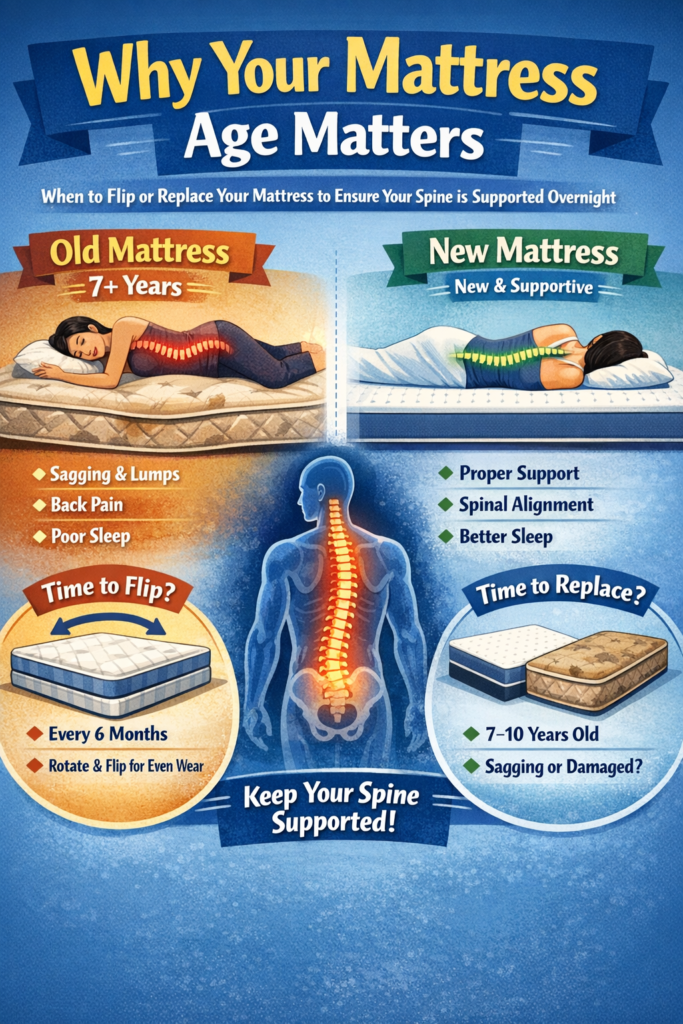
We spend approximately one-third of our lives asleep. In a seventy-year lifespan, that equates to over twenty years spent horizontal. Yet, while we obsess over the ergonomics of our office chairs or the suspension in our cars, the most hardworking piece of furniture in our homes—the mattress—is often treated as a “set it and forget it” purchase.
The reality is that mattresses are not immortal. From the moment you break the seal on a new bed, a slow process of structural degradation begins. Understanding the intersection of mattress age, material fatigue, and spinal health is essential for more than just a good night’s rest; it is a fundamental pillar of long-term physical wellness.
1. The Anatomy of Support vs. Comfort
To understand why age matters, we must distinguish between comfort and support.
Comfort is the immediate tactile sensation—the softness of the quilted top or the “hug” of memory foam.
Support is the structural ability of the mattress to push back against your body weight, maintaining the natural “S” curve of your spine.
As a mattress ages, the comfort layers (foams and fibers) are the first to compress, leading to a loss of the “new bed” feel. However, the real danger lies in the failure of the support core—the springs or high-density base foams. When these lose their resiliency, your heaviest points (usually the hips and shoulders) sink too deep. This misalignment forces your back muscles to work all night just to keep your spine straight, leading to that familiar morning stiffness.
2. The General Rule: How Long Does a Mattress Last?
While the industry standard suggests replacing a mattress every 7 to 10 years, the actual lifespan depends heavily on the materials used:
| Mattress Type | Average Lifespan | Why it Fails |
| Innerspring | 5–7 Years | Coils lose tension and begin to sag or squeak. |
| Memory Foam | 8–10 Years | Foam loses its “memory” and fails to bounce back, creating permanent dips. |
| Hybrid | 7–9 Years | A combination of foam compression and coil fatigue. |
| Latex | 12–15 Years | Highly durable; usually the most resilient against sagging. |
3. The Telltale Signs: When "Old" Becomes "Expired"
Age is just a number; the physical condition of the mattress is the true indicator. If you notice any of the following, your spine is likely at risk:
The "Valley" Effect
If you get out of bed and can still see the silhouette of your body in the mattress, the material has reached “permanent set.” Even a dip of just 1.5 inches is enough to compromise spinal alignment.
Unexplained Aches and Pains
If you wake up with lower back pain that dissipates after thirty minutes of moving around, the culprit is almost certainly your bed. Your mattress should be a recovery tool, not a source of physical stress.
The Allergy Connection
Mattresses are giant filters. Over a decade, they accumulate dead skin cells, sweat, and dust mites. For those with respiratory issues, an old mattress can become a nightly trigger for inflammation, further disrupting the quality of deep sleep.
4. To Flip or To Rotate? The Maintenance Myth
There is a common misconception that “flipping” a mattress can double its life. In the modern market, this is rarely true.
Most modern mattresses are “one-sided.” They are engineered with a specific base-to-top hierarchy (Support core – Transition layer – Comfort layer). Flipping these would mean sleeping on the hard, structural base foam.
The Power of Rotation: Instead of flipping, you should rotate your mattress 180 degrees every 3 to 6 months. This ensures that the weight-bearing areas (hips/shoulders) are distributed across different sections of the foam or springs, preventing localized sagging.
Note: Only “double-sided” innerspring mattresses, which are increasingly rare, should be flipped. Always check your manufacturer’s tag before attempting a flip.
5. The Science of Spinal Alignment
Why is the “neutral spine” so important? When you lie down, your vertebrae should be stacked as they are when you stand with perfect posture.
The Sagging Mattress: If the bed sags, your midsection drops. This creates a “hammocking” effect, stretching the ligaments in the lower back and putting pressure on the intervertebral discs.
The Overly Firm Mattress: Conversely, a mattress that has become “hard” (due to thin comfort layers wearing out) creates pressure points. Your shoulders and hips are pushed upward, arching the spine unnaturally.
Research suggests that medium-firm mattresses are generally the gold standard for back health, but as they age and soften, they transition into the “dangerously soft” category.
6. Protecting Your Investment
If your mattress is still within its 7-year window but feels like it’s struggling, you can utilize a few “triage” methods:
The Foundation Check: Sometimes the “sag” isn’t the mattress—it’s the bed frame. Ensure your slats are no more than 3 inches apart. A sagging box spring can ruin a brand-new mattress in months.
Mattress Toppers: A high-quality 3-inch latex or memory foam topper can provide a temporary “reset” for the comfort layers, though it won’t fix a failing support core.
Deep Cleaning: Use a vacuum with a HEPA filter and baking soda to neutralize odors and remove allergens, extending the “hygienic life” of the bed.
7. The Final Verdict: Replacement vs. Repair
How do you know it’s truly time to go shopping? Ask yourself these three questions:
Do I sleep better in hotels or on a friend’s guest bed than in my own?
Is there a physical “trough” in the middle of the bed?
Am I over the 8-year mark?
If the answer to two or more is “yes,” your health is worth the investment. A new mattress isn’t just a piece of furniture; it is a medical device for your musculoskeletal system. By staying proactive with rotations and knowing when to retire an aging bed, you ensure that your spine remains supported, your sleep remains deep, and your mornings remain pain-free.