
For millions of people, chronic spinal pain is not just a physical sensation; it is a persistent shadow that influences every decision, from the way one sits at a desk to the willingness to engage in social activities. Traditional medicine often approaches spinal issues—be it degenerative disc disease, herniations, or non-specific lower back pain—through a structural lens: surgery, injections, or pharmacotherapy. However, a growing body of evidence in Mind-Body Medicine suggests that the most profound tool for pain management might not be found in a medicine cabinet, but within the architecture of the mind itself.
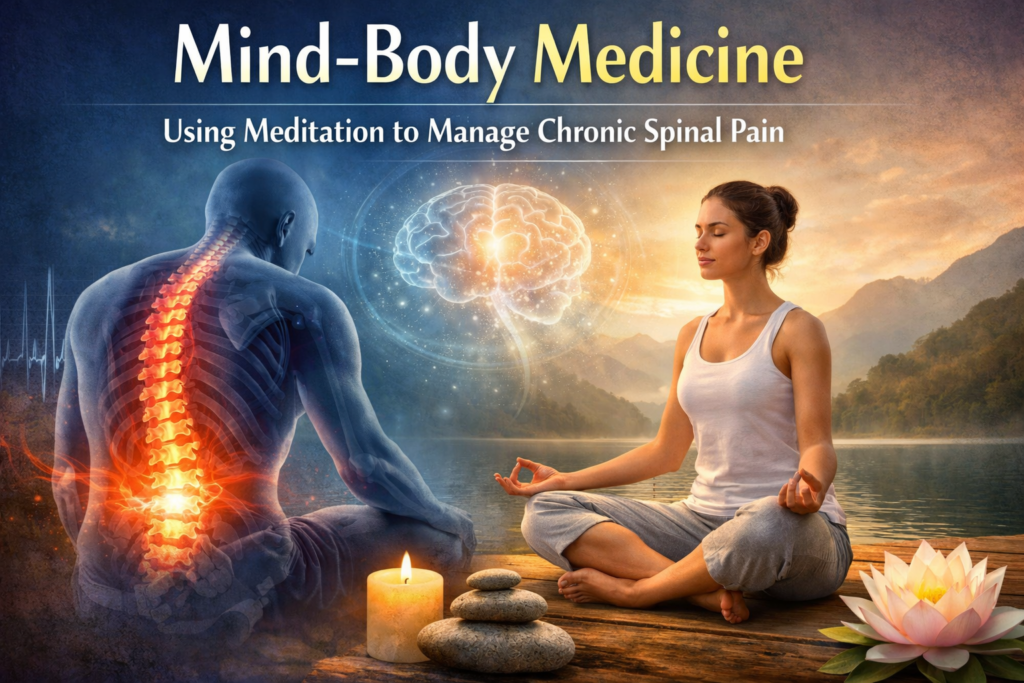
Understanding the Architecture of Pain
To understand how meditation can alleviate spinal pain, we must first redefine what pain is. Pain is not a simple one-to-one transmission of “damage” signals from the spine to the brain. Instead, it is a complex output of the Central Nervous System.
When the spine is injured or stressed, nociceptors (pain-sensing nerves) send signals to the brain. However, the brain acts as an editor. It filters these signals through the lens of past experiences, emotional states, and current stress levels. In cases of chronic pain, the nervous system can become “sensitized.” The brain begins to over-react to even minor signals, creating a feedback loop where the fear of pain actually amplifies the physical sensation. This is known as central sensitization.
Mind-Body Medicine, specifically through meditation, seeks to “down-regulate” this hypersensitive system. By changing the relationship between the mind and the physical sensation, we can effectively turn down the volume of the pain.
The Science of Meditation and the Spine
Neuroimaging studies have shown that consistent meditation practice can lead to structural and functional changes in the brain regions associated with pain processing. Two primary mechanisms are at play:
Reduced Activity in the Anterior Cingulate Cortex (ACC): The ACC is responsible for the “unpleasantness” or emotional weight we attach to pain. Meditation helps decouple the physical sensation from the emotional distress, allowing a person to feel the sensation without the accompanying “suffering.”
Activation of the Parasympathetic Nervous System: Chronic pain keeps the body in a state of “fight or flight.” This muscle tension further compresses the spine, exacerbating the pain. Meditation triggers the relaxation response, lowering cortisol levels and allowing the paraspinal muscles to release their grip.
Practical Meditative Strategies for Spinal Relief
Managing spinal pain requires a multifaceted approach. Here are three core meditative techniques specifically tailored for back and neck health.
1. Mindfulness-Based Stress Reduction (MBSR) and the "Body Scan"
The Body Scan is perhaps the most effective tool for those with spinal issues. It involves systematically focusing attention on different parts of the body without judgment.
The Technique: Lie flat on a firm surface (or a yoga mat) with a small pillow under your knees to neutralize the lumbar curve. Close your eyes and move your internal “spotlight” of attention from your toes up to your head.
The Spinal Focus: When you reach the sacrum, the lower back, the mid-back, and the neck, stay there longer. Instead of labeling the sensation as “bad” or “stabbing,” try to describe it neutrally: “heat,” “tightness,” or “pulsing.” This objective observation prevents the brain from triggering a secondary stress response
2. Breath-Directed Softening
Pain often causes us to hold our breath or breathe shallowly into the chest. This creates tension in the secondary respiratory muscles—the scalenes and trapezius in the neck—which are frequent contributors to cervical spinal pain.
- The Technique: Practice Diaphragmatic Breathing. Place one hand on your chest and the other on your belly. Inhale deeply through the nose, ensuring the belly hand rises while the chest hand stays still.
- The Visualization: As you inhale, imagine the breath traveling down the spinal column, creating space between each vertebra. As you exhale, imagine the pain leaving the body as a dull gray mist. This “micro-stretching” of the intercostal muscles helps mobilize the mid-spine (thoracic region).
3. Loving-Kindness Meditation (Metta)
It may sound counterintuitive to practice “love” when you feel betrayed by your own body. However, chronic pain often leads to self-resentment and frustration, which increases muscle guarding.
- The Technique: Quietly repeat phrases such as, “May my body be at ease,” or “May I be free from this burden.” * The Goal: Shifting from a state of “fighting” the pain to “accepting” the body’s current state reduces the neurological friction that keeps pain signals firing.
Integrating Meditation into a Modern Lifestyle
For a professional or a busy individual, the idea of sitting for an hour in silence can feel daunting. The key to Mind-Body Medicine is consistency over intensity.
| Strategy | Implementation | Benefit |
| Micro-Meditation | 3 minutes between meetings | Resets the nervous system before tension builds. |
| Mindful Movement | Gentle cat-cow stretches with breath | Combines physical mobilization with mental focus. |
| The Evening Reset | 10-minute guided meditation before bed | Improves sleep quality, which is vital for tissue repair. |
Moving Beyond the Cushion: The Bio-Psycho-Social Model
Meditation is not a “magic pill” that replaces traditional care. Instead, it is a vital component of the Bio-Psycho-Social model of healthcare. This model recognizes that spinal health is influenced by:
Biological factors: Disc health, muscle strength, and genetics.
Psychological factors: Stress levels, depression, and coping mechanisms.
Social factors: Work environment, ergonomics, and support systems.
By incorporating meditation, you are addressing the psychological pillar, which in turn improves the biological pillar by reducing inflammation and muscle tension.