
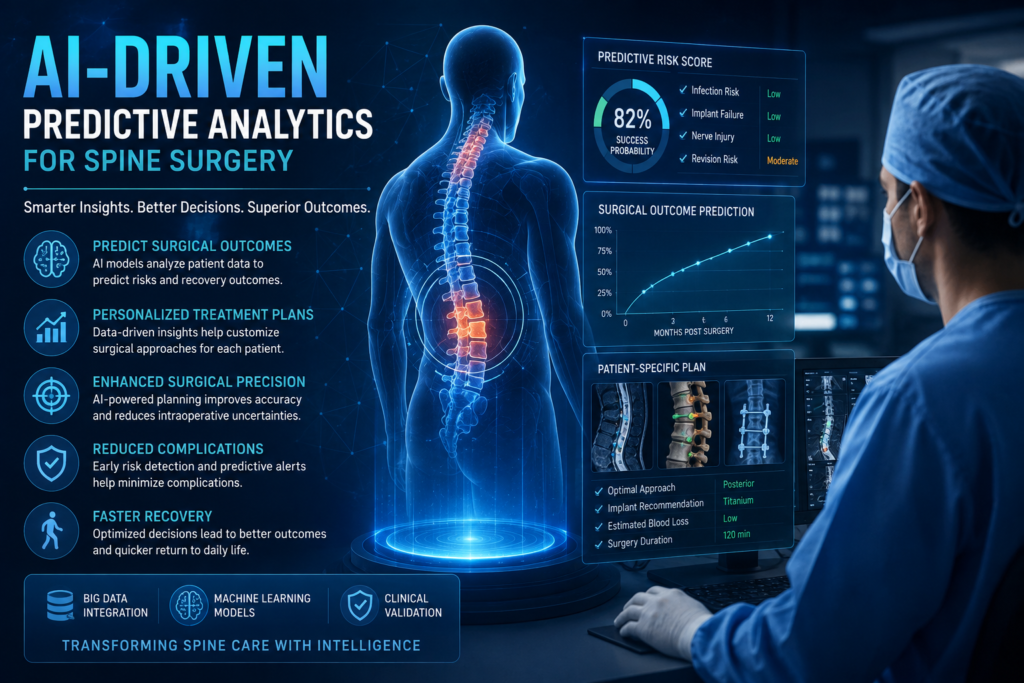
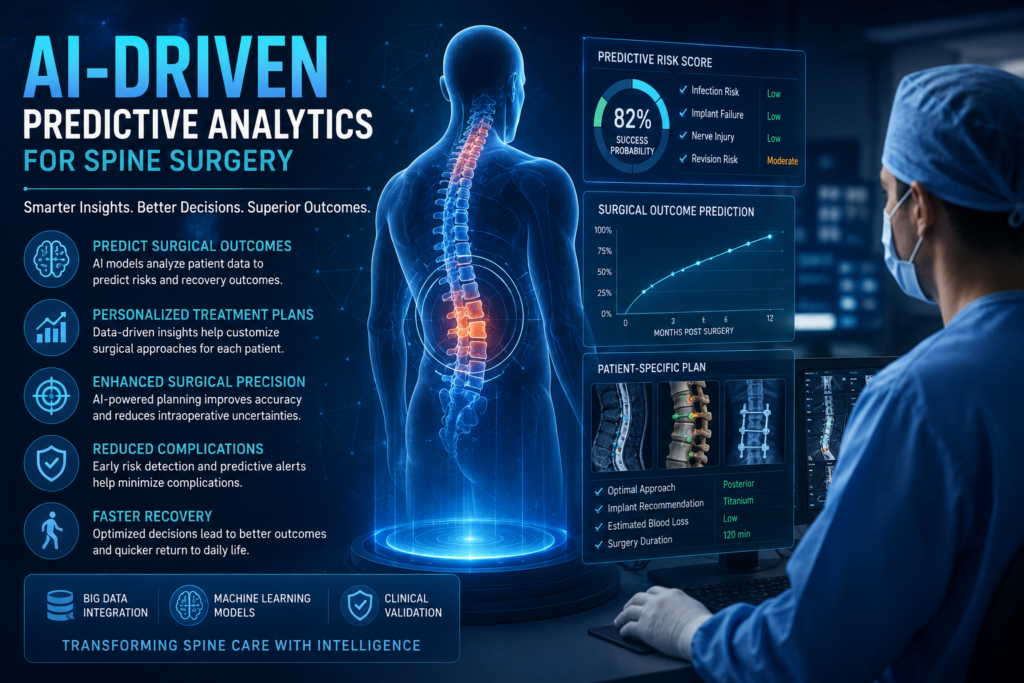
AI-Driven Predictive Analytics for Spine Surgery: A New Era of Precision Medicine
Few medical decisions carry consequences as profound as operating on the spine. A successfully executed spinal fusion or decompression can relieve years of debilitating chronic pain and restore mobility, while a poorly targeted procedure can lead to chronic discomfort, prolonged opioid use, or revision surgery.
For decades, orthopedic and neurosurgeons have relied on clinical intuition, standard risk scores, and generalized guidelines to determine who should go under the knife. Today, a technological paradigm shift is changing how surgeons plan care: AI-driven predictive analytics.
What is Predictive Analytics in Spine Surgery?
These include:
Patient demographics and comorbidities
Advanced imaging and bone quality metrics
Spinal alignment parameters
Psychosocial screening scores (e.g., anxiety or depression metrics)
Lifestyle factors (such as smoking status and opioid utilization history)
By processing these variables through trained algorithms, the system generates a personalized probability score. This tells the care team precisely how likely an individual patient is to achieve meaningful pain relief, experience a complication, require readmission, or face prolonged recovery.
Why Predictive Analytics Matters: Moving Beyond the "Average" Patient
Traditional medicine often treats patients based on population averages. However, spine surgery outcomes are famously multifactorial. Two patients with identical spinal stenosis on an MRI can experience entirely different surgical outcomes based on non-anatomic variables like mental health, bone density, and socioeconomic factors.
AI-driven models excel precisely where traditional clinical intuition is tested hardest:
Optimizing Patient Selection: Predictive tools help surgeons identify high-risk individuals before any incisions are made. If an algorithm flags a high probability of failure due to unmanaged osteoporosis, smoking, or severe psychological distress, the care team can initiate prehabilitation, smoking cessation programs, or bone health optimization before scheduling surgery.
Mitigating Complication Risks: Studies show that AI-supported planning tools can drastically reduce the risk of mechanical complications and adjacent segment issues by simulating precise alignment and implant placement.
Managing Patient Expectations: Transparent, data-backed insights allow surgeons to provide realistic recovery timelines. This minimizes disappointment and fosters a stronger, trust-based physician-patient relationship.
The Synergy: AI Analytics Meets Robotics and AR
Predictive analytics doesn’t just live on a computer screen; it bridges directly into the operating room. When combined with robotic-assisted surgery and advanced navigation platforms, predictive algorithms inform real-time intraoperative execution.
While AI analytics determines if and how a procedure should be approached based on predicted outcomes, surgical robots and augmented reality (AR) systems execute the plan with millimeter-level precision. This integration reduces operative times, minimizes blood loss, and shrinks incision sizes.
Challenges and the Path Forward
Despite its massive potential, AI in spine surgery is still evolving. Embracing these tools requires addressing specific hurdles:
Data Generalization: A model trained exclusively on data from a specialized metropolitan spine center may not perform accurately in a community hospital setting.
Algorithmic Bias: If historical training datasets lack demographic diversity, the model can miscalibrate risk for underrepresented populations.
Ethical and Legal Governance: Questions surrounding data privacy, electronic health record integration, and ultimate accountability for AI-assisted decisions remain critical subjects of ongoing medical debate.
To overcome these barriers, ongoing validation and rigorous oversight by spine surgeons are essential.
Conclusion
Artificial intelligence and predictive analytics are not here to replace human surgical judgment; rather, they are here to redefine what informed surgical judgment looks like. By converting subjective intuition into quantifiable, modifiable risk factors, AI empowers spine surgeons to deliver safer procedures, smoother recoveries, and better overall quality of life for every unique patient who walks through their doors.