
Breaking Boundaries: How Custom 3D-Printed Titanium Implants Are Revolutionizing Medicine
In medicine, one size has never truly fit all. For decades, orthopedic, craniofacial, and spinal surgeons had to rely on standard stock implants, often spending valuable operating room time bending, cutting, or modifying titanium plates to fit a patient’s unique anatomy.
Enter the era of custom 3D-printed titanium implants. By blending advanced digital imaging with state-of-the-art additive manufacturing, modern medicine is entering a paradigm shift where implants are grown layer-by-layer to match a single human body.
Let’s explore why this intersection of 3D printing and titanium is changing the face of modern surgery.
Why Titanium? The Gold Standard of Biomaterials
Before looking at how they are manufactured, it helps to understand why titanium is the material of choice for demanding medical applications. Titanium and its alloys offer a rare combination of physical properties:
Exceptional Biocompatibility: The human body readily accepts titanium, minimizing the risk of adverse immune reactions.
High Strength-to-Weight Ratio: It provides the structural integrity required to support load-bearing bones like hips, jaws, and spines without adding unnecessary weight.
Corrosion Resistance: It withstands the harsh, electrolytic environment of human bodily fluids effortlessly.
Favorable Elastic Modulus: Compared to older metals like stainless steel, titanium’s stiffness is closer to natural cortical bone, reducing the risk of stress shielding (where the implant bears all the load, causing surrounding bone to weaken).
The Workflow: From CT Scan to Custom Implant
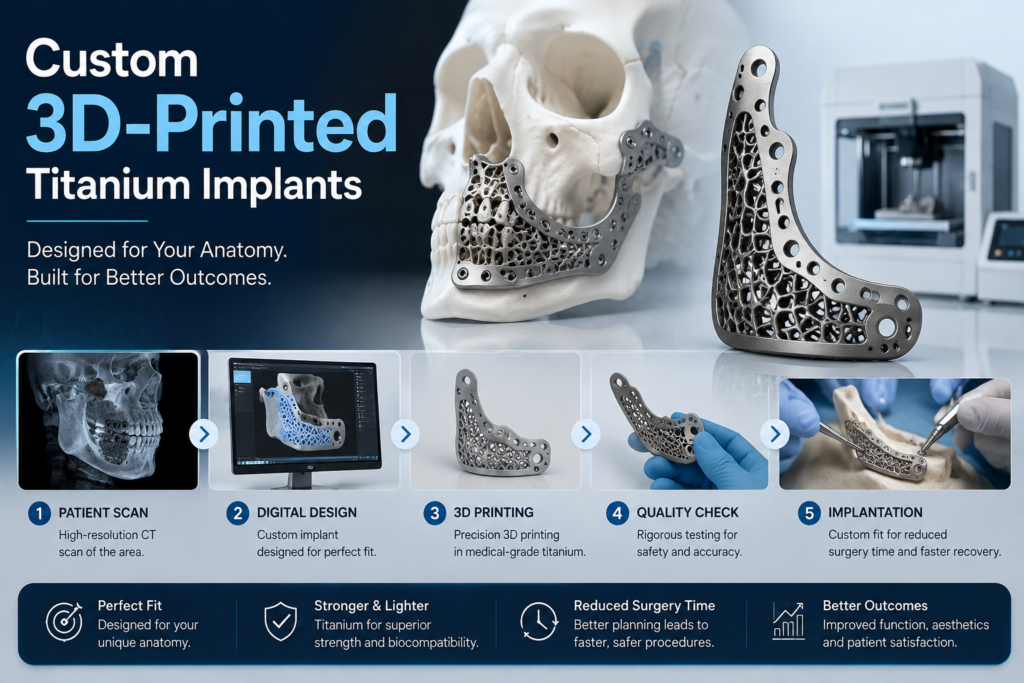
Creating a patient-specific titanium implant is a high-tech collaboration between medical imaging specialists, biomedical engineers, and surgeons. The process typically follows these four steps:
Digital Data Acquisition: High-resolution diagnostic scans (such as CT or MRI scans) capture the exact contours of a patient’s defect or skeletal structure.
Computer-Aided Design (CAD): Specialized software converts the scan data into a 3D digital model. Engineers and surgeons then design an implant that mirrors the missing or damaged bone down to a fraction of a millimeter.
Additive Manufacturing (3D Printing): Using technologies like Selective Laser Melting (SLM) or Electron Beam Melting (EBM), a high-powered laser or electron beam fuses microscopic titanium powder layer by layer to build the complex physical object.
Post-Processing & Sterilization: The finished implant undergoes heat treatment, rigorous cleaning, and medical-grade sterilization before it is delivered to the operating room.
Game-Changing Benefits for Patients and Surgeons
The shift toward custom 3D-printed titanium solutions offers remarkable clinical advantages over traditional manufacturing methods:
Perfect Anatomical Match: Because the device is engineered directly from the patient’s scan data, it fits seamlessly into complex geometries—such as facial bones, pelvic structures, or irregular spinal segments—where stock implants fall short.
Accelerated Osseointegration: 3D printing allows for the creation of intricate, porous lattice and trabecular structures that mimic natural spongy bone. This porous architecture encourages bone tissue to grow directly into and through the implant, locking it permanently in place.
Reduced Operating Time: Because the implant is pre-shaped and tailored, surgeons spend significantly less time modifying hardware mid-surgery, which translates to shorter anesthesia times and reduced surgical risks.
Enhanced Aesthetics and Function: In reconstructive and plastic surgery (such as jaw or cranial rebuilding), custom implants restore natural symmetry, expression, and structural function that standard plates simply cannot achieve.
Real-World Applications
Where are we seeing these implants used today?
Craniofacial & Maxillofacial Reconstruction: Rebuilding complex skull defects, eye sockets, or jaws following trauma or tumor removal.
Orthopedics & Spine: Tailored spinal cages, bone plates, and complex joint revisions that require maximum stability.
Oncology Cases: Replacing large sections of bone safely excised during cancer treatments, such as sarcomas
Looking Ahead
As software automation improves and 3D-printing speeds increase, custom titanium implants are transitioning from elite, specialized interventions to mainstream clinical practice. By marrying human anatomy with digital precision, custom 3D-printed titanium implants are doing much more than mending bones—they are restoring lives with unprecedented accuracy.
Would you like to dive deeper into a specific application of this technology, such as its use in spinal fusion or jaw reconstruction?