
We have all been there. After a long, exhausting day of work, commuting, and responsibilities, nothing feels quite as inviting as collapsing onto the sofa. We sink into the cushions, grab the remote, and melt into a posture that feels like pure, unadulterated relief.
We call it relaxing. But biomechanically speaking, your body might call it a disaster.
In the modern era of remote work, streaming services, and constant screen time, “couch slouching” has quietly become a national pastime. While kicking back on the sofa feels harmless—even necessary for unwinding—prolonged slouching takes a severe, cumulative toll on our physical health, mental well-being, and long-term mobility.
It is time to look beyond the cozy cushions and examine the hidden dangers of the modern couch slouch.
The Anatomy of a Slouch: What Happens to Your Body?
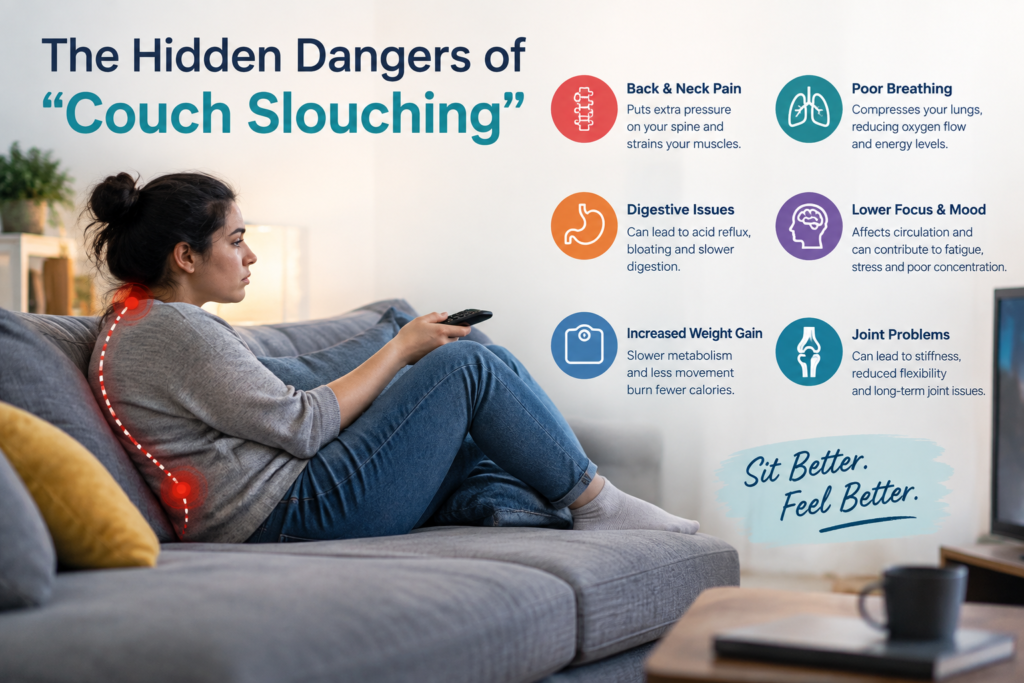
When you sink into a plush sofa, your spine loses its natural, supportive S-curve. Instead, it collapses into a continuous, rigid C-shape. This might feel comfortable for the first ten minutes, but a domino effect begins almost immediately beneath the surface.
1. The Spine Under Siege
Your vertebral column is an architectural marvel designed to distribute weight evenly through natural curves in your neck, mid-back, and lower back. Slouching forces the lower back (lumbar region) to flatten or bow outward, placing immense, unnatural pressure on your intervertebral discs. Over time, this uneven pressure can lead to:
Disc herniation or bulging: The jelly-like center of the disc pushes outward against surrounding nerves.
Premature degeneration: The connective tissues and cartilage wear down much faster than they would under normal alignment.
2. Muscle Imbalances and Fatigue
When you slouch, certain muscles are forced to overwork while others completely switch off. Your chest muscles (pectorals) shorten and tighten, while your upper back muscles (rhomboids and trapezii) stretch out, weaken, and eventually forget how to properly support your frame. This sets off a frustrating cycle: the weaker your postural muscles become, the more exhausting it is to sit up straight, driving you right back into the slouch.
3. Compromised Breathing and Digestion
Have you ever noticed how shallow your breath feels when you are deeply slumped on the couch? Slouching compresses your thoracic cavity, leaving your diaphragm and lungs with less room to expand. This restricts your oxygen intake, which can lower your energy levels and leave you feeling sluggish. Furthermore, compressing your abdominal cavity pushes your stomach and digestive organs upward, which can contribute to acid reflux, indigestion, and a sluggish metabolism.
The Mental Trap: How Posture Affects Your Mind
The consequences of couch slouching extend well beyond musculoskeletal aches. There is a fascinating, bidirectional communication highway between your body and your brain.
The Posture-Mood Loop
Numerous psychological studies have shown that physical posture directly influences emotional state and cognitive processing. Slouching is subconsciously associated by the brain with defeat, fatigue, sadness, and low self-efficacy.
-
Increased Stress: Poor posture has been linked to elevated levels of cortisol (the stress hormone).
-
Lower Confidence: Slumped individuals often report lower self-esteem and higher feelings of helplessness during problem-solving tasks compared to those sitting upright.
When you slouch on the couch to “de-stress,” your physical posture might actually be tricking your brain into staying in a low-energy, heightened-stress state, working against your goal of true relaxation.
The Long-Term Fallout: Chronic Pain and Mobility Loss
Occasional slouching is not going to ruin your life. The human body is resilient. The real danger lies in chronic, habitual slouching—spending hours every single evening molding your spine into the shape of your sofa.
Over the course of years, this habit hardens into structural reality.
Hyperkyphosis: Commonly known as a “dowager’s hump” or excessive outward rounding of the upper back, this condition limits your range of motion, strains your neck, and can eventually affect your balance and breathing capacity.
Chronic Low Back Pain: What starts as a dull ache after a Netflix marathon can morph into persistent, debilitating lower back pain that interferes with walking, exercising, and sleeping.
Atrophied Core: Your deep abdominal and stabilizing muscles turn to “jelly” when the couch does the heavy lifting for you, making you far more susceptible to acute injuries when you finally do decide to move.
Reclaiming Your Comfort: How to Save Your Spine
You do not have to banish your sofa or live life sitting at rigid attention like a Victorian aristocrat. Relaxation is vital for mental health. The key is mindful lounging and breaking the cycle of structural neglect.
Rethinking How We Rest
Our couches were designed for comfort, but they have inadvertently become traps for our musculoskeletal health. By understanding the hidden dangers of couch slouching, you can transform how you unwind.
Next time you sink into the sofa, pause for a moment. Check in with your body. Support your lower back, keep your chest open, and remember that true relaxation shouldn’t come at the cost of your posture. Your spine will thank you tomorrow.
What is your go-to strategy for staying active and maintaining good posture during your downtime?
+————————————————————-+
| STRATEGIES FOR HEALTHIER LOUNGING |
+————————————————————-+
| • The 30-Minute Rule: Stand up, stretch, or walk around |
| every half hour during screen time. |
| • Strategic Cushioning: Place a small pillow or rolled |
| towel behind your lower back to maintain your lumbar curve.|
| • Core Activation: Alternate couch time with floor seating, |
| which forces your core and hips to actively engage. |
| • Targeted Stretching: Incorporate chest-openers and hip |
| flexor stretches into your daily routine. |