
Core Beyond Crunches: Why Your Midsection Needs More Than Just Sit-Ups
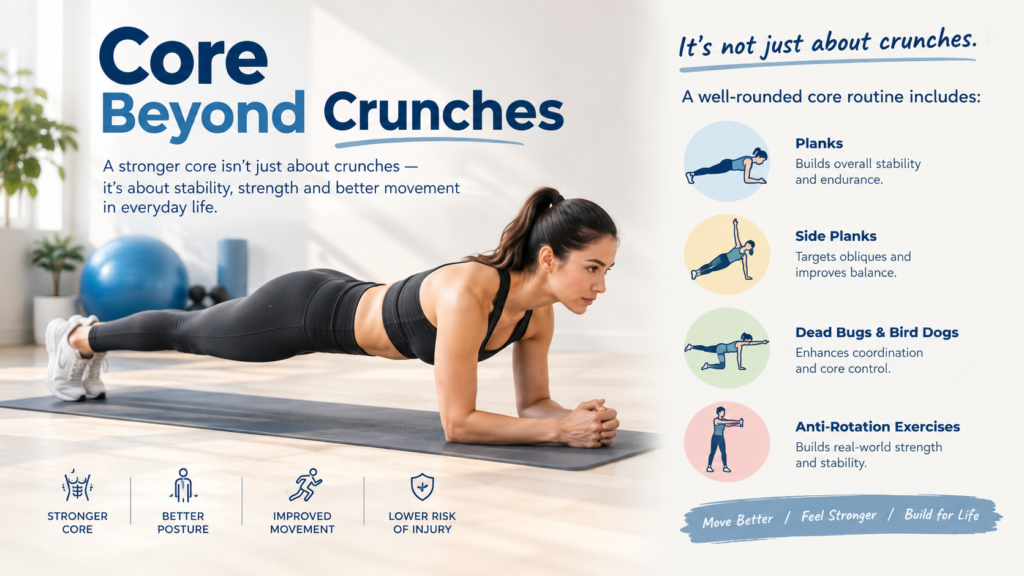
When people think of core training, endless crunches and sit-ups usually come to mind. But a truly resilient midsection involves much more than bending your spine back and forth. The core is a complex 360-degree cylinder designed to stabilize your body, protect your spine, and transfer power seamlessly between your upper and lower body.
Understanding the True Anatomy of the Core
Your core isn’t just your rectus abdominis (the “six-pack” muscles). It includes deep stabilizers like the transverse abdominis, your obliques, the lower back muscles, glutes, and even your diaphragm. Together, they act as a natural weightlifting belt that supports your posture during everyday movements and intense athletic feats.
Why Traditional Crunches Fall Short
-
Spinal Stress: Repeatedly flexing the spine under load can place unnecessary strain on your lower back discs.
-
Lack of Functional Stability: Crunches only train forward flexion, completely ignoring anti-rotation, lateral stability, and anti-extension.
-
Limited Transferability: Daily life rarely requires you to crunch from a lying floor position; it demands stability while standing, twisting, and carrying.
Top Exercises for Functional Core Strength
Planks & Variations: Build isometric anti-extension endurance to keep your spine neutral under gravity.
Pallof Presses: Challenge your anti-rotation strength, which is vital for twisting movements and sports.
Farmer’s Carries: Train functional bracing and grip strength under heavy, dynamic loads.
Dead Bugs: Teach your limbs to move independently while keeping your core braced and stable.
Moving beyond crunches unlocks true functional fitness, better posture, and a lower risk of injury. It is time to train your core for what it was actually built to do: protect and empower your entire body.
Would you like me to turn these exercises into a step-by-step weekly core routine?