
Rewiring Your Spine: How Multifidus Muscle Stimulation (ReActiv8) Is Changing Chronic Back Pain Treatment
If you have been battling chronic low back pain for years, you are likely all too familiar with the revolving door of treatments: physical therapy, core exercises, pain medications, chiropractic adjustments, and perhaps even nerve blocks or steroid injections. While these methods help many, millions of people find themselves trapped in a cycle of persistent, mechanical back pain that refuses to go away.
Enter a paradigm shift in neuromodulation: Restorative Neurostimulation, widely known by the device name ReActiv8.
Rather than just masking pain signals or masking inflammation, ReActiv8 targets one of the most overlooked root causes of chronic back pain—multifidus muscle dysfunction.
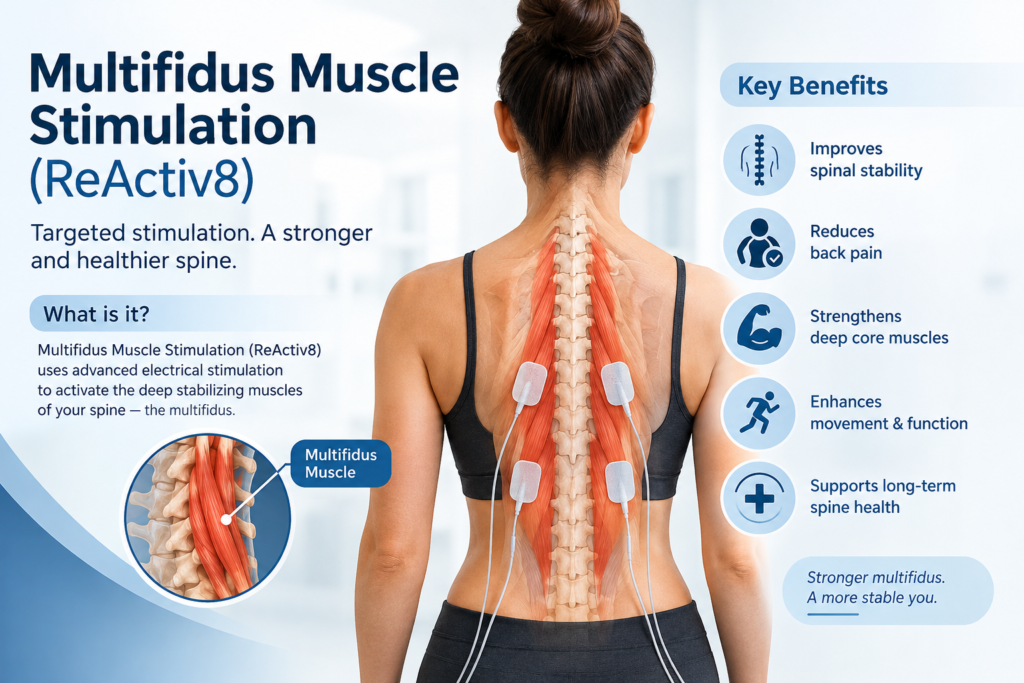
The Missing Link: Why Your Back Feels "Unstable"
To understand why ReActiv8 is generating excitement in the pain management community, we have to look at a small but mighty muscle running along your spine: the lumbar multifidus.
The multifidus muscles are deep stabilizers. Think of them as the guy-wires on a tent; they provide segmental stability to your vertebrae every time you bend, twist, lift, or even stand still.
However, when you suffer a back injury or experience severe, prolonged pain, a strange phenomenon occurs: arthrogenic muscle inhibition. Your nervous system essentially hits a “kill switch” to the multifidus muscle. Even after the initial injury heals, the brain stops properly communicating with the muscle.
The muscle goes into a state of disuse and atrophy.
Your spine loses its natural internal bracing system.
You experience mechanical instability, leading to more pain, which causes further muscle shutdown.
Standard core exercises and physical therapy often struggle to break this cycle because the neural connection is blocked; your brain simply won’t “fire” the muscle correctly.
What Is ReActiv8 and How Does It Work?
ReActiv8 is an implantable neurostimulation system specifically designed to solve this exact problem.
Unlike a traditional Spinal Cord Stimulator (SCS), which is designed to intercept and mask pain signals traveling to the brain, ReActiv8 is a restorative therapy.
The Placement: During a minimally invasive outpatient procedure, a surgeon places tiny leads (electrodes) near the nerves that control the lumbar multifidus muscles, connecting them to a small implantable pulse generator.
The Routine: Once healed, patients use a handheld wireless remote to activate the device twice a day for about 30 minutes per session.
The Activation: The device delivers gentle, rhythmic electrical pulses that trigger isolated contractions of the multifidus muscle.
The Retraining: Because you are resting (usually lying down) during these sessions, the muscle contracts without bearing weight, allowing it to safely re-learn activation patterns, build endurance, and restore structural stability over time.
Who Is a Candidate for ReActiv8?
ReActiv8 is not intended as a first-line treatment, nor is it designed for every type of back pain (such as acute disc herniations with severe nerve compression or sciatica). Instead, it is typically considered for adults who meet criteria such as:
Intractable Chronic Mechanical Low Back Pain: Pain lasting 6 months or longer that is mechanical in nature (worsened by movement or load).
Failed Conservative Care: Patients who have exhausted options like physical therapy, medications, and targeted injections without lasting relief.
Documented Multifidus Dysfunction: Evidence of poor neuromuscular control or muscle atrophy in the lower back.
Not a Spine Surgery Candidate: Individuals who do not have major structural instabilities requiring fusion, but still suffer from debilitating, functional back pain.
What Does Clinical Research Show?
Clinical trials evaluating restorative neurostimulation have reported encouraging long-term outcomes:
Significant Pain and Disability Reduction: A large percentage of clinical trial participants achieve meaningful, sustained drops in pain scores and functional disability ratings over multi-year follow-up periods.
Decreased Medication Reliance: Many patients successfully reduce or completely eliminate their reliance on heavy pain medications, including opioids.
Functional Recovery: Because the therapy focuses on fixing the root instability rather than numbing the sensation, patients frequently report a renewed confidence in everyday movements—like bending down to pick up a grandchild or returning to work.
Looking Ahead
Chronic back pain can make your world very small. When your back feels unreliable, fear of movement often takes over. Multifidus muscle stimulation represents a shift away from endless symptom-management and toward genuine neuromuscular rehabilitation.
By waking up the muscles that nature intended to protect your spine, ReActiv8 gives patients a viable pathway to rebuild strength, reclaim their mobility, and get back to living life on their own terms.
Disclaimer: This blog is for informational purposes only and does not constitute medical advice. If you are struggling with chronic low back pain, consult with a qualified interventional pain specialist or spine surgeon to discuss whether restorative neurostimulation is right for you.
Would you like to explore the specific surgical recovery timeline or compare ReActiv8 more closely with traditional spinal cord stimulation?