
Revolutionizing Spinal Fusion: The Rise of Expandable Interbody Cages
Spinal fusion surgery has transformed significantly over the decades, moving from rigid, fixed implants to dynamic, patient-tailored solutions. Among the most impactful advancements in modern spine surgery are expandable interbody cages. These innovative devices are changing how surgeons approach lumbar and thoracic fusions, offering enhanced precision, anatomical restoration, and improved patient recovery trajectories.
Expandable interbody cages represent a major advancement in spinal fusion surgery, replacing rigid, fixed-height implants with dynamic devices that can be adjusted in situ. By being inserted in a compact profile and then expanded to restore precise disc height and natural anatomical lordosis, these cages minimize the need for aggressive bone removal and reduce trauma to surrounding neural and muscular tissues. This customizable fit not only improves sagittal balance and maximizes endplate contact for superior fusion rates, but it also paves the way for safer, less invasive procedures and more reliable recovery outcomes for patients with degenerative spinal conditions.
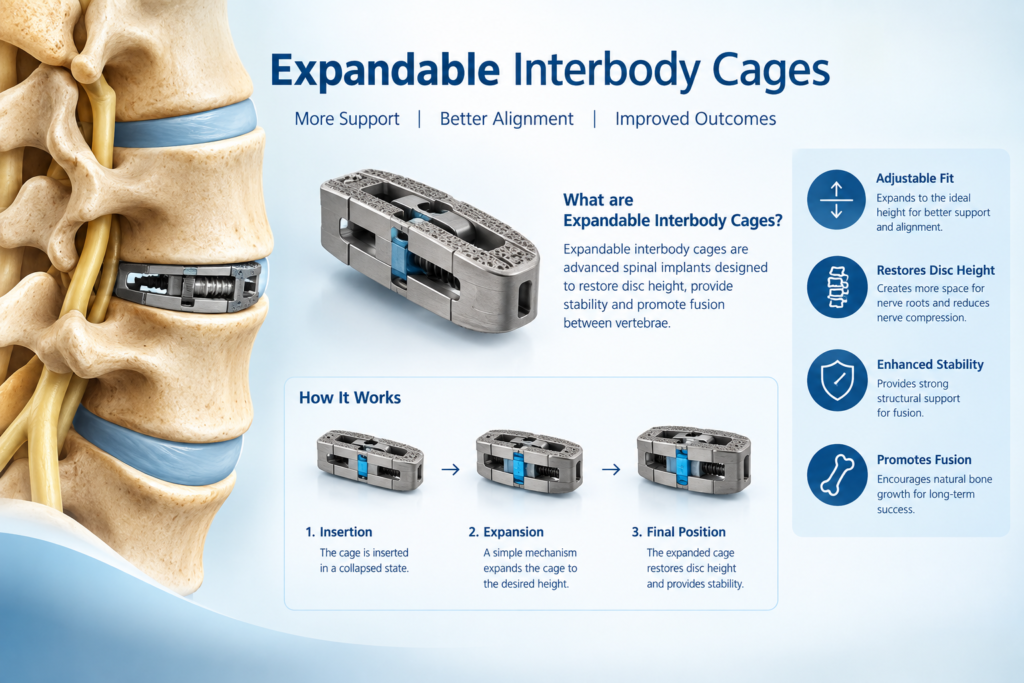
Understanding Expandable Interbody Cages
Traditional static cages are manufactured at a fixed height, which often requires a larger surgical corridor, forceful retraction, or excessive bone removal to fit properly into a collapsed disc space. In contrast, expandable cages are inserted in a compact, low-profile state and then expanded in situ to the exact height and lordotic angle required. This allows surgeons to restore optimal disc height with minimal disruption to surrounding neural and muscular tissues.
Key Clinical Benefits
The shift toward expandable technology is driven by several distinct surgical and clinical advantages:
Minimized Tissue Trauma: Smaller insertion profiles significantly reduce the risk of nerve root irritation and muscle damage.
Restoration of Sagittal Balance: Precise in-situ expansion helps accurately recreate the spine’s natural curvature and alignment.
Enhanced Bone Graft Contact: Greater surface area expansion maximizes vertebral endplate coverage, fostering superior fusion rates.
Reduced Insertion Force: Sliding a collapsed cage into place lowers the risk of endplate fracture during placement.
The Future of Minimally Invasive Spine Surgery
As engineering techniques and image-guided surgery continue to evolve, expandable interbody cages are solidifying their place as a cornerstone of minimally invasive spine care. By blending anatomical customization with structural stability, they provide a reliable pathway toward faster recovery and long-term relief for patients suffering from degenerative disc disease and spinal stenosis.
Would you like me to generate SEO-optimized image assets (such as file names, alt text, and meta descriptions) for this blog post based on your preferences?