
Receiving a diagnosis like degenerative disc disease, spinal stenosis, or a herniated disc often feels like a finish line you weren’t ready to cross. For the lifelong runner or the cyclist who finds their zen at 90 RPM, the clinical language of an MRI can sound like an eviction notice from the sports they love.
But here is the reality: your spine is not a fragile stack of porcelain. It is a robust, adaptable structure. With the right shifts in strategy, “aging athlete” doesn’t have to mean “retired athlete.”
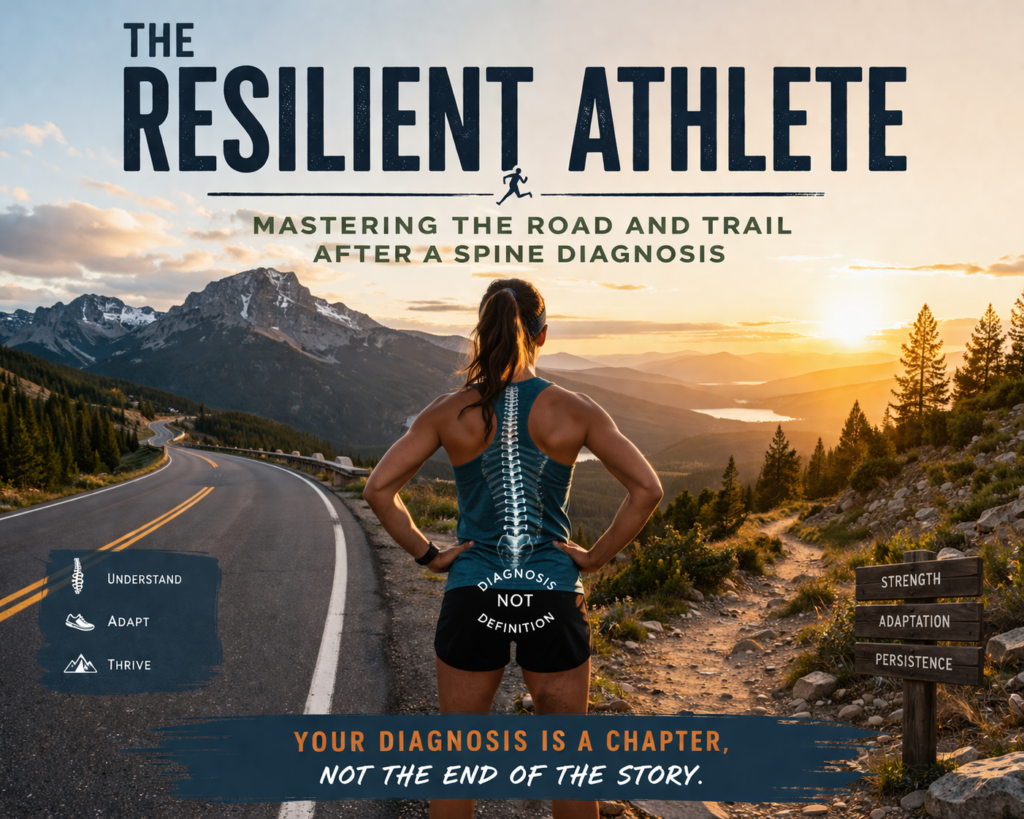
1. The Mindset Shift: From "Broken" to "Managing Load"
The most significant hurdle isn’t usually the vertebrae; it’s the psychology of the diagnosis. Many athletes fall into the trap of kinesiophobia—the fear of movement.
Understanding the "Graying" Spine
Just as skin wrinkles, the spine undergoes natural changes. Research shows that a high percentage of asymptomatic people (those with no pain) have disc bulges or arthritis on their scans. A diagnosis is often just a “snapshot” of a moment, not a life sentence.
The Golden Rule: Let symptoms, not scans, dictate your activity. If a movement causes sharp, radiating, or increasing pain, we pivot. If it’s just the “good” kind of tired, we proceed.
2. Strategic Running: Reducing the G-Force
Running is essentially a series of controlled, single-leg hops. The impact forces can reach 2.5 to 3 times your body weight per step. For a compromised spine, the goal isn’t to stop running; it’s to dampen the vibration.
Shorten Your Stride
Over-striding (landing with your foot far in front of your body) creates a massive braking force that travels straight up to your lumbar spine.
The Fix: Increase your cadence (steps per minute) by 5–10%. Taking smaller, quicker steps encourages a midfoot strike and allows your knees and ankles to act as natural shock absorbers before the force reaches your back.
Surface Selection
If you have spinal stenosis or disc issues, the “give” of the surface matters.
The Best: Graded gravel, synthetic tracks, or firm forest trails.
The Worst: Cambered (slanted) asphalt or uneven concrete sidewalks.
Gear Up
Now is the time to embrace maximalist footwear. Brands like Hoka or New Balance’s Fresh Foam line provide stack heights that significantly reduce the peak impact force on the skeletal system.
3. The Cyclist’s Edge: Geometry and Ergonomics
Cycling is often touted as the “safe” alternative for bad backs, but the prolonged flexion (hunched position) of a road bike can be a nightmare for certain disc conditions.
The Professional Bike Fit
A “good enough” fit at age 25 is a recipe for a flare-up at 55. If you have a spine condition, a professional fit is non-negotiable.
Handlebar Height: Raising the “stack” (height of the bars) reduces the strain on the lower back.
Reach: A shorter stem can keep you from overextending, which prevents “locking out” the lumbar spine.
Specialized Considerations
For Disc Herniations: You likely prefer a more upright position (think endurance geometry or even a mountain bike).
For Spinal Stenosis: Many athletes with stenosis actually feel better in a slightly flexed position, as it opens the spinal canal.
4. The "Support Beam": Beyond the Core
We’ve all heard we need a “strong core,” but for the aging athlete, we need to redefine what that means. It isn’t about six-pack abs; it’s about spinal stiffness and hip mobility.
The Big Three (and a Half)
Dr. Stuart McGill’s “Big Three” exercises are the gold standard for creating a “muscular brace” around the spine:
The Modified Curl-Up: For anterior stability.
The Side Bridge: For lateral stability (crucial for runners to prevent pelvic drop).
The Bird-Dog: For posterior chain activation without high spinal load.
The Big Three (and a Half)
Dr. Stuart McGill’s “Big Three” exercises are the gold standard for creating a “muscular brace” around the spine:
The Modified Curl-Up: For anterior stability.
The Side Bridge: For lateral stability (crucial for runners to prevent pelvic drop).
The Bird-Dog: For posterior chain activation without high spinal load.
The "Stolen" Mobility
Often, back pain occurs because the hips are locked up. If your hips can’t move, your lower back will try to do the moving for them. Focus on:
-
Hip Flexor Release: Long hours of sitting or cycling shorten these, pulling your pelvis into a tilt that stresses the discs.
GluteActivation: Strong glutes are a runner’s best friend. They take the “work” of propulsion away from the lower back.
5. Recovery: The New Training Peak
In your 20s, recovery was what happened while you slept. At 50+, recovery is the training.
The 48-Hour Rule
As we age, the rate of collagen synthesis slows down. If you have a spine condition, your “window” for recovery is longer. Try to avoid back-to-back high-impact days.
Example: Run Monday, Strength/Yoga Tuesday, Cycle Wednesday, Rest Thursday.
Anti-Inflammatory Lifestyle
Chronic low-grade inflammation makes a diagnosed spine condition feel much worse.
Hydration: Discs are primarily water. Dehydration leads to loss of disc height and less cushioning.
Sleep: This is when your body repairs micro-trauma. Aim for 7–9 hours.
6. Knowing When to Pivot
Authenticity matters: there may come a day when a 20-mile road run is no longer the best choice for your long-term mobility. However, that doesn’t mean you stop being an athlete.
The Elliptigo: A brilliant hybrid for runners who can’t handle the impact but want the upright “running” motion and outdoor experience.
E-Bikes: For the cyclist with spinal issues, an E-bike allows you to stay in the group and enjoy the scenery without the high-torque climbing efforts that can strain the lower back.