
The human head weighs between 10 and 12 pounds in a neutral, upright position. However, tilting the head forward to look down at a smartphone screen, tablet, or laptop dramatically alters this physical dynamic. At a 60-degree angle—the typical posture assumed when texting or scrolling—the gravitational burden on the cervical spine spikes to roughly 60 pounds (27 kg).
This chronic postural collapse is clinically known as forward head posture (FHP), but in modern digital health, it goes by a more ubiquitous name: Tech Neck. Studies indicate that up to 73% of young adults and office workers experience postural changes and associated neck discomfort due to repetitive screen viewing.
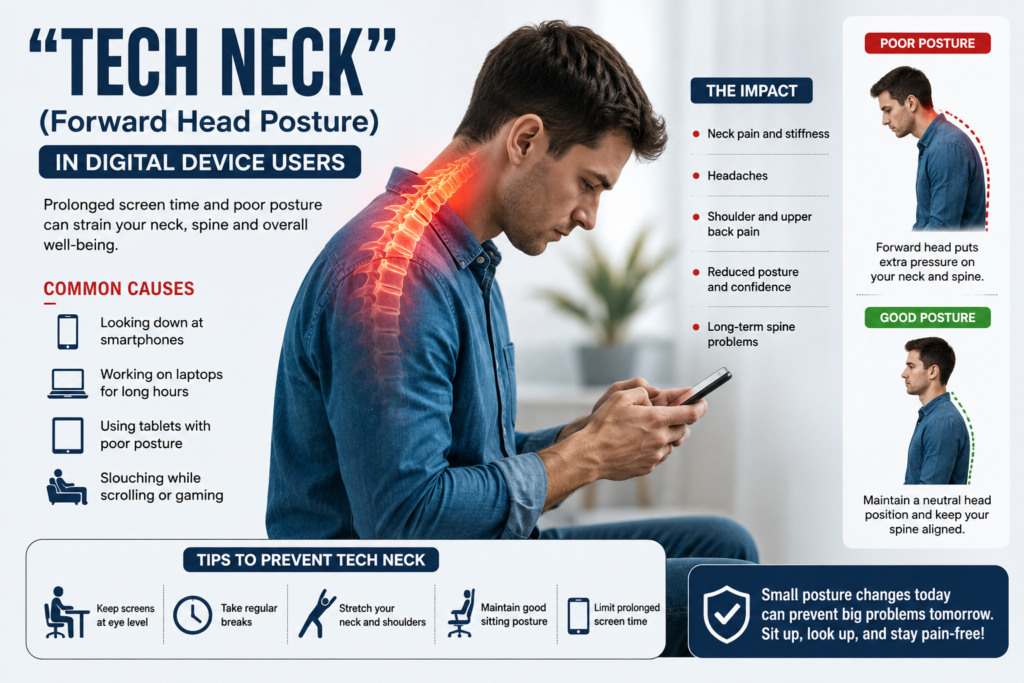
The Biomechanics of Tech Neck
To understand why Tech Neck causes widespread physical discomfort, it helps to review the structural engineering of the human neck. The cervical spine consists of seven vertebrae (C1 to C7) arranged in a gentle, backward C-shaped curve called cervical lordosis. This curvature acts as a natural shock absorber, distributing the heavy weight of the skull evenly across spinal discs, facet joints, and supporting ligaments.
When you tilt your head forward, the center of gravity shifts in front of the spine’s central load-bearing axis. The neck muscles—primarily the upper trapezius, levator scapulae, and suboccipital muscles—must continually contract to prevent the head from dropping completely forward.
Muscle Imbalance: Upper Crossed Syndrome
Tight and Overactive Anterior Muscles: As the head protrudes, the pectoralis major and minor muscles in the chest shorten and tighten, pulling the shoulder blades forward and rounding the upper back (kyphosis). Simultaneously, the sternocleidomastoid (SCM) and suboccipital muscles at the base of the skull become chronically hypertonic.
Weak and Inhibited Posterior Muscles: Because the chest and anterior neck muscles are constantly short and tight, the opposing muscles become stretched out and structurally weakened. The deep cervical flexors (the muscles along the front of the spinal column that keep the neck stable) lose endurance, while the rhomboids and lower trapezius muscles in the mid-back lose their ability to pull the shoulder blades together.
This muscular imbalance locks the upper body into a self-reinforcing slump. The weaker the back muscles become, the harder it is to hold an upright posture, driving the head further forward.
Systemic Health Consequences
While stiffness and tension are the most immediate complaints, chronic Tech Neck causes secondary health issues across multiple body systems:
Cervical Spine Degeneration and Disc Herniation
The unnatural pressure applied to the anterior portion of the vertebral bodies compresses the intervertebral discs. Over time, this accelerates disc wear and tear, increasing the risk of cervical disc bulging or herniation. Research indicates that individuals with severe forward head posture exhibit a significantly higher incidence of cervical disc herniation compared to those with neutral alignment.
Cervicogenic Headaches and Nerve Compression
Tension in the suboccipital muscles at the base of the skull can compress the greater occipital nerves. This compression triggers cervicogenic headaches, which typically present as a dull, throbbing pain originating at the top of the neck and radiating forward over the scalp toward the eyes or temples. Furthermore, bone spurs or narrowed neural foramina in the lower neck can pinch cervical nerve roots, causing numbness, tingling, or weakness radiating down the arms and into the fingers
Restricted Respiration and Lung Capacity
Postural slumping directly impacts ribcage expansion. When shoulders round forward and the thoracic spine curves excessively, the diaphragm’s movement is restricted. Studies show that forward head posture can decrease vital lung capacity by up to 30%, forcing the body to rely on shallow chest breathing that engages auxiliary neck muscles, furthering neck strain.
Temporomandibular Joint (TMJ) Strain
As the head projects forward, the lower jaw (mandible) is pulled backward and downward relative to the skull due to soft tissue tension. This subtle shift alters the bite mechanics, stressing the temporomandibular joint and leading to jaw popping, facial pain, and involuntary teeth clenching (bruxism).
Ergonomic Workspace Solutions
[ Monitor Top ] <— Eye Level Alignment
|
[ Screen ] <— Arm’s Length Away (20 – 30 inches)
|
[ Keyboard ] <— Elbows at 90° – 100° Angle
|
[ Chair ] <— Lumbar Support Active, Feet Flat on Floor
1. Optimize Screen Elevation
Desktop Monitors: Adjust the top third of your computer screen so it aligns directly with your eye level. This encourages a neutral gaze straight ahead rather than downward.
Laptops: Laptops unite the keyboard and screen, forcing users into a downward gaze. Use a laptop riser or a stack of books to lift the laptop display to eye level, and pair it with an external keyboard and mouse.
Smartphones & Tablets: Bring the device up toward eye level using your hands, rather than bringing your head down toward the device. Rest your elbows against your torso to minimize arm fatigue while holding your device up.
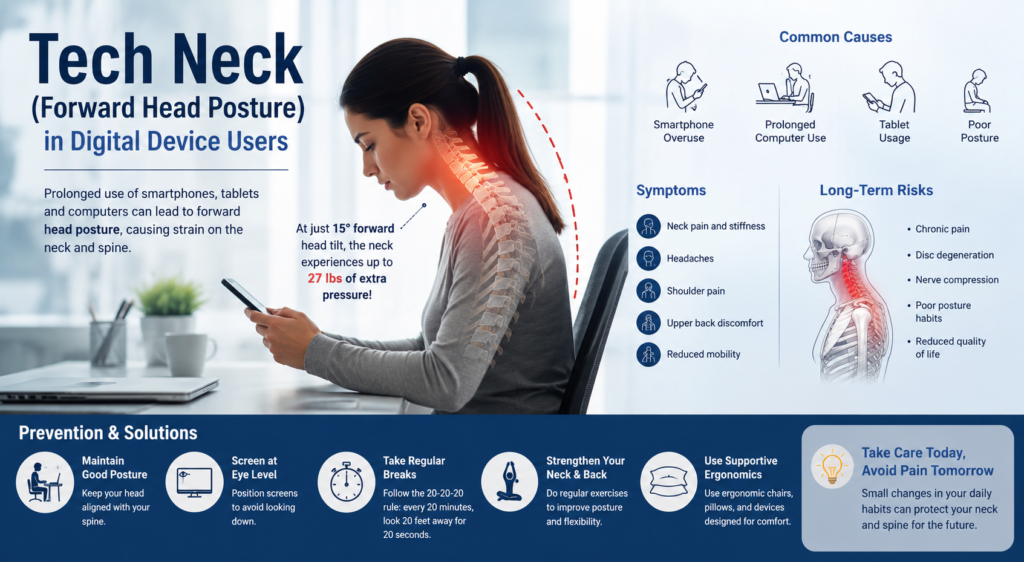
2. Seating and Spine Alignment
Desktop Monitors: Adjust the top third of your computer screen so it aligns directly with your eye level. This encourages a neutral gaze straight ahead rather than downward.
Laptops: Laptops unite the keyboard and screen, forcing users into a downward gaze. Use a laptop riser or a stack of books to lift the laptop display to eye level, and pair it with an external keyboard and mouse.
Smartphones & Tablets: Bring the device up toward eye level using your hands, rather than bringing your head down toward the device. Rest your elbows against your torso to minimize arm fatigue while holding your device up.
Corrective Exercises and Stretches
To reverse established forward head posture, target both sides of Upper Crossed Syndrome: stretch tight anterior muscles and strengthen weak posterior muscles. Perform these daily exercises to restore tissue balance.
Step 1: Decompress & Reset
The Chin Tuck: Sit or stand up straight. Look straight ahead, place two fingers on your chin, and gently glide your head directly straight backward (creating a “double chin” effect). Do not tilt your head down; keep your gaze horizontal. Hold for 5 seconds, release, and repeat 10 to 12 times. This strengthens deep neck flexors while lengthening suboccipital muscles.
Doorway Chest Stretch: Stand inside an open doorway. Raise your arms to 90-degree angles (like a goalpost) and place your forearms against the doorframe. Step forward gently with one foot until you feel a stretch across your chest and shoulders. Hold for 30 seconds while breathing deeply. Repeat 3 times.
Step 2: Activate Posterior Muscles
Scapular Retractions (Y-T-W Drills): Stand with your back against a wall. Squeeze your shoulder blades down and back, as if trying to hold a pencil between them. Raise your arms to form a “Y”, bring them down to a “T”, and then bend elbows into a “W”, holding each shape for 5 seconds. Repeat 8 cycles.
Prone Cobra: Lie face down on a comfortable mat with arms at your sides, palms facing down. Contract your upper back to lift your chest, shoulders, and hands off the floor while keeping your eyes focused on the floor (maintaining a tucked chin). Hold for 10 seconds, lower, and repeat 6 times.
When to Seek Professional Evaluation
Correction is an ongoing practice rather than a single fix. Integrating these small behavioral shifts into your daily routine helps prevent structural relapse:
Adhere to the 20-20-20 Rule: Every 20 minutes, take a 20-second break and look at an object at least 20 feet away. Use this pause to perform three quick chin tucks and shoulder rolls.
Set Position Prompts: Create visual or digital triggers. For example, every time you open a video call, join a phone conversation, or read an email, perform a quick posture audit: ears over shoulders, shoulders over hips.
Hydrate Spinal Discs: Intervertebral discs rely on adequate systemic hydration to retain their height, elasticity, and cushioning properties. Drink sufficient water throughout the day.
Incorporate Dynamic Movement: Human physiology is designed for motion rather than static postures. Switch between sitting and standing workstations, or take walking breaks during phone calls.
Tech Neck is a natural byproduct of modern digital convenience, but it does not have to become a permanent structural handicap. By optimizing your device height, taking strategic movement micro-breaks, and consistently strengthening key upper-body muscles, you can protect your spine and maintain optimal posture in an increasingly screen-centric world.