
The Silent Strain: Understanding and Preventing Text Neck in Children and Adolescents
In an era where digital devices are integral to learning, socialization, and entertainment, a quiet physical health crisis is emerging among youth. From toddlers watching videos on tablets to teenagers scrolling through social media or gaming for hours, young people spend unprecedented time looking down at screens. This repeated forward-head posture gives rise to a modern musculoskeletal disorder: Text Neck Syndrome.
While neck strain was once considered an adult condition linked to desk jobs, healthcare professionals now observe a sharp rise in children and adolescents presenting with chronic neck pain, upper back stiffness, and tension headaches. Because a child’s skeletal system is still growing, uncorrected postural stress can lead to long-term spinal complications.
What Is Text Neck Syndrome?
Text neck refers to the repetitive strain injury and pain caused by looking down at handheld devices—such as smartphones, tablets, handheld consoles, or e-readers—for prolonged periods.
When standing with neutral posture, an average human head weighs between 10 to 12 pounds (approx. 4.5 to 5.5 kg). However, as the neck tilts forward and downward, the gravitational force exerted on the cervical spine increases exponentially:
| Neck Angle (Degrees) | Effective Weight on Cervical Spine | Physical Impact |
| 0° (Neutral) | 10 – 12 lbs (4.5 – 5.5 kg) | Balanced distribution; minimal muscle strain. |
| 15° | 27 lbs (12.2 kg) | Mild muscle tightening in upper trapezius. |
| 30° | 40 lbs (18.1 kg) | Notable tension on upper back and shoulder girdle. |
| 45° | 49 lbs (22.2 kg) | Significant strain on cervical ligaments and spinal discs. |
| 60° | 60 lbs (27.2 kg) | Equivalent to carrying an 8-year-old child around the neck. |
When young people sit or slouch at 45° to 60° angles for 3 to 6 hours daily, the surrounding spinal ligaments, tendons, and supporting muscles endure continuous micro-trauma.
Why Children and Adolescents Are Uniquely Vulnerable
Adolescents and children are not simply miniature adults; their bodies are undergoing rapid structural development. Several factors make them particularly susceptible to text neck:
Malleable Skeletal Systems: A child’s spinal column, growth plates, and surrounding ligaments are flexible and still developing. Sustained abnormal pressure can alter proper bone alignment and soft tissue adaptation.
Higher Cumulative Device Exposure: Modern students utilize digital media for both academic work and social connection, combining school laptop use with evening smartphone browsing.
Lack of Body Awareness: Children frequently fail to register early discomfort or pain cues, maintaining fixed, awkward positions for hours during immersive gaming or streaming sessions.
Reduced Physical Play: Increased screen time often correlates with decreased unstructured physical play, weakening the core and back musculature required to support healthy posture.
Signs and Symptoms to Watch For
Text neck presents through both physical discomfort and behavioral shifts. Parents, guardians, and educators should look out for the following warning signs:
                  +-----------------------------------+
                  |   Symptom Profile of Text Neck   |
                  +-----------------------------------+
                                    |
        +---------------------------+---------------------------+
        |                                                       |
[ Physical Symptoms ]                                  [ Functional Impacts ]
  • Persistent neck/shoulder ache                        • Reduced cervical mobility
  • Suboccipital tension headaches                       • Rounded shoulders (kyphosis)
  • Numbness/tingling in hands                           • Reduced chest expansion
  • Upper back muscle spasms                             • Fatigue during seated tasks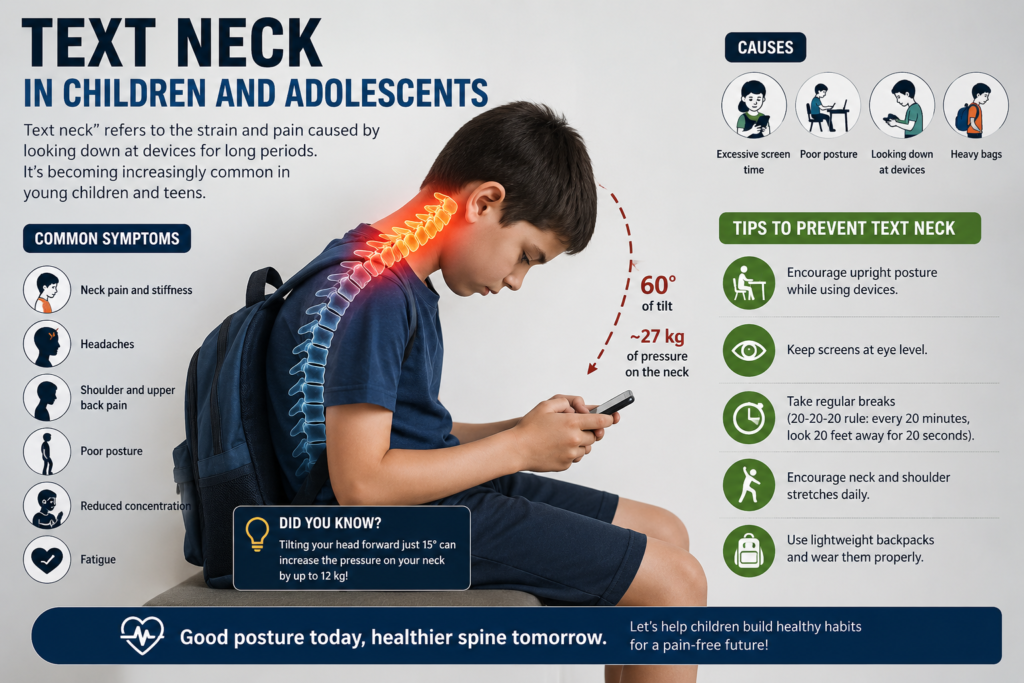
1. Persistent Neck and Shoulder Stiffness
Children may frequently stretch, rub their necks, or complain of a dull, aching sensation across the top of the shoulders (trapezius region).
2. Tension Headaches
Tightness at the base of the skull (suboccipital muscles) can trigger cervicogenic headaches, radiating pain from the upper neck toward the temples or behind the eyes.
3. Postural Deformities
Chronic forward tilt causes the shoulders to round forward and the upper back to hunch—a structural alteration known as postural kyphosis.
4. Impaired Lung Capacity
Severe forward head posture compresses the thoracic cavity, reducing rib cage expansion and limiting full diaphragmatic breathing. This can lower oxygen intake and accelerate physical fatigue.
Long-Term Health Consequences
If left unaddressed during formative years, text neck can progress beyond muscular fatigue into permanent structural changes:
Early-Onset Spinal Degeneration: Continuous stress on cervical intervertebral discs accelerates wear and tear, potentially leading to premature arthritis, disc degeneration, or disc herniation in early adulthood.
Nerve Impingement: Chronic muscle tightness and altered alignment can compress cervical spinal nerves, leading to radiculopathy—characterized by pain, tingling, or weakness radiating down the arms and fingers.
Spinal Misalignment & Structural Changes: Persistent postural imbalances can cause natural spinal curves (lordosis and kyphosis) to flatten or exaggerate, affecting overall biomechanics and balance.
Preventive Strategies and Postural Solutions
Preventing and reversing text neck requires a combination of ergonomic adjustments, behavioral habits, and physical strengthening.
Ergonomic Best Practices
Raise the Device: Bring devices closer to eye level rather than lowering the chin to the chest. Prop elbows on pillows or use desktop stands when studying or watching content.
Support the Spine: Ensure seating provides firm lower back support with feet placed flat on the floor. Avoid slouching on soft couches or lying on the stomach while holding devices.
Use External Peripherals: When using laptops for homework, connect an external keyboard and elevate the laptop display so the top third of the screen sits at eye height.
The 20-20-20 & Movement Rules
Take Frequent Micro-Breaks: Implement the 20-20-20 Rule: Every 20 minutes, look away from the screen at an object 20 feet away for at least 20 seconds.
Incorporate Postural Resets: Encourage children to stand up, roll their shoulders backward, and stretch every 30 to 45 minutes of device use.
Corrective Exercises for Kids and Teens
Simple daily mobility drills help recondition overstretched upper back muscles and release tight neck flexors.
Chin Tucks: Sit upright. Without tilting the head up or down, gently glide the head straight backward, creating a “double chin.” Hold for 5 seconds and repeat 10 times to strengthen deep cervical flexors.
Chest Openers: Stand in a doorway, place elbows and forearms against the frame at 90-degree angles, and lean forward gently until a stretch is felt across the chest. Hold for 20–30 seconds.
Angel Wings (Wall Slides): Stand with back and head flat against a wall. Raise arms into a “W” shape and slide them upward into a “Y” while keeping elbows and wrists in contact with the wall. Repeat 10–12 times.
Cat-Cow Stretch: On hands and knees, alternate between arching the spine upward (Cat) and dipping the belly down toward the floor while gently raising the chest (Cow) to promote segmental spinal mobility.
The Role of Parents and Educators
Creating a supportive environment is key to establishing lifelong digital habits.
Model Good Behavior: Children mirror adult habits. Practice proper posture and intentional screen breaks.
Set Clear Device-Free Zones: Establish screen-free mealtimes and bedrooms to limit overall static sitting hours.
Promote Active Play: Engage youth in sports, swimming, gymnastics, or outdoor play that naturally strengthens core and back musculature.
Consult Professionals Early: If a child reports persistent pain, numbness, or headaches lasting more than a few days, schedule an evaluation with a pediatrician, pediatric physical therapist, or chiropractor.
By fostering early awareness and introducing simple ergonomic adjustments, we can help the next generation enjoy the benefits of digital technology without sacrificing their spinal health.