
Gluteal Amnesia
In an era where remote work and desk jobs keep us seated for the better part of the day, a silent structural shift is happening beneath the surface. Have you ever stood up after a long day of work only to feel a dull, nagging ache in your lower back? While you might immediately blame your office chair or your posture, the root cause could be lying dormant—literally.
It is called Gluteal Amnesia (also known as dormant butt syndrome or gluteal inhibition). More than just a catchy fitness buzzword, this condition represents a critical breakdown in biomechanics where your gluteus maximus stops firing efficiently. The scariest part? When your body’s primary powerhouses clock out, the structural burden doesn’t just disappear—it gets dumped directly onto your lumbar spine.
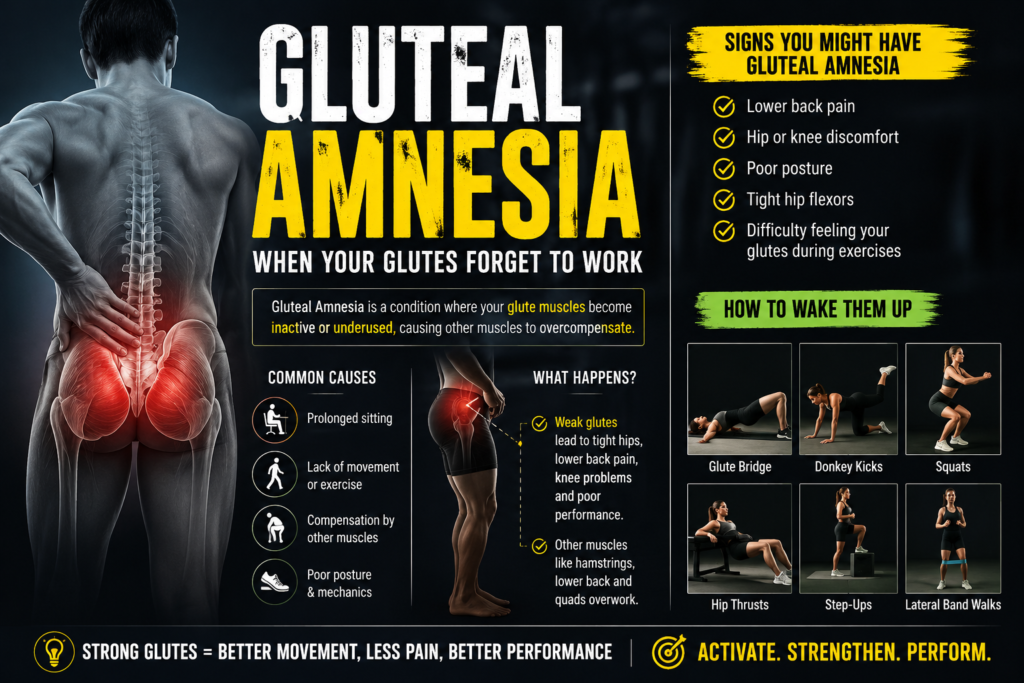
The Anatomy of the Problem: Pelvic Stability and the Glutes
Your pelvis is the absolute cornerstone of human movement, acting as the bridge between your upper and lower body. To keep this bridge stable, your body relies on a sophisticated kinetic chain.
The gluteus maximus and gluteus medius are designed to be the primary stabilizers of the pelvis. When you walk, run, bend, or lift, your glutes contract to keep your pelvis level and absorb shock.
However, when you spend 8 to 10 hours a day sitting:
Hip Flexors Shorten: Muscles like the psoas and rectus femoris remain in a shortened, contracted state.
Reciprocal Inhibition Occurs: Tight hip flexors send continuous neural signals to your glutes telling them to relax.
The Brain-Muscle Connection Fades: Over time, your nervous system essentially forgets how to recruit the glute muscle fibers efficiently, leaving your hips functionally weak even when you stand up.
The Domino Effect: Shifting the Load to the Lumbar Spine
If your glutes refuse to do their job, the body still has to complete movements like standing up, walking, or lifting objects. Nature abhors a vacuum, so your body looks for alternative muscles to pick up the slack.
Enter the lumbar spine and the lower back extensors (erector spinae), along with your hamstrings.
However, when you spend 8 to 10 hours a day sitting:
Hip Flexors Shorten: Muscles like the psoas and rectus femoris remain in a shortened, contracted state.
Reciprocal Inhibition Occurs: Tight hip flexors send continuous neural signals to your glutes telling them to relax.
The Brain-Muscle Connection Fades: Over time, your nervous system essentially forgets how to recruit the glute muscle fibers efficiently, leaving your hips functionally weak even when you stand up.
If your glutes refuse to do their job, the body still has to complete movements like standing up, walking, or lifting objects. Nature abhors a vacuum, so your body looks for alternative muscles to pick up the slack.
Enter the lumbar spine and the lower back extensors (erector spinae), along with your hamstrings.
Red Flags: How to Tell if Your Spine Is Bearing the Glutes' Burden
How do you know if your back pain stems from asleep glutes? Look out for these clinical and functional patterns:
Hamstring Dominance: During exercises like deadlifts or hip hinges, your hamstrings feel like they are tearing or pulling, while your glutes feel entirely unresponsive.
Persistent Lower Back Tightness: Your lower back feels stiff and tight after routine tasks like walking, standing, or doing light chores.
Stubborn Hip Flexor Tightness: No matter how much you stretch your quads and hip flexors, they tighten right back up because they are constantly fighting an unstable pelvis.
“Dead Butt” Sensation: Physical numbness or a dull ache in the gluteal region after prolonged sitting.
How to Wake Up Your Glutes and Protect Your Spine
1. Decompress and Open the Front Line
Incorporate daily kneeling hip flexor stretches to open up tight psoas muscles.
Use foam rolling on your quads and hip flexors to reduce neural tone inhibiting the glutes.
2. Isolate Before You Integrate
Before moving into heavy compound lifts, use activation movements to “prime” the neural pathway.
Perform Glute Bridges with a 2-second hold at the top, focusing heavily on a hard mind-muscle squeeze.
Add Clamshells or Monster Walks with Resistance Bands to target the gluteus medius and restore lateral pelvic stability.
3. Move Frequently
Break up long sitting sessions by standing up, walking, or doing 10 bodyweight squats every 45 to 60 minutes to prevent the neural pathways from shutting down.
Gluteal Amnesia, often referred to as “dormant butt syndrome,” is a common condition caused by prolonged periods of sitting that essentially causes the gluteus maximus to “forget” how to fire properly. When your hips remain flexed for hours a day, your hip flexors tighten and send neural signals telling your glutes to switch off, forcing secondary muscles like your lower back and hamstrings to overcompensate. This muscular imbalance frequently leads to lower back pain, hip discomfort, and reduced athletic performance. Fortunately, you can reverse gluteal amnesia by taking regular movement breaks, stretching your hip flexors, and incorporating targeted activation exercises like glute bridges and resistance-band walks into your daily routine.